Why is it OK for US & Israel to kill their enemies abroad?
Israel kills Palestinians, Lebanese, Syrians & Iranians in their own countries at will & no international consequences.
US kills Mexicans, Colombians & Venezuelans abroad & at times in their countries with no consequence.
When Russia or India kill their enemies abroad, who are their citizens, international diplomatic furore ensues!
Maybe it is time we redefined Rule-based international order!
GLOBAL HYPOCRISY STINKS TO THE HEAVENS!
🚨Breaking:According to diplomatic sources, today’s meeting between Somalia political stakeholders, opposition leaders, and the outgoing Hassan Sheikh administration ended with a blunt message: the so-called constitution pushed through by Villa Somalia and the illegitimate elections conducted under it have effectively been rejected and nullified.
Sources say Hassan Sheikh’s failed attempt to impose a “one person, one vote” agenda without consensus has collapsed, and Somalia will now return to an indirect electoral process within the next three months.
The international community reportedly made it clear that no unilateral power grab, political manipulation, or imposed constitutional changes will be accepted.
Breaking News 🚨🚨🚨
The First Somalilander to play for the World Cup- Taha Ali representing Sweden. Well Done to Taha Ali for making it onto the squad 🎉🎉🎉
There are increasing signs that the United Arab Emirates is about to become the second country (after Israel) to recognize Somaliland as an independent state.
Prominent Emirati influencers on social networks, as well as sources in Somaliland, are hinting that the moment is approaching.
#somaliland
This was you on June 20, 2024, strongly urging members of parliament to vote for the Finance Bill 2024.
On the final reading you somehow ghosted.
Now you've suddenly become very clever.
Sisi sio wajinga buana.
PRESS RELEASE
Subject: Public Legal Clarification on the United States National Emergency and Sanctions Framework Concerning Somalia, and the Constitutional Expiry of Federal Mandates
Mogadishu, Somalia - As a Former Member of the Foreign Affairs Committee of the House of the People of the Federal Republic of Somalia, I issue this official public clarification to inform the Somali people of the legal, political, and national implications arising from the continued application of the United States national emergency and sanctions framework concerning Somalia, in conjunction with the constitutional expiry of the current federal mandates.
The Government of the United States, acting under the authority of the International Emergency Economic Powers Act and related legislation, has maintained a standing national emergency designation with respect to Somalia. This legal framework grants the United States sweeping authority to impose financial and legal restrictions on individuals and entities deemed to be engaged in corruption, destabilization, or activities contrary to international peace and security. This authority operates extraterritorially and does not require the involvement, consent, or validation of Somali judicial or constitutional institutions.
The implications of this regime are profound. It establishes, in effect, an external accountability mechanism that functions parallel to, and in many respects above, Somalia’s domestic governance and legal enforcement systems. Through this framework, the United States possesses the legal capacity to freeze assets held abroad, block access to the global financial system - particularly transactions conducted in U.S. dollars - and impose travel and financial restrictions on designated individuals. In practical terms, this means that any Somali official or associated actor engaged in corruption or abuse of public office is exposed to immediate and enforceable consequences beyond the jurisdiction of Somali courts.
This exposure directly affects individuals occupying or connected to positions of authority at the highest levels of the Federal Government under the administration of Hassan Sheikh Mohamud. These include senior executive office holders, key cabinet ministers responsible for finance, petroleum, internal security, and foreign affairs, senior officials within the Central Bank of Somalia, and individuals exercising control over public procurement, sovereign contracts, and natural resource concessions, as well as politically exposed persons and affiliated entities benefiting from state-linked financial flows.
Today, April 14, 2026, marks the formal expiry of the mandate of the House of the People of the Federal Republic of Somalia. Consequently, no legislative authority lawfully exists to enact binding national legislation until the full constitutional composition of 275 members of the House of the People and 54 members of the Upper House is duly constituted in accordance with the Provisional Constitution. Furthermore, the term of the President, Hassan Sheikh Mohamud, is set to expire on May 15, 2026. These constitutional deadlines are not symbolic; they are binding legal limits on authority.
The convergence of an externally enforced sanctions regime with the expiration of constitutional mandates creates a situation of exceptional national risk. It introduces legal uncertainty regarding the validity of executive actions, undermines institutional legitimacy, and raises serious concerns among international partners regarding continuity of governance, fiscal accountability, and lawful authority to enter into binding agreements or receive budgetary support.
In this context, international financial assistance, including budget support and security funding, is likely to come under heightened scrutiny and conditionality. Donor institutions and partner governments will assess not only financial management practices but also the constitutional legitimacy of the authorities receiving and administering such funds. Any perception of illegitimacy, combined with ongoing concerns regarding corruption and accountability, will significantly increase the risk of funding delays, reductions, or suspension.
This situation carries direct implications for national stability and security. The interruption or conditional restriction of external financial support - upon which critical sectors, including security forces and public services, heavily depend - may weaken operational capacity, disrupt governance functions, and exacerbate existing political tensions. These risks are compounded by the potential for sanctions designations targeting individuals within the governing structure, further constraining financial flows and institutional effectiveness.
It must be stated without ambiguity that the current trajectory represents one of the most serious governance and accountability crises in Somalia’s recent history. The combination of systemic corruption risks, external enforcement mechanisms, and expiring constitutional mandates creates conditions that threaten to undermine both state stability and public confidence.
The political consequences are equally significant. Opposition actors will inevitably utilize this convergence of legal and constitutional factors to challenge the legitimacy of the current administration, to demand immediate accountability, and to mobilize both domestic and international pressure. This will likely intensify political contestation and may further shift elements of Somalia’s internal political process into international arenas where sanctions, legal exposure, and diplomatic leverage are actively engaged.
This situation underscores a fundamental principle: no sovereign state can sustain legitimacy, stability, or international confidence in the absence of constitutional compliance, transparency, and accountable governance. External enforcement mechanisms will continue to expand in influence where internal systems fail to meet these standards.
The Somali people are entitled to a government that operates within the bounds of the Constitution, upholds the rule of law, and protects national resources from abuse. The responsibility to restore legitimacy, ensure transparency, and safeguard sovereignty rests with those in positions of authority.
Failure to act decisively at this critical juncture will not only deepen external intervention but will also accelerate institutional breakdown, economic disruption, and political fragmentation, with consequences that will be borne by the Somali people.
End of Statement
@UKinSomalia@HouseForeignGOP@realDonaldTrump@StateDept@SpeakerJohnson@susiewiles2024@HassanSMohamud@TheVillaSomalia@HamzaAbdiBarre@AadanMadobe@SomaliainQatar@MOFAKuwait@UAEinSomalia@ChineseSomalia@KSAmofaEN@US2SOMALIA@EU_in_Somalia@ItalyinSomalia@UNSomalia@TC_MogadisuBE@UNDPSomalia@WorldBankAfrica@IMFAfrica@CanHCKenya@SwissEmbassyKE
The warning signs of a fragmenting #Ethiopia are becoming harder to ignore. The President of the Somali Region (Mustafe Mohammed Omer) is openly discussing about the breakup of the #Ethiopian state, admitting that he had prepared the Somali region to secede if the TPLF were to return to power.
That admission speaks volumes about the state of Ethiopia under Abiy Ahmed. It depicts one ethnic region is unwilling to be governed by another, and where the prospect of TPLF leadership is seen as a trigger for the country's disintegration. In this video he clearly states that, as TPLF forces advanced toward Addis Ababa, his overriding concern was not to fight for his country, but breaking the Somali Region away from Ethiopia.
This raises an obvious question: what calculations were being made by Abiy at the time? may be seceding Oromia?
The current fragile state of Ethiopia demands leadership capable of leading the country peacefully —not presiding over its slow unraveling.
Somalian lawmakers failed to elect a new president as the parliament’s current term came to an end on Tuesday, creating fresh uncertainty in the Horn of Africa nation that’s suffered years of political instability https://t.co/kTnnp7566m
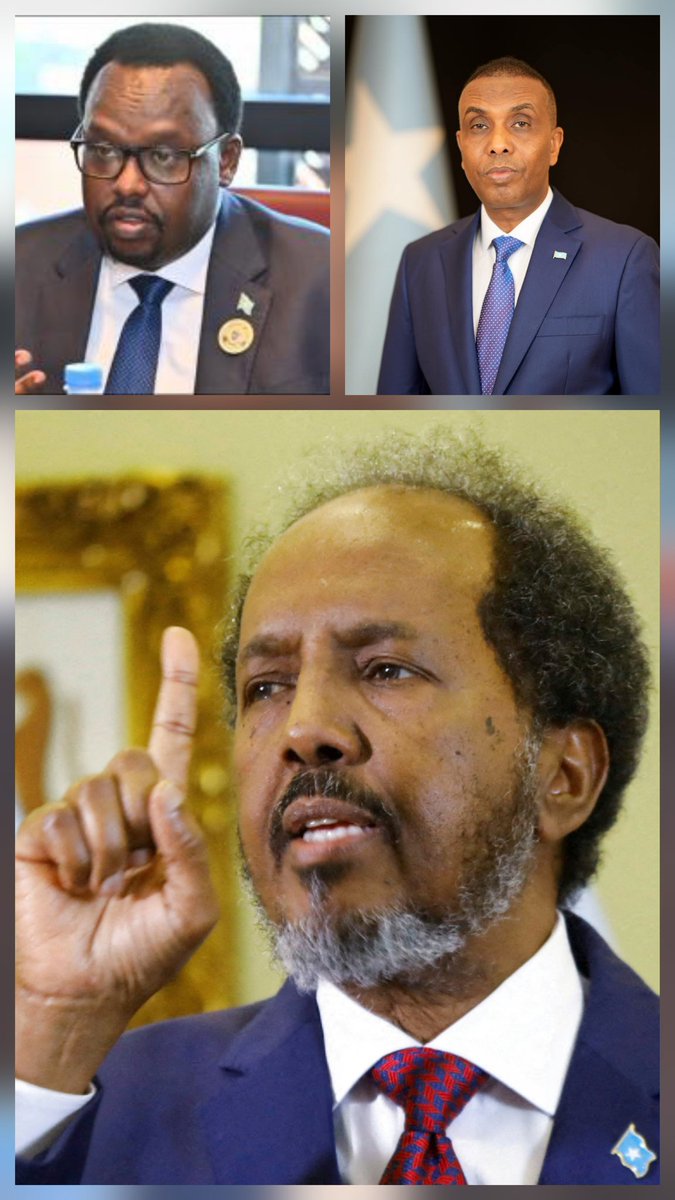
These 3 men, none of whom can even visit his home district, are hellbent on holding 1st nationwide one-person one-vote elections in 🇸🇴 over 56 years.
HSM can’t visit his hometown because it’s under Al-Shabaab, PM & Deputy PM can’t because Jubaland & Somaliland won’t allow them.
In his annual speech to parliament #Somaliland Pres. @Abdirahmanirro hails #Israel🇮🇱’s “historic and decisive step” in recognizing the country, noting: “We are confident that this partnership will be characterised by reliability, mutual respect, and shared strategic interests.”
#BREAKING
Analysis: Mogadishu moves to oust Puntland leader Deni
Somali federal troops backed by heavily-armed technicals, APCs and assorted clan militias are heading towards Puntland in an apparent bid to overthrow the elected regional President Sa'id A. Deni.
Buoyed by the success in ousting President Abdiaziz Laftagareen of South West State, Somali President Hassan Sheikh is turning his sights on Puntland and Jubaland.
Already, HSM has mobilised Deni's opponents, created an interim 'government-in-exile' based in Mogadishu that is coordinating political action, and the planned military takeover of Puntland to remove Deni.
The strategy to oust Deni has been in the works for sometime now and is closely being coordinated with Turkey which is providing intelligence, equipment and logistical support to the operation (just as happened in South West State).
Turkish Ambassador to Somalia met Deni recently and tried to pressure him to make a deal with HSM.
Turkey sees Puntland as a big prize owing to its strategic position, vast coastline, relative peace, blue economy resource potential. The Puntland coast is rich in tuna and possibly significant hydrocarbon reserves.
The port of Bosaso is also a key infrastructure/asset coveted by the Turks. The port is leased to the UAE's DP World.
Gaining a foothold in Puntland locks out the Emiratis and moves Ankara closer to another equally prized target - Somaliland.
Turkey is planning to establish a naval military outpost in Laas Qorey.
The recognition by Israel of Somaliland has galvanised Turkey into fast-tracking its plan to help HSM seize the Puntland and oust Deni.
Turkey's preference for a centralised Somalia is clear. Dismantling the federal system is now a top agenda.
In HSM, Ankara finds a believer and a willing executioner.
From a counter-terrorism and counterinsurgency perspective, the prospect of a new conflict and turmoil in Puntland could prove disastrous - wiping out all the gains made recently by Puntland against jihadist groups.
A blue-on-blue violence is precisely what Daesh/ISIS and Al-Shabaab need to regroup.
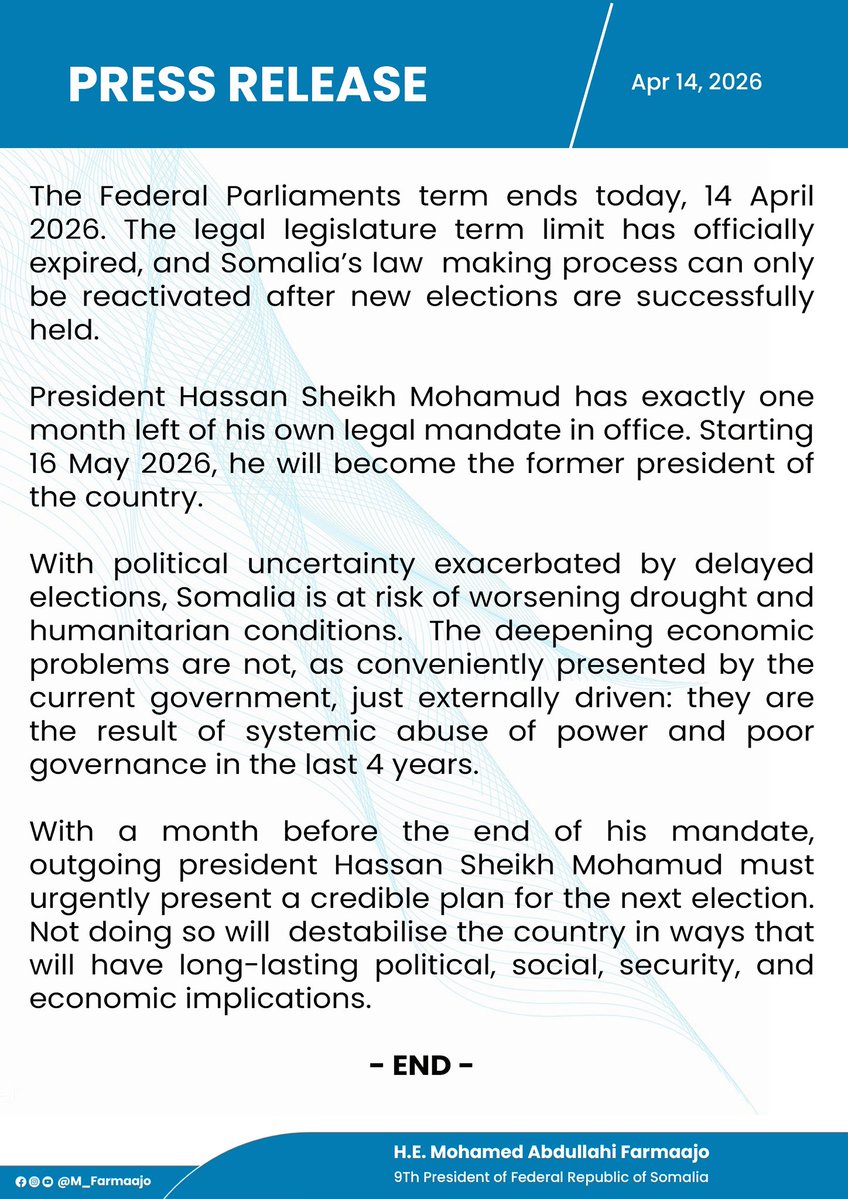
The Federal Parliament’s term ends today, and President Hassan Sheikh has exactly one month remaining in his legal mandate. Without broad political consensus or timely elections, the country could face long-lasting political, social, security, and economic crisis
Mw Cirro si wacan,ayuu uhadlay oo Odaytinimo iyo masuuliyad ka muuqato.
Waa rajaynayaa in SL isqaadato oo is aqbasho,isla markaana Maleeshiyaadka Sool Bari la midoobaan Ciidanka Qaran ee SL.
Horjoogayaasha Jamhada Sool Bari,waxaa looga fadhiyaa in ay Miiska fariistaan oo waaqiciga wajahaan oo la xaajoodaan SL-ta ay qaybta ka yihiin.
Colaad walba marka ugu danbaysa,waxaa lagu dhameeyaa wadahadal.
JQ.
Corruption is KILLING KENYA. We pay global standard rate for infrastructure. But get shit, because goverment officials take 40% of the contract price as bribe. The contractor makes 30% as profit and puts only 30% into the project. Look at the SHIT that is Ngong-Suswa Road.
🇸🇴 30 Years of Failure — Somalia National Army Day
Turkish F-16s flew over Mogadishu today for Somalia’s National Army Day celebrations.
Not Somalia jets. Not Somalian pilots. Not Somalian sovereignty.
After 30 years of collapse, civil war, corrupt politicians, and billions in aid, the Somalian National Army still cannot put its own aircraft in the sky on its own national day.
They borrowed from a foreign country to show off what they don’t possess.
This is not partnership — it’s the symbol of a questionable Turkish colony.
True independence isn’t flown by someone else’s air force.
@HassanSMohamud Somalians deserves better than this endless cycle of failure and corruption.
La leçon du Somaliland
Pendant que #Djibouti s’use dans l’éternisation d’un seul homme, le #Somaliland, malgré son statut non reconnu, aura rappelé une vérité simple : un ordre politique digne de ce nom sait faire sortir un dirigeant et entrer un autre. Là commence la force d’un pays.