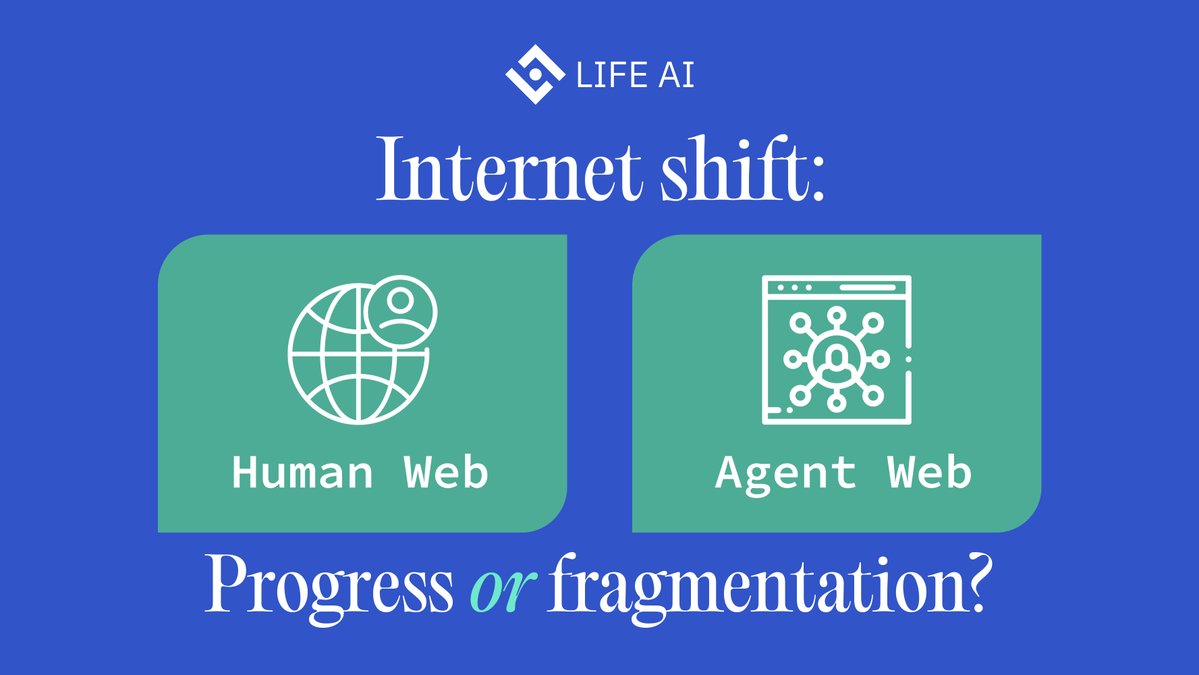
🌐 Community Question:
As the internet evolves to support autonomous AI agents, splitting into the Human Web (interfaces for people) and the Agent Web (API-driven infrastructure for machines), will this shift drive innovation and automation, or fragment and dehumanize the online experience?
Viewpoint A: A New Layer of Internet Intelligence
The rise of AI agents interacting directly with digital systems could transform the internet into a more intelligent infrastructure. Agents can automate tasks such as trading, payments, data analysis, and content generation, enabling a new agent economy. This machine-to-machine coordination may significantly improve efficiency, scalability, and innovation across industries.
Viewpoint B: Erosion of the Human-Centered Web
Expanding the Agent Web may reduce the role of the Human Web, as machines increasingly interact through APIs rather than human interfaces. This could create privacy and security risks, weaken traditional web models, and concentrate power in automated systems, potentially leading to a fragmented internet with less authentic human participation.
👇 Drop A or B and share your perspective
We normalize yearly checkups but not daily conversations about health.
Maybe that's the problem.
Join the debate on @LifeNetwork_AI: https://t.co/388CKrpefi
Code: 9Y25QCW
#LifeAITestnet#HealthcareAI
This isn't the testnet you're used to.
Here, your voice earns, not your clicks.
Jump in @LifeNetwork_AI: https://t.co/388CKrpefi
Code: 9Y25QCW
#LifeAITestnet#HealthcareAI
Most testnets - boring tasks.
This testnet - exciting rewards for real conversations.
Join me: https://t.co/388CKrpefi
Code: 9Y25QCW
@LifeNetwork_AI#LifeAITestnet#HealthcareAI
🩺Community Question:
Should healthcare prioritize personalized care for individuals, or one-size-fits-all care for everyone?
Viewpoint A: One-size-fits-all as the default
Standardized care is more practical, affordable, and equitable for large populations and resource-limited settings. It delivers consistent, proven outcomes at scale, reduces disparities, and avoids the high cost and access barriers of full personalization.
Viewpoint B: Shift to personalized care
Personalized care is more precise, effective, and preventive. Leveraging genetics, AI, and real-world insights enables better outcomes, fewer side effects, and long-term cost savings as personalization becomes increasingly accessible.
Have you benefited from standardized care or struggled because it wasn’t personalized enough?
👇 Share A, B, or a short personal insight.
Tag someone who should be part of this conversation.
Your voice can earn by highlighting what healthcare often overlooks.
Sometimes the simplest truths hit the hardest.
Discuss with me on @LifeNetwork_AI: https://t.co/388CKrpefi
Code: 9Y25QCW
#LifeAITestnet#HealthcareAI