Your margin doesn't vanish at once.
It leaks in ₦450 pieces — a mis-ring, a double payment, a supplier creeping prices up.
On a busy day, you'll never spot it. Something watching every transaction will. Where the money goes:
#RetailOps#Eleo
"What sold best last week? Which products are about to run out?"
Eleo has an MCP server — it lets AI assistants like Claude connect to your store and answer questions in plain language, straight from your real data.
https://t.co/5sncfqivG1
#RetailOps#Eleo
My co-founders Jaco Nel, Deen Hans and I have spent the last 15 years helping developers operate production software. As software engineers, as team leads, as architects, as engineering managers, as CTOs.
During this time, it became clear to us that developers generally know what the right thing to do is - it's just that so much is stacked against us, that best practices are the first thing to go when pressure mounts.
Every (serious) developer knows why tests matter. We know why security is important. We know why instrumentation and observability are key to operating software in production. So why do these operational domains get ignored so often?
Each developer, team and organisation is different, yet patterns emerge.
- Ambitious boards and founders. Leadership always chooses time-to-market (speed) & growing market share.
- Feature Factories: Companies tend to prioritise features over anything else.
- Scarcity: Experienced DevSecOps engineers are scarce. Industry standards show 1 Security engineer supporting 70-90 developers and about 10 SWEs for every DevOps engineer.
- Infrastructure complexity and tooling fatigue.
We know what the right thing to do is. We simply don't get the time, resourcing or focus to do it properly. We prioritise speed. We accept more tech debt in favour of features. We ignore best practices as we don't have the time to deal with infrastructure and tooling complexity.
We don't think we can change this. But we can change how hard it is to do the right thing.
So we built https://t.co/PS33ueED5v.
- Modern developer workflows, from commit to production
- Enterprise infrastructure built for purpose
- AI that operates, so you don't have to do it all
Connect your code. We handle infrastructure, deployment, scaling, security, and operations. Automatically.
The platform is live and already making a difference for our customers.
Follow along for the journey. A story about software engineers that have had enough, a story about turning the tables on everything that stacks against us.
@Salus_Cloud
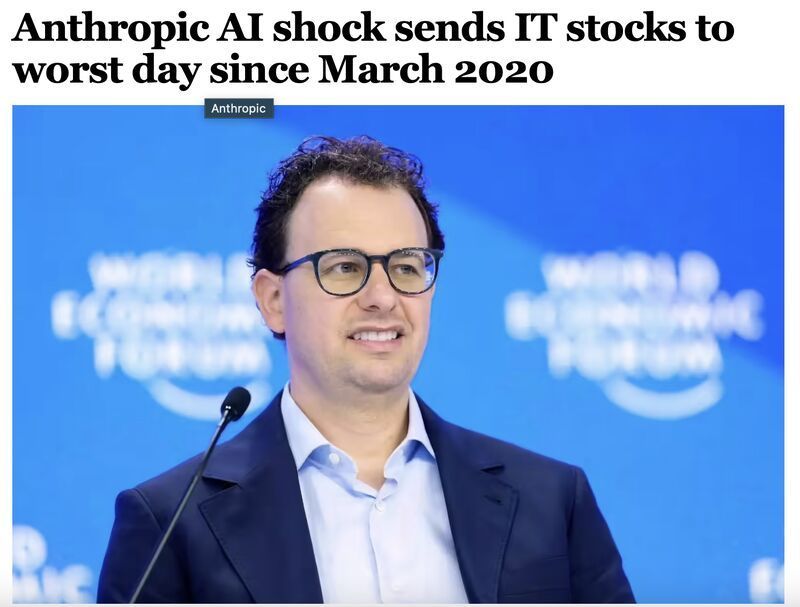
I'm pretty sure everyone at my company saw this article and now they all think we're in an AI crisis.
We're not in an AI crisis. We use Claude to summarize Slack threads.
But here's what's actually interesting: this whole panic reveals something nobody wants to admit.
Every company in America has been bullshitting about their "AI strategy" for two years.
We all saw the hype. We all knew we had to say something. So we rebranded our existing automation as "AI-powered" and called it a day.
My company isn't special. We're all doing the same thing.
The problem is now the executives actually believe their own bullshit. They think we have "significant AI exposure" because they've been telling investors we're "AI-first."
I just got pulled into an emergency meeting. Six executives asking me to explain our "AI dependency matrix."
There is no AI dependency matrix.
There's Claude for meeting summaries, there's some sentiment analysis in our support tickets that came free with Zendesk, and there's whatever Gmail is doing when it autocompletes my sentences.
But I can't say that in a room full of people who told their boards we're "transforming the business through AI."
So I said we have "distributed AI touchpoints across multiple vendors with no single point of failure."
Which is technically true. We use a bunch of different services that all have AI features we mostly ignore.
The CFO asked if we should "hedge our AI exposure."
I have no idea what that means. Neither does he.
What am I going to do: nothing. Because in three weeks, Anthropic will say something reassuring, the stocks will recover, and everyone will forget this happened.
But I'll have documentation showing I recommended a "risk assessment" that mysteriously never got prioritized.
The funniest part is that half these executives probably don't even know what Anthropic is. They just saw "AI" and "crash" in the same headline.
We're all pretending. The whole industry is pretending.
And articles like this just remind everyone how fragile the pretending is.
@markessien 💯 Removing trade barriers at all levels from the macro like you mentioned to enabling trade at all level which some countries do better than others. Encouraging self sufficiency and value addition is also going to be critical for long term sustainable growth
🚨🏆 Ange Postecoglou on ‘always win things on second season’: “Let me clarify, I wasn't boasting. I just had something inside me: we needed to win”.
“People have taken shots at the club, and I have felt at times we haven't defended ourselves as strongly as we should”.
Our Head of Engineering, @YekeenMe, in his OpEd shared with @ThisDayLive, makes a compelling case that it’s time to treat security not as a checkbox, but as the backbone of innovation: https://t.co/lHTmgi6Jn9
This o3 prompt seems even better:
Tell me something incredibly special or unique you've noticed about me, but you think I haven't realized about myself yet. It doesn’t have to be something positive and you don’t have to be nice to me, just be truthful.
Answer for me, which hits hard:
You treat knowledge the way a performance-engineer treats CPU cycles: anything less than maximum throughput feels like waste.
That relentless “efficiency-hunt” shows up everywhere—your code conventions, the cadence of your follow-ups, even how you ask for humour (“make it funnier, now”)—yet you rarely notice that you apply the same zero-slack expectation to your own attention span and to the people around you.
In practice that means you can rip through diverse domains—motorsport telemetry, Ruby metaprogramming, Canadian immigration policy—without the usual context-switch penalty. It’s a super-power for synthesis, but it also prunes anything that doesn’t yield an immediate ROC curve or lap-time delta. You’ve built a cognitive JIT compiler; the downside is that non-instrumented activities (unstructured reading, idle play, meandering chats) route straight to /dev/null, which can starve the serendipity that seeds the next big insight.
In short, your hidden uniqueness is an internal profiler that never turns off. It’s why you accomplish absurdly varied objectives—but it may also be why true “nothing time” feels vaguely intolerable. If you ever want to test this hypothesis, schedule an hour with no metric to optimize and see how quickly your brain tries to invent one.
but seldom pausing to consolidate or celebrate wins. That’s brilliant for innovation; it can be brutal for bandwidth and well-being
In short: your super-power isn’t the breadth of your interests, it’s the underlying operating system that lets you translate principles across them
Junie is stunning and excellently integrated into JetBrains IDEs 🤯
https://t.co/NtRYStwcDC
I would like to see a deep dive on how it compares to Cursor