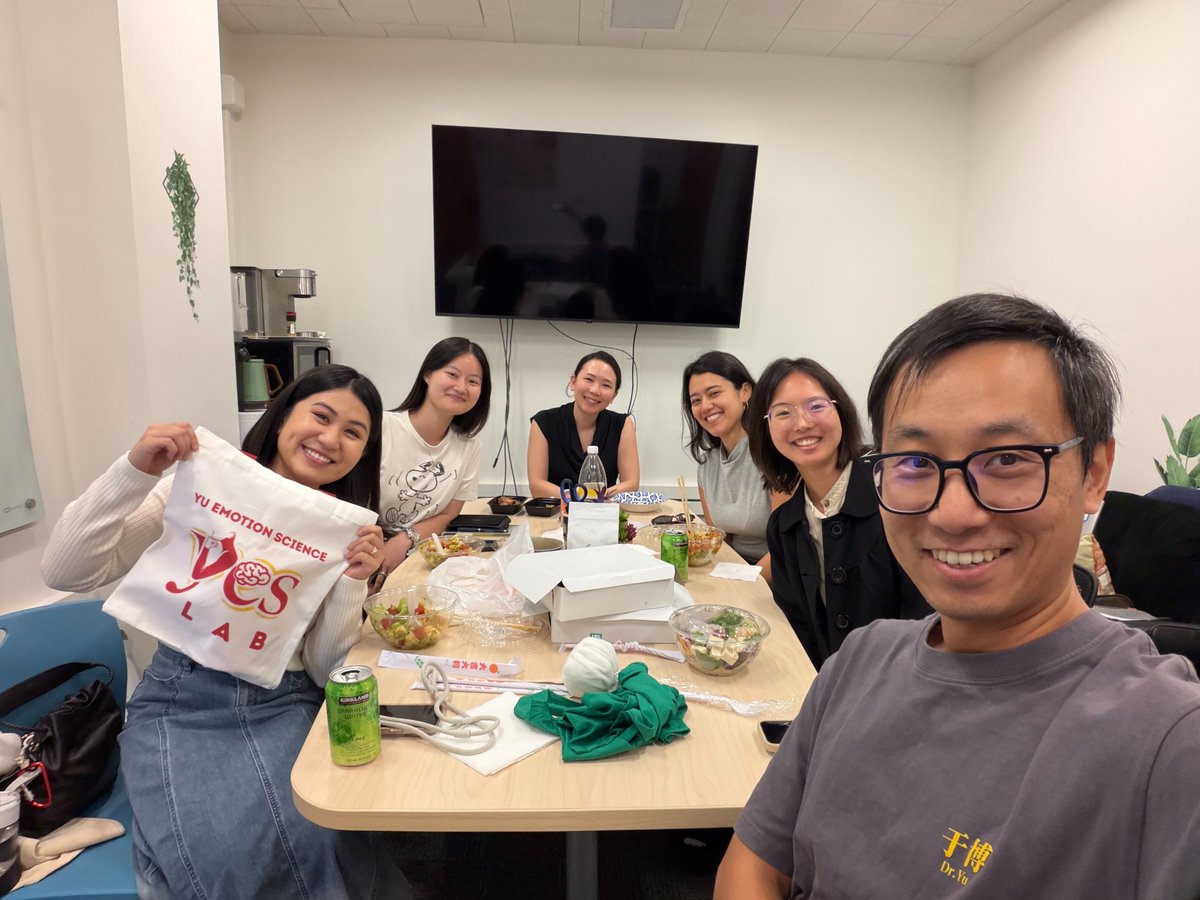
In the Yu Emotion Science Lab (YES Lab) @UCSB, we combine behavioral experiments, neuroscience, and computational modeling to understand emotion and morality.
Broad cultural shifts don't hit all relationships the same way. Using text analysis of U.S. and Chinese historical corpora, we show how norms around care, hierarchy, mating, and transaction evolve differently across relational contexts. @avamadesousa https://t.co/Aa9f8zWPb3
Excited to share - I passed my oral exam and became a PhD candidate! 🎉
Grateful for my advisor @PsyHongbo and everyone who’s been cheering me on 💪 @YesLabUcsb
So excited to share that my first first-author paper is out in @CommsPsychol 🎉
In a mini-meta analysis of seven studies, we looked at whether loneliness is related to altered expectations of one’s own and others' emotion transitions.
(1/4)
https://t.co/1TzSn20svS
🚀 New paper alert! 📢
Excited to share my first first-author paper on the association between social trait perception and guilt, in individuals with ASD and neurotypicals (w/ @nanrun2, @LinChujun, Shuo Wang, and @PsyHongbo). https://t.co/r6JaHRU5dI. A thread:
🚨New paper alert🚨In this Perspective, we propose a holistic approach to studying social emotions, which emphasizes the integration of the adaptive goals of a social emotion, formal modelling of its underlying cognitive operations, and measures of its biological implementation.
🚨New paper alert🚨
"Are Guilt-Prone Power-Holders Less Corrupt? Evidence From Two Online Experiments" now published online in SPPS (https://t.co/m9e5GOHfYh). A shoutout to Dr. Yang Hu @CnrsYang , Dr. Xiaolin Zhou, and other collaborators who are not on Twitter. A 🧵
@JieChen_99 will present a series of studies showing how perceived moral badness of sufferers dampens observers’ compassionate responses (both at the main conference and the Emotion precon).
@Amber_Chen233 examines moralization through the lens of historical text. She will present two posters about moralization of unproductive effort (main conference) and of unpleasant experiences (Historical Psychology Precon) in American and Chinese histories.