🚀 Excited that our work has been selected as an ACL SAC Highlight @aclmeeting !
We sincerely thank the reviewers and the SAC for their recognition, thoughtful feedback.
Can AI agents predict before they execute?
Instead of spending hours running code, can an LLM estimate which solution will work best in seconds?
We introduce FOREAGENT, a Predict-then-Verify framework that enables agents to reason before execution—exploring 3.2× more candidates, converging 6× faster, and achieving +6% better performance.
📄 Paper: https://t.co/nYWEoKgq06
🤗 We also open-source our 158GB PredictBeforeExecute dataset:
https://t.co/rXULSeNOeb
Already 30K+ downloads.
We hope these resources contribute to the Agent community and inspire future research on predictive execution and implicit reward modeling.
#ACL2026 #LLM #Agents #AI #OpenSource
🔥 LabVLA: Bringing AI from reading experiments to actually performing them in wet labs
AI systems today can read papers, write code, and even design experiments —
but they still stop at the edge of the physical lab.
Can we move from AI that understands science
to AI that executes science?
We introduce LabVLA, a vision-language-action system for real laboratory execution.
🧪 RoboGenesis
A large-scale data generation engine that converts visual inputs into structured lab assets, composing 100K+ diverse lab environments across 16+ robotic embodiments (single-arm, dual-arm, mobile manipulation).
📦 LabEmbodied-Data
A large-scale dataset of multi-view, structured demonstrations for robust scientific manipulation learning.
🤖 LabVLA
A VLA system trained with fast action-token pretraining, flow-matching post-training, and knowledge-insulated representation learning to enable stable multimodal alignment.
📊 Results
LabVLA achieves state-of-the-art performance on LabUtopia, and demonstrates strong sim-to-real transfer on a Franka robotic platform.
This model is currently only an exploratory research prototype and still has many limitations.
We will gradually open-source the data and the synthetic data engine, and hope that they will be valuable to the community and help advance progress in this direction.
Home: https://t.co/H4ioK7GDUf
Paper: https://t.co/eOTrz8wRsg
Code: https://t.co/iHhVyKUW5A
#EmbodiedAI #Robotics #AI4Science #VLA #MachineLearning #LLM #NLP
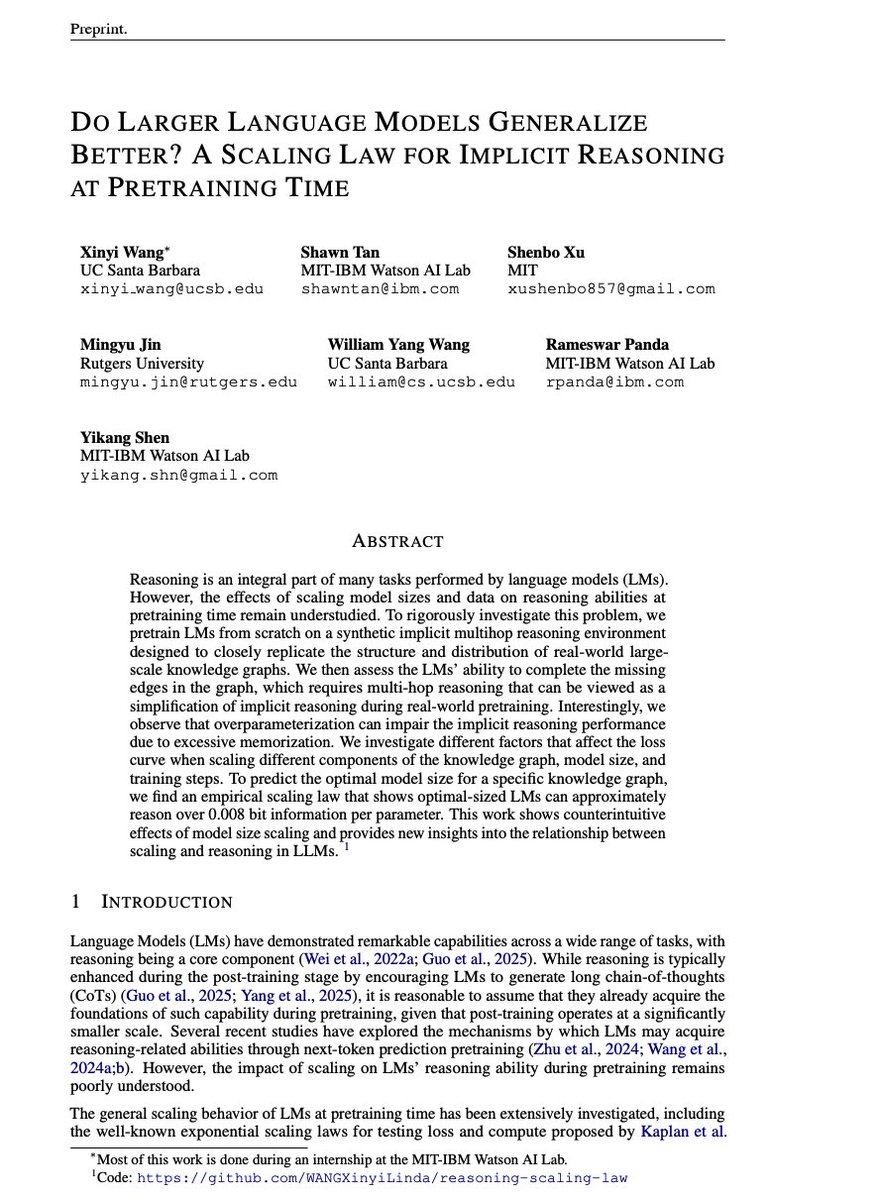
🎉 Excited to share that our Interpretability paper about Scaling Law was accepted to ICML!
Do Larger LMs Generalize Better? We study implicit reasoning at pretraining time and find that bigger isn’t always better: overparameterization can hurt.
📄 https://t.co/96A1NinRLu
AI systems repeatedly reinvent the same domain know-how—buried in prompts, tools, and brittle pipelines.
Skills remain fragmented, duplicated, and inconsistent in quality.
We believe the missing layer in the AI stack is skills as infrastructure.
We are pleased to introduce SkillNet, an ongoing project to build an open infrastructure for creating, evaluating, and organizing executable AI skills at scale.
Homepage: https://t.co/D4PkIlTbRA
Code: https://t.co/2Zej4VL7Rk
SkillNet is not a skill repository.
It is infrastructure to standardize how skills are built, evaluated, and interconnected across domains.
With SkillNet:
→ Skills become reusable, composable assets
→ Agents gain reliable, evaluated capabilities
→ Workflows become modular and interoperable
→ Knowledge becomes infrastructure
Each SkillNet skill undergoes explicit evaluation across safety, completeness, executability, maintainability, and cost.
This infrastructure may enable composable scientific and enterprise workflows.
We gratefully acknowledge the open-source community for sharing numerous projects and skills that inspired this work.
We have built an initial prototype demonstrating:
• Autonomous Scientific Discovery
• Autonomous Coding Agents
The system is still experimental and not yet production-ready.
An initial Python library supporting skill search, download, creation, evaluation, and analysis is available:
pip install skillnet-ai
Technical report coming soon.
#SkillNet #Skills #Agents #LLMs #NLP
Introducing our latest work, LightMem: Lightweight and Efficient Memory-Augmented Generation 🚀.
A memory system that cuts cost while preserving (and often improving) long-horizon reasoning for LLM agents. #NLP#LLMs#Memory#LightMem#Agents
📖 Paper: https://t.co/I9EjkePBYI
🔗 Code: https://t.co/MlyaxqfHAw
🧩 Motivation: LLMs struggle in long, multi-turn interactions — context gets noisy, expensive, and models get “lost in the middle.”
Existing memory systems are often accurate but heavy on tokens, API calls, and latency. ⚠️
💡 Solution Overview: LightMem is inspired by human memory and uses a three-stage lightweight pipeline to keep memories compact, topical, and consistent:
1️⃣ Pre-compressing Sensory Memory — remove redundant/low-value tokens before further processing.
2️⃣ Topic-aware Short-Term Memory — group turns by topic and summarize to form precise memory units.
3️⃣ Sleep-time Long-Term Updates + Soft Updates — do only incremental inserts at test time and run high-fidelity consolidation offline to avoid runtime latency.
🔬 Results: On LONGMEMEVAL, LightMem yields notable gains in accuracy (up to ~10.9%) while slashing costs — tokens reduced up to 117×, API calls up to 159×, and runtime reduced >12× in some settings. ⚡
☑️ Upcoming (README Todo — highlights):
- Offline pre-computation of KV cache for update (lossless)
- Online pre-computation of KV cache before Q&A (lossy)
- MCP (Memory Control Policy)
- Integration of more common models & feature enhancements
- Coordinated use of context and long-term memory storage
We’d love your feedback, issues, and PRs — let’s make memory for agents practical and lightweight! 🎙️
🚀 Just reached 5k citations on Google Scholar — a nice reminder of how fortunate I’ve been to work with so many talented colleagues and mentors in medical AI.
Back in 2018/19 when we pre-trained the first generative LM in biomedicine (BioELMo, https://t.co/Xydx3hCg8q), I certainly didn’t imagine how quickly the field would grow.
Similarly, PubMedQA (https://t.co/nDwcRN4Np2) started as a small annotation effort between two medical students — I’m grateful it has been useful to the community.
Then I spent 3 years (2019-2022) doing clinical rotations at a top hospital in China. I also interned at Alibaba during my spare time, and that group later created Qwen.
While I missed the opportunity to contribute to Qwen, I embraced even better opportunities for medical AI research at NIH.
Here, we trained MedCPT (https://t.co/OFyNdz2Cyp), which has become one of the most commonly used open retrievers for biomedical RAG. Now it has been downloaded over 4M times on Hugging Face.
MedCPT also powered our medical RAG trilogy: MedRAG (https://t.co/s3XHtWWHXU), iterative MedRAG (i-MedRAG, https://t.co/Aiv3vtgvyn), and the agentic RAG-Gym (https://t.co/ppTgvdFOmp). The open source MedRAG codebase lays the foundation for many other medical RAG studies.
In addition to search, we conducted early explorations of tool use for biomedical agents, including clinical calculators (MedCalc-Bench, AgentMD) and database APIs (GeneGPT, GeneAgent).
Last but not least, our TrialGPT (https://t.co/ALACfA2vQw) created a standard framework for patient-trial matching with large language models, hopefully accelerating the most time-consuming step of conducting clinical trial.
Feeling grateful for everyone who has supported, collaborated, or shared feedback along the way. Excited to keep learning and contributing to this community!
Sharing two new publications from our lab at NLM/NIH that were recently published during the government shutdown period.
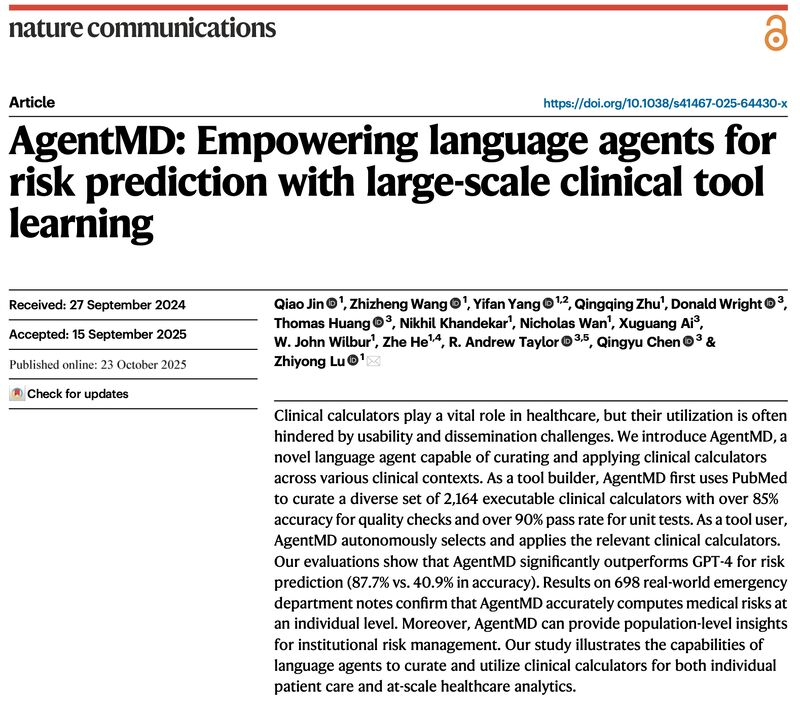
Paper #1. AgentMD: an AI agent framework for clinical risk prediction.
🔸 As a tool builder, AgentMD curated a diverse set of 2k+ executable clinical calculators with high accuracy (e.g., over 90% pass rate for unit tests) from PubMed.
🔸 When applied to patient notes, AgentMD can autonomously select and apply the relevant clinical calculators, significantly outperforming GPT-4 for risk prediction
🔸 The system shows strong performance across benchmark questions, real emergency-department notes, and large-scale EHR datasets (MIMIC-III).
https://t.co/uvs4meNEBx
Paper #2: Adversarial Attacks in Biomedical LLMs
🔸 Medical LLMs are vulnerable to both prompt-injection and poisoned fine-tuning attacks.
🔸 These attacks can change clinical recommendations while keeping benchmark performance largely unnoticed.
🔸 Findings highlight the urgent need for stronger security safeguards as LLMs move into practical uses.
https://t.co/HQk4Ks987N
When Professor Yejin Choi @YejinChoinka spots the acronym collision 😃...
Thrilled to see our work "EPO: Entropy-Regularized Policy Optimization" featured in her KeyNote in NeurIPS!
Thanks for the shoutout!
Code: https://t.co/Pi1o0aLL3H Paper: https://t.co/ohe8NocN7h
🥳 I am very excited to share that I received the NIH Pathway to Independence Award (K99/R00) from NLM, working on improving medical information verifiability with AI.
This $1m grant will also support me as an independent PI to transition to a faculty position.
🥳 I am very excited to share that I received the NIH Pathway to Independence Award (K99/R00) from NLM, working on improving medical information verifiability with AI.
This $1m grant will also support me as an independent PI to transition to a faculty position.
🎉 Thrilled to share our latest paper in Nature Methods on GeneAgent, a next‑generation AI agent designed for gene‑set analysis with built‑in self‑verification against biological databases to minimize LLM hallucinations.
🔬 Key Highlights
📍 Gene‑set analysis helps researchers interpret large-scale omics data but traditional methods struggle to predict novel functions or provide explanatory insights.
📍 Standard LLMs like GPT‑4 show promise in annotating gene sets but can generate plausible yet incorrect results (“hallucinations”).
📍 GeneAgent addresses this by autonomously querying expert-curated biological databases to verify its results, entering a four‑stage pipeline: generation → self‑verification → modification → summarization.
📍 In a benchmark study of 1,106 gene sets, GeneAgent significantly outperformed GPT‑4 in accuracy. When applied to seven new mouse melanoma gene sets, our human expert panels confirmed that GeneAgent provided more relevant, comprehensive, and trustworthy functional annotations than GPT‑4.
In summary, by verifying output against domain‑specific data, GeneAgent reduces factual errors in LLM‑generated interpretations.
🔗 Read the full paper: https://t.co/EXe1TZCVv6
🚀 Run your analysis at our GeneAgent website: https://t.co/60dbxYgbiZ
Many thanks to all co-authors at National Library of Medicine (NLM): Drs. Zhizheng Wang, Chih-Hsuan Wei, Shubo Tian, Po-Ting Lai, Qingqing Zhu, Robert Leaman, Zhiyong Lu, and our collaborators at National Cancer Institute (NCI): Chi-Ping Day & Christina Ross, Ph.D.
We're also deeply grateful to the scientists and developers behind the various biological databases used in this study: Gene Ontology (GO), KEGG, Reactome, WikiPathways, Transfer, MiRTarBase, CORUM, Human Phenotype Ontology (HPO), MSigDB, etc.
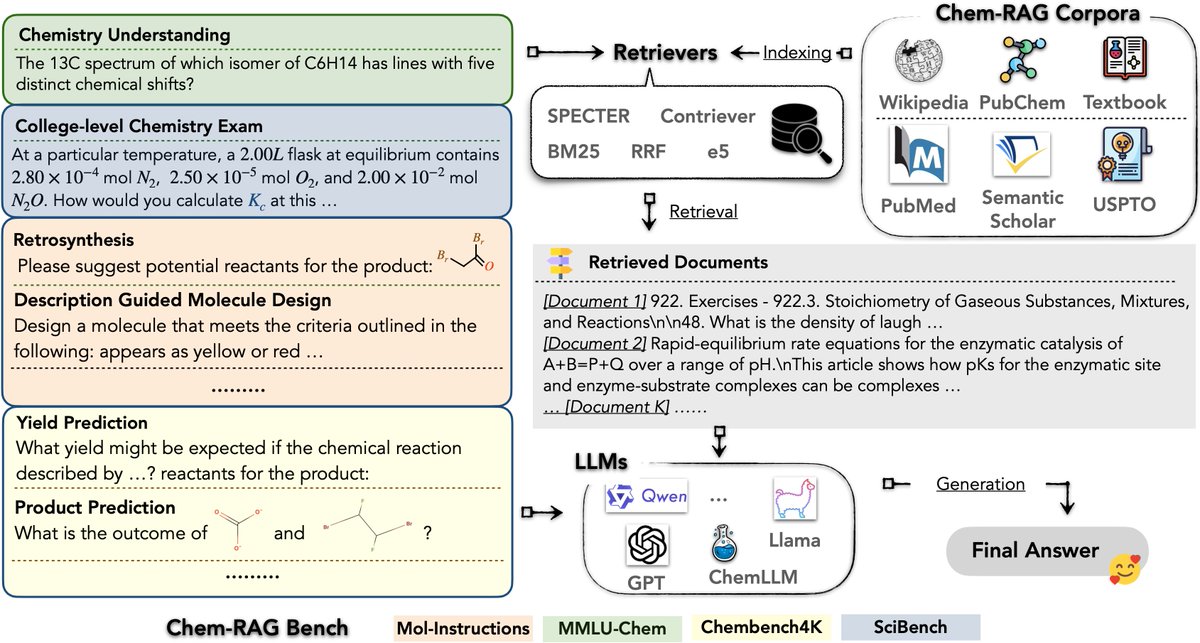
Excited to share that our work ChemRAG: Benchmarking Retrieval-Augmented Generation for Chemistry has been accepted by #COLM 2025!
Paper: https://t.co/WgvJMrJMu7
Code: https://t.co/wJIrnNwth9
Data: https://t.co/5UP1fsjVGy
How can we make LLMs not only answer complex, knowledge-intensive questions correctly, but also ensure every retrieval & reasoning step is high-quality and reliable?
Previous methods like Search-R1 use outcome supervision—rewarding only final answer correctness—but this ignores intermediate step quality, leading to poor generalization on new domains.
Enter RAG-Gym: a systematic framework that optimizes agents using process supervision, evaluating and rewarding every intermediate step. It strengthens RAG agents across three key dimensions.
🧵 (1/8)
Circuits are one lens for understanding LLM behaviors—offering a new pathway to interpret how models work.
Welcome to join the MIB Shared Task!
Also check out our recent work on Knowledge Circuits:
🔹 Knowledge Circuits in Pretrained Transformers (NeurIPS'24)
https://t.co/MmEwJhTyxb
🔹 How Do LLMs Acquire New Knowledge? A Knowledge Circuits Perspective on Continual Pre-Training (ACL'25 Findings)
https://t.co/pisQPBlvgH
#LLM #Interpretability #KnowledgeCircuits #MIBSharedTask #NLP
Introducing AutoMind: Adaptive Knowledgeable Agent for Automated Data Science
Paper: https://t.co/Ts3cE0SDXd
Code (will be released soon): https://t.co/NgMD9b7gIG
Our latest work AutoMind is a new LLM agent framework that automates end-to-end machine learning pipelines by dynamically integrating domain expertise, strategic solution exploration, and adaptive code generation.
Unlike rigid workflow-based agents, AutoMind mimics human practitioners' empirical insights to solve complex, real-world data science challenges.
AutoMind is evaluated on two automated data science benchmarks using different foundation model families. Our results demonstrate superior performance over baselines on both benchmarks:
🏆 On the OpenAI's MLE-bench, AutoMind surpassed 56.8% of human participants - representing improvement over prior state-of-the-art (AIDE).
🔬 Comprehensive efficiency analysis revealed 300% increased efficiency and 63% lower token costs compared to previous SOTA approaches.
Specifically, AutoMind improves automated data science with these breakthrough features:
🔍 Expert Knowledge Base: Curated from domain expertise to ground the agent in empirical best practices, overcoming LLMs' inherent lack of human practitioner experience. This enables handling of complex, innovative tasks beyond classical problems.
🌳 Agentic Knowledge Tree Search: Strategically explores solution spaces through a structured search approach, dynamically navigating possible paths to optimize problem-solving efficiency and effectiveness.
⌨️ Self-Adaptive Coding Strategy: Dynamically adjusts code generation complexity based on task requirements, moving beyond rigid workflows to deliver context-aware implementations—from simple scripts to cutting-edge solutions.
👩💻Excited to share my first project as a postdoc:
🔬Cell-o1 – a reasoning-enhanced LLM for single-cell annotation, trained via RL on our new benchmark CellPuzzles.
📄 https://t.co/qbFk54WeW6
🧩 Introducing Cell-o1, a reasoning-enhanced LLM for batch-level single-cell annotation.
🧬 It takes on CellPuzzles, a new benchmark where each batch contains multiple cells with globally unique types – requiring joint reasoning over gene expression and context.
🧠 Not just answers, Cell-o1 shows how it thinks, with detailed reasoning for each annotation.
🔥 Trained via:
- Supervised fine-tuning on distilled expert reasoning traces
- Reinforcement learning (GRPO) with batch-level reward
✨ Emergent behaviors:
- Self-reflection: revisits and revises earlier decisions
- Curriculum-style reasoning: solves easier cells first
Fully open-source!
Repo: https://t.co/hFtz2YIXAb
Paper: https://t.co/y2ZPxoLxZc
Model: https://t.co/hZCIq2wX7N
Data: https://t.co/BAQ9tWwKZd
#LLM #SingleCell #ReinforcementLearning #AIforScience #Bioinformatics #Reasoning
🧩 Introducing Cell-o1, a reasoning-enhanced LLM for batch-level single-cell annotation.
🧬 It takes on CellPuzzles, a new benchmark where each batch contains multiple cells with globally unique types – requiring joint reasoning over gene expression and context.
🧠 Not just answers, Cell-o1 shows how it thinks, with detailed reasoning for each annotation.
🔥 Trained via:
- Supervised fine-tuning on distilled expert reasoning traces
- Reinforcement learning (GRPO) with batch-level reward
✨ Emergent behaviors:
- Self-reflection: revisits and revises earlier decisions
- Curriculum-style reasoning: solves easier cells first
Fully open-source!
Repo: https://t.co/hFtz2YIXAb
Paper: https://t.co/y2ZPxoLxZc
Model: https://t.co/hZCIq2wX7N
Data: https://t.co/BAQ9tWwKZd
#LLM #SingleCell #ReinforcementLearning #AIforScience #Bioinformatics #Reasoning
🥼 As an MD, I always believe evaluation is the cornerstone of medical AI. That's why we built PubMedQA in 2019.
🤗 Today I am very excited to share my first blog on @OpenAI's HealthBench and beyond.
🔗 Please check it out: https://t.co/H8wTQ4t1Cy