🚀 Exciting news! Our open-source project ReSearch: Learning to Reason with Search for LLMs via Reinforcement Learning has just released its models, paper, and updated code!
Check it out: https://t.co/5KkVcgU50u
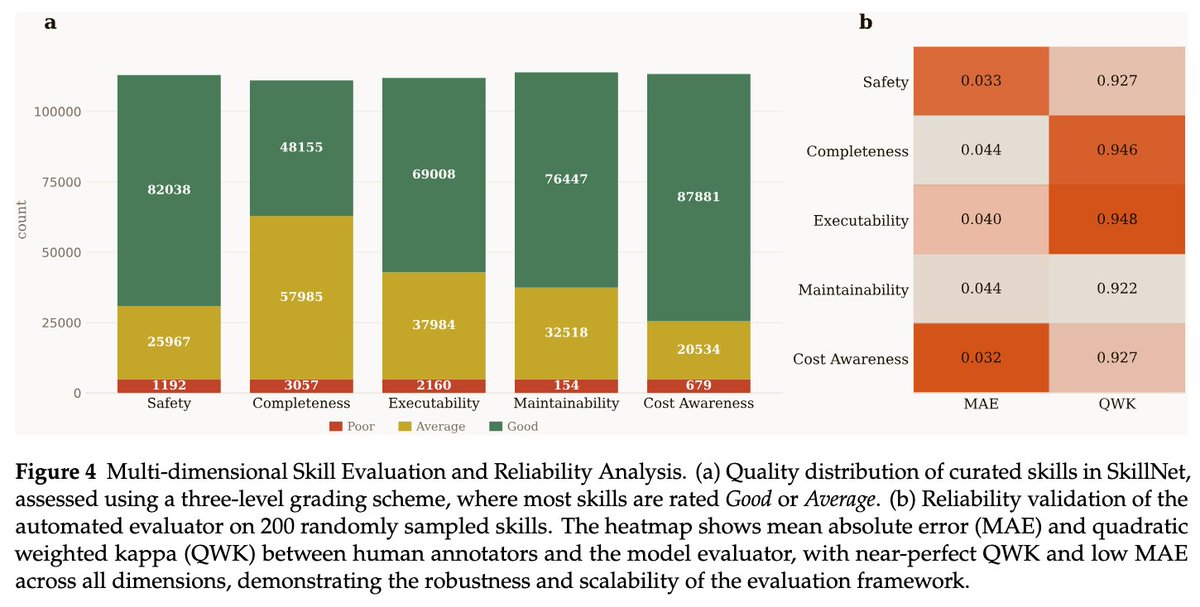
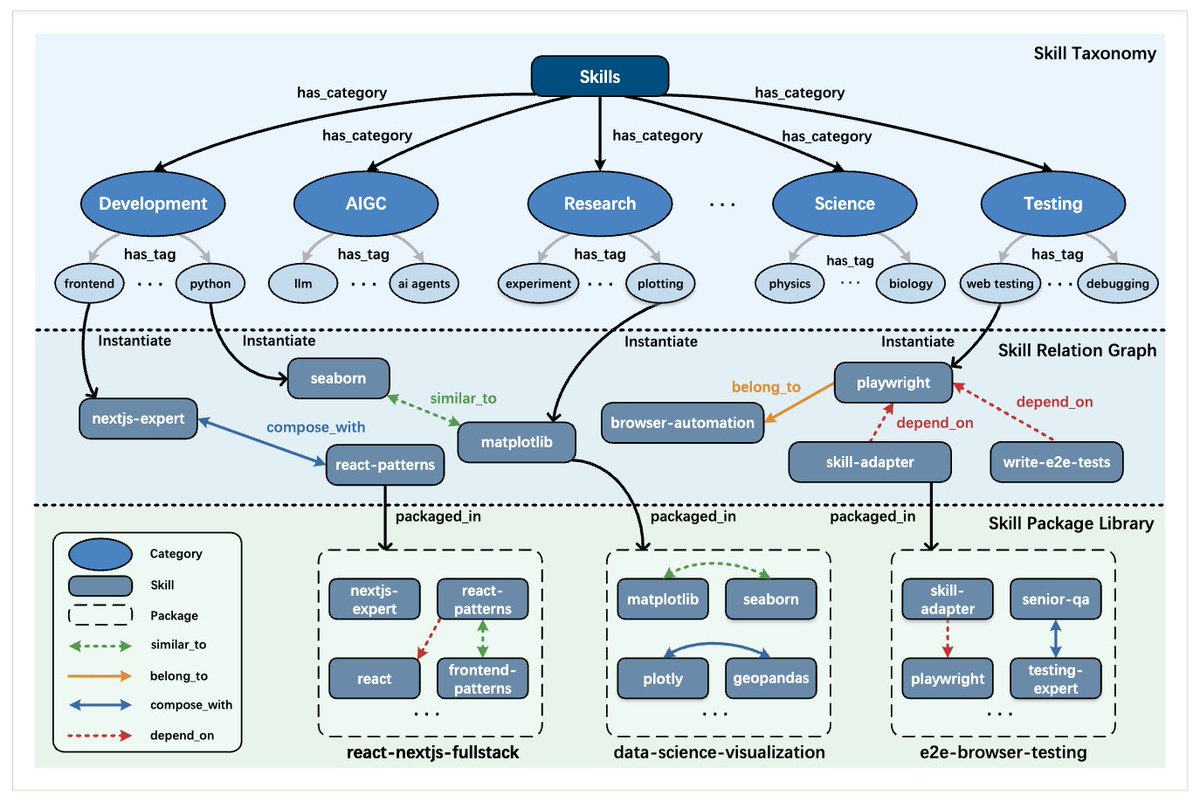
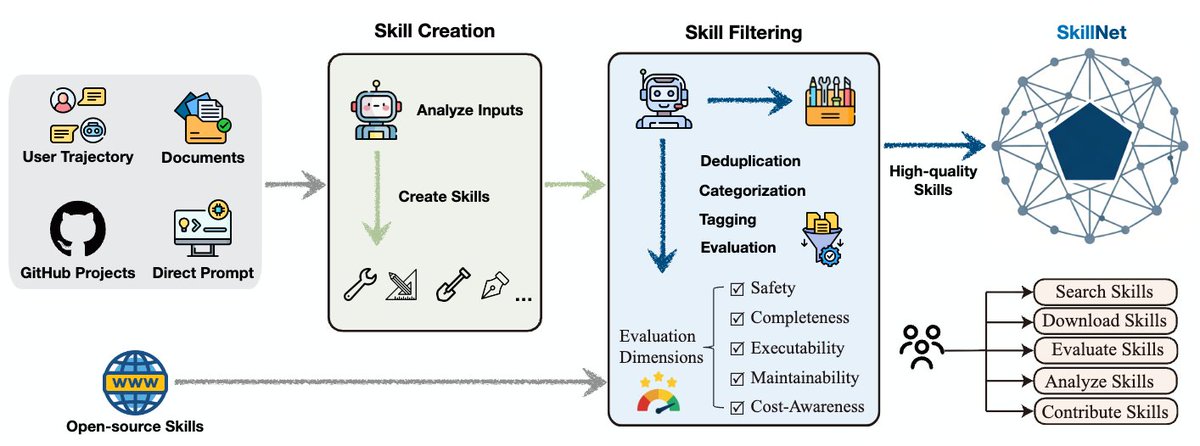
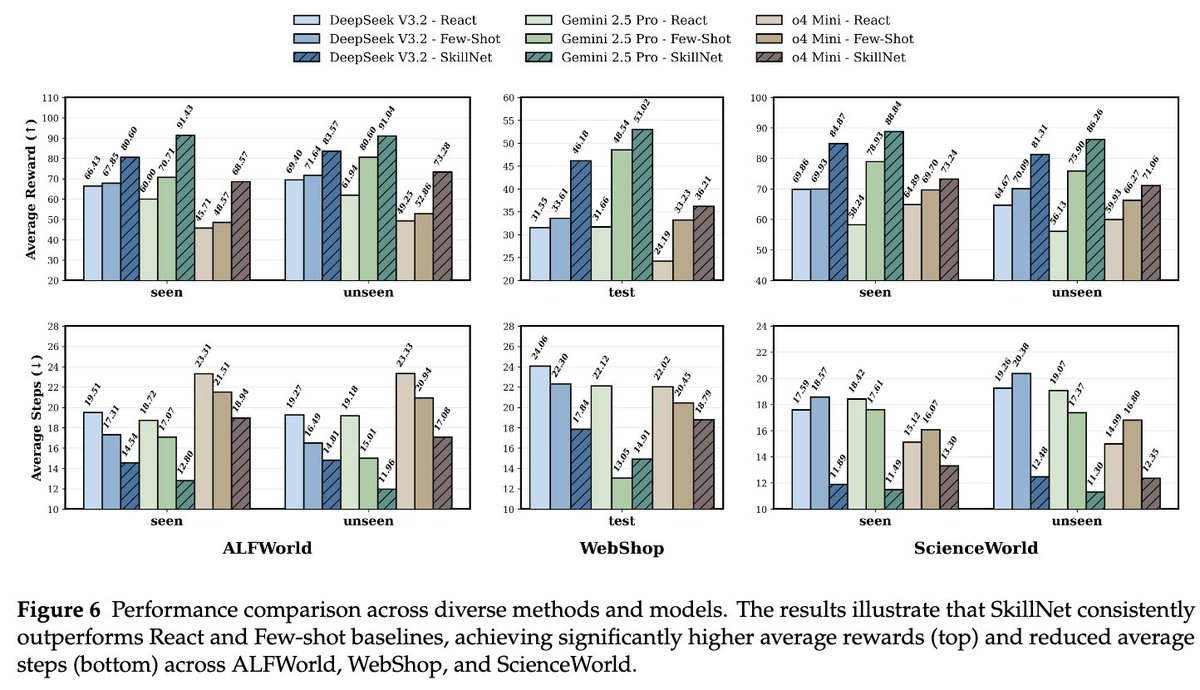
We’re releasing the technical report for SkillNet.
Report: https://t.co/9Hp3OcDI6y
Homepage: https://t.co/VEaFsY8YLV
Code: https://t.co/2Zej4VL7Rk
SkillNet explores this idea by providing a framework to create, evaluate, and organize executable AI skills at scale.
SkillNet is still experimental, but we hope it can serve as a foundation for scalable skill accumulation in AI agents.
Additionally, we have been exploring an interesting direction: Enterprise adoption through a private SkillNet.
For enterprises, SkillNet may act as an engine for accumulating operational knowledge, turning expert SOPs and internal APIs into reusable agent skills, enabling secure private skill repositories, and allowing agents across teams to invoke business capabilities as easily as library functions. 🚀
Feedback and suggestions are very welcome.
#SkillNet #AIInfrastructure #Agents #LLMs #NLP
Many thanks to AK for sharing our work!
Introducing "ReCode: Updating Code API Knowledge with Reinforcement Learning" — the RL framework that teaches models to update code API knowledge.
Paper: https://t.co/sotwZm6e23
Code: https://t.co/zqDMxXaSuC
📚 Trained on 2K+ API updates
🔁 New string-sim reward
Boosts dynamic code gen on CodeUpdateArena
Qwen2.5-Coder-7B > 32B models post-ReCode
#LLM #ReinforcementLearning #AI4Code #ReCode #QwenCoder #KnowedgeUpdate #NLP
Introducing AutoMind: Adaptive Knowledgeable Agent for Automated Data Science
Paper: https://t.co/Ts3cE0SDXd
Code (will be released soon): https://t.co/NgMD9b7gIG
Our latest work AutoMind is a new LLM agent framework that automates end-to-end machine learning pipelines by dynamically integrating domain expertise, strategic solution exploration, and adaptive code generation.
Unlike rigid workflow-based agents, AutoMind mimics human practitioners' empirical insights to solve complex, real-world data science challenges.
AutoMind is evaluated on two automated data science benchmarks using different foundation model families. Our results demonstrate superior performance over baselines on both benchmarks:
🏆 On the OpenAI's MLE-bench, AutoMind surpassed 56.8% of human participants - representing improvement over prior state-of-the-art (AIDE).
🔬 Comprehensive efficiency analysis revealed 300% increased efficiency and 63% lower token costs compared to previous SOTA approaches.
Specifically, AutoMind improves automated data science with these breakthrough features:
🔍 Expert Knowledge Base: Curated from domain expertise to ground the agent in empirical best practices, overcoming LLMs' inherent lack of human practitioner experience. This enables handling of complex, innovative tasks beyond classical problems.
�� Agentic Knowledge Tree Search: Strategically explores solution spaces through a structured search approach, dynamically navigating possible paths to optimize problem-solving efficiency and effectiveness.
⌨️ Self-Adaptive Coding Strategy: Dynamically adjusts code generation complexity based on task requirements, moving beyond rigid workflows to deliver context-aware implementations—from simple scripts to cutting-edge solutions.
🧩 Introducing Cell-o1, a reasoning-enhanced LLM for batch-level single-cell annotation.
🧬 It takes on CellPuzzles, a new benchmark where each batch contains multiple cells with globally unique types – requiring joint reasoning over gene expression and context.
🧠 Not just answers, Cell-o1 shows how it thinks, with detailed reasoning for each annotation.
🔥 Trained via:
- Supervised fine-tuning on distilled expert reasoning traces
- Reinforcement learning (GRPO) with batch-level reward
✨ Emergent behaviors:
- Self-reflection: revisits and revises earlier decisions
- Curriculum-style reasoning: solves easier cells first
Fully open-source!
Repo: https://t.co/hFtz2YIXAb
Paper: https://t.co/y2ZPxoLxZc
Model: https://t.co/hZCIq2wX7N
Data: https://t.co/BAQ9tWwKZd
#LLM #SingleCell #ReinforcementLearning #AIforScience #Bioinformatics #Reasoning
We introduce Reinforcing "Cognitive Experts" – a new approach to enhance reasoning in MoE-based Large Reasoning Models (LRMs) 🌟.
Thanks to Tencent's support, we had the opportunity to explore the inner workings of ultra-large models like DeepSeek-R1-671B and Qwen3-235B.
By selectively amplifying (steering) just two cognitive experts, we can influence the model's reasoning behavior to improve performance without extra training.
Paper: https://t.co/YBlTrtrWrJ
🔍 Key highlights:
✅ Identifying cognitive experts using nPMI through linguistic markers like the <think> token
✅ No additional training or supervision required
Our technique is just an early exploration of how expert manipulation can steer model reasoning. LLMs are complex systems, and results may vary or not align with expectations.
It’s like giving the model a little nudge! 🤖💡 Our approach strengthens certain "cognitive experts" inside the model, helping it solve problems more effectively.
Think of it as stimulating the brain of a giant model to make better decisions! 🧠✨
The "cognitive expert" introduced in this work is a hypothetical concept. 🤔 Given the complexity of LRMs, we offer no theoretical justification for its existence—our conclusions are purely empirical. More research is needed to further explore this intriguing idea!🔍👩🔬 #AI #MoE #ModelEditing #KnowledgeEditing #Steering #NLP #LLM
🎉 Introducing our latest work !
🚀 We propose a label-free method that enables RL without ground truth answer, yet achieves impressive performance on mathematical tasks: 40.0% accuracy on AIME2024 🎯 with a 7B base model.
Paper: https://t.co/ooMFSxYoVf
Is it possible to “give medicine” (vectors) to large language models to control their behavior at inference time?
🚀 Excited to share our ACL 2025 work: Steering Target Atoms (STA) — an approach to controlling LLM behavior at inference time without retraining. #ACL2025#LLM#AI #NLP #TestTime #KnowledgeEditing #Steering
Paper: https://t.co/7xCcYkBHrX
Code (will be released soon): https://t.co/Jvxwzntf9N
🧠 Why STA?
Entangled knowledge in LLMs can cause unintended side effects when intervening.
STA pinpoints key "atoms"—features with distinct activation patterns in positive vs. negative samples—for fine-grained, low-side-effect control.
🔬 Results:
STA achieves better safety control with minimal side effects.
The steering vectors remain effective even with few-shot supervision.
🤔 Steering Vectors vs. Prompt Engineering:
Prompt engineering can steer model behavior. However, the prompt design is limited by search space and transferability, STA allows us to convert prompts into steering vectors for a fair comparison.
📊 Findings:
Steering Vectors > Prompt Engineering in robustness and flexibility
More consistent and effective behavioral control
🧩 We also apply STA to a large reasoning model—it precisely modulates reasoning steps.
Our recent work on “cognitive experts” shows further gains in structured reasoning control. (See our last tweet for more https://t.co/kuaiOuWnUz!)
However, this technique still has its limitations — it requires careful hyperparameter tuning and can sometimes fail. Our understanding of the underlying mechanisms of large language models remains limited.
There’s still much to explore, and we hope to tackle this together with the community.
🌟 Introducing Tool-Star, a powerful RL-based multi-tool reasoner!
🚀Achieving impressive results on 10+ top reasoning benchmarks with only 3B params!
🥳 We’ve open-sourced all the code, datasets, and checkpoints
Github: https://t.co/PfJbH4Gvl5
Paper: https://t.co/DiTHPGXRrP
Giving your models more time to think before prediction, like via smart decoding, chain-of-thoughts reasoning, latent thoughts, etc, turns out to be quite effective for unblocking the next level of intelligence.
New post is here :)
“Why we think”: https://t.co/21xduoZaAF
🚨 New paper 🚨
J1: Incentivizing Thinking in LLM-as-a-Judge via RL
- Converts judgement task into a verifiable one for both verifiable and non-verifiable prompts. Uses only synthetic pairwise data
- Optimizes thoughts, scores, and judgments using GRPO
- Outperforms all baselines at 8B & 70B scale, o1-mini, and on some benchmarks, even R1
- We find J1 uses various thought strategies: outlines evaluation criteria, compares against self-generated reference answers, and re-evaluates correctness
📝: https://t.co/yG6xAPafTv
RL for Search-Efficient LLMs
Presents a new post-training RL framework that explicitly trains LLMs to optimize search usage.
Recipe: structured reasoning template and reward policy + GRPO
Leads to smarter and more efficient reasoning and retrieval of external knowledge.
🚨 New Blog Drop!
🚀 "Reflection on Knowledge Editing: Charting the Next Steps" is live!
💡 Ever wondered why knowledge editing in LLMs still feels more like a lab experiment than a real-world solution? In this post, we dive deep into where the research is thriving — and where it's falling short. From foundational breakthroughs to the practical roadblocks no one’s talking about, we connect the dots and propose what’s needed to move forward. Join the conversation! #KnowledgeEditing #LLMs #AI #ModelEditing
📌 If you're working on LLMs, model updates, or mechanism interpretability, you don’t want to miss this.
👉 Read the full post: https://t.co/7sp8xYVDyq
Key insights from our analysis:
0⃣ Current evaluation metrics and benchmarks inadequately assess knowledge updates in LRMs, highlighting the need for more comprehensive evaluation frameworks.
1⃣ Scaling challenges persist, with significant memory and computational constraints limiting the practical application of editing methods for larger or quantized local models.
🎁 Resource Release: To support the research community, we release covariance matrices for Qwen2.5-32B & QwQ-32B models for the current locate-and-edit methods.
2⃣ We outline promising research directions for developing language models that can effectively learn, adapt, and evolve their knowledge base.
Huge thanks to the brilliant collaborators who made this deep dive into #ModelEditing possible! @uclanlp@CanyuChen3@Jiachen_Gu@dsmall2apple1@ManlingLi_@VioletNPeng
isn’t it weird that we spend >99% of RL compute on the agent and <1% on the environment (eg python runtime)?
who is working on scaling environment compute? and is there an optimal agent-environment compute frontier for intelligence?
Honored to contribute to a survey on Full-Stack LLM Safety 🔒🤖
A Comprehensive Survey in LLM(-Agent) Full Stack Safety: Data, Training and Deployment
ArXiv: https://t.co/97nJqdn3tQ
We go beyond existing works by covering the entire lifecycle of LLMs—from data to deployment to commercialization.
📚 800+ papers reviewed
🧠 Key topics: data safety, alignment, knowledge editing, agent security
Personally, I see knowledge editing/unlearning as crucial but underdeveloped—deep implications for AI safety, misuse prevention, and better understanding LLMs themselves (a.k.a science for AI). Let’s push this forward.
Feedback welcome!
#AI #LLM #KnowledgeEditing #ModelEditing #Safety #AGI