Associated Professor@UCLA (leave), Scientist and manager@Google. AI and Infra, AI for science, AI creativity, event. (she/her/hers). Opinions are my own.
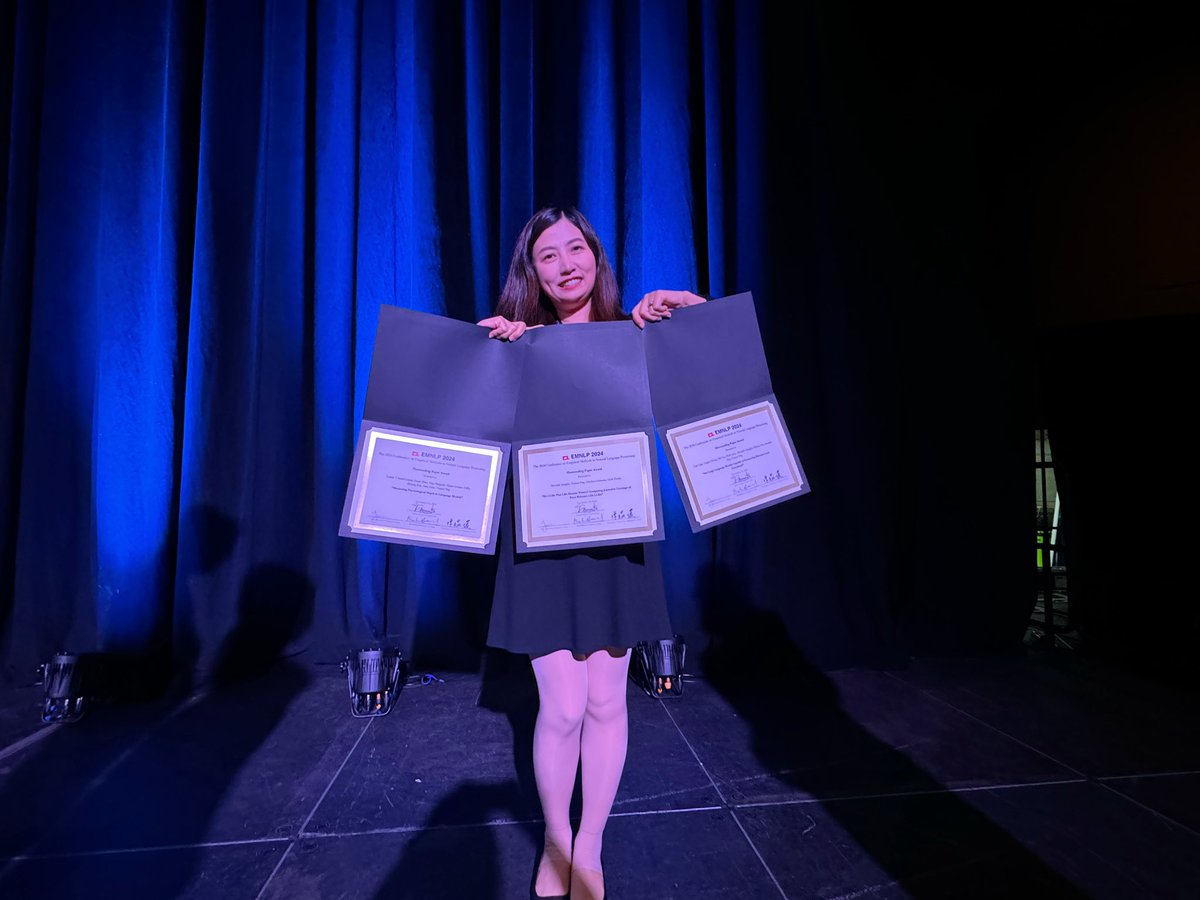
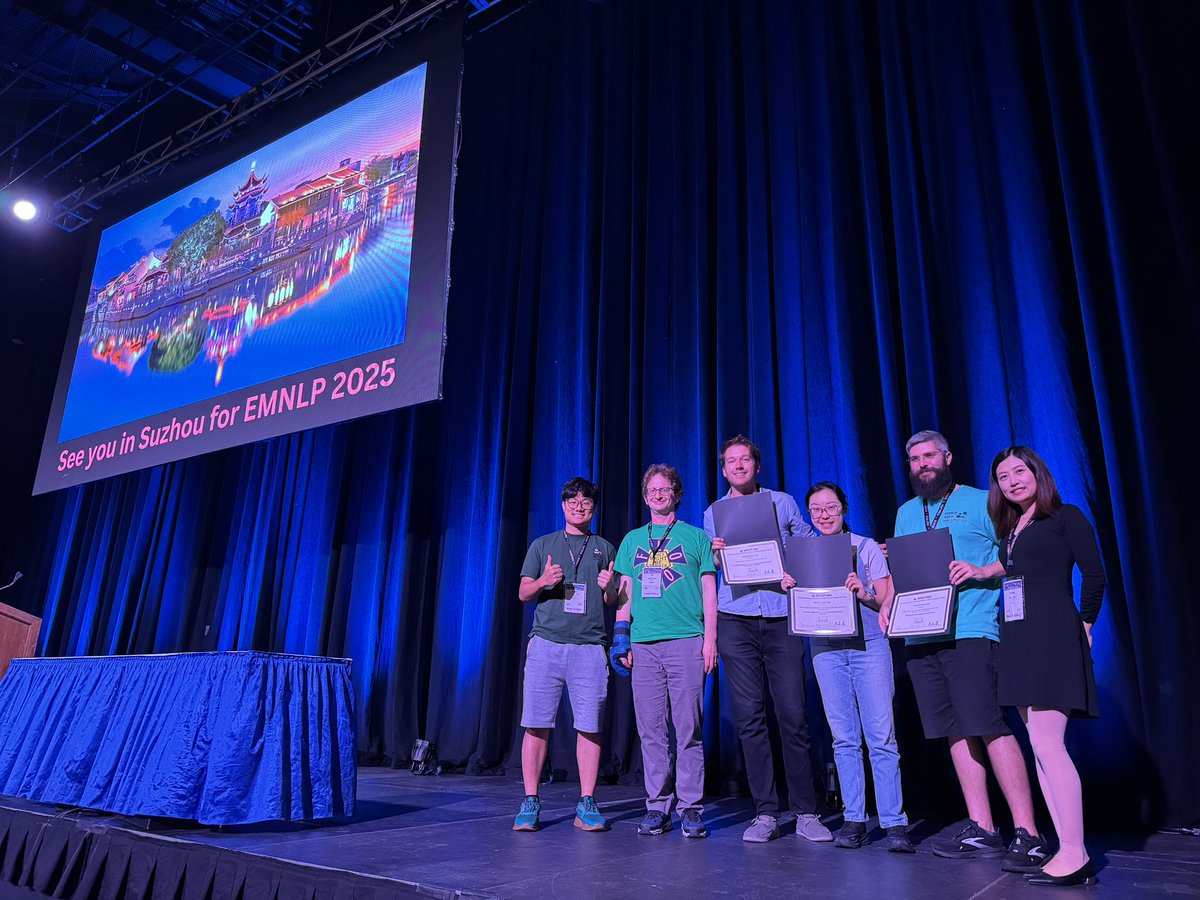
Thrilled, grateful, and humbled to have won 3 outstanding paper awards at #EMNLP2024!!! Not even in my wildest dreams. Immense thanks to my amazing students and collaborators!
All three works are on evaluating LLM’ abilities in creative narrative generation. 🧵👇
I joined @noeri_ai part-time two months ago.
It has been a blast! I’m very impressed by the team that Yejin and Carlos (@guestrin) have built. Everyone is incredibly talented and kind, and it’s been so much fun working together.
I’m especially excited about plural AI for scientific discovery, where every scientist can aim AI at their own hard problems.
At a personal level, I am grateful that I’ve finally had the opportunity to work with my long-time role model and friend @YejinChoinka.
We are hiring in Palo Alto and Zurich. The picture is me working from the Zurich office this week :)
Frontier science doesn't advance through single-turn AI prompts — it advances through rigorous discovery loops.
Today, @GoogleResearch is sharing how Antigravity’s /teamwork feature (powered by Gemini 4 Models) is helping researchers solve long-standing open problems across math, chemistry, and systems software:
🧵 A few milestones:
1/ Mathematics & Formal Proofs Proved and verified information theory’s 2013 Courtade–Kumar conjecture in full generality (in Lean 4 with 50M lines of code), with progress on decades-old problems in quantum query complexity, dynamic graph algorithms, and made the first progress in nearly two decades toward Tarjan's Deque Conjecture.
2/ Molecular Chemistry Reached 95% top-1 accuracy in determining complex 3D molecular structures from raw NMR data—nearly doubling single-agent benchmarks by organizing 30 specialized agents in a self-correcting loop with physics simulators.
3/ Systems & Production Impact Automated end-to-end safe Rust kernel rewrites, achieved 4x TPU kernel speedups, and surpassed 1 PiB fleet memory saving across Google’s production fleet.
4/ Open to Researchers All preprints and Lean 4 repos are public, and we're opening 6 months of free access for 10,000 academic researchers to use these multi-agent tools in their own work.
Kudos to @mirrokni and the entire Google Research team pushing the boundaries of human-AI collaboration.
Almost a year after taking a sabbatical from UCLA to join Google, I’m thrilled to introduce my new research team: AIS (Agents for AI-Infra and Science)! 🚀
We’re betting big on AI for Discovery — co-designing models & agentic frameworks to optimize ML/AI infra and tackle frontier scientific problems. Check out our new team page: https://t.co/2eV3jLyqLa
Excited to share that two of our projects were just featured on the Google Research Blog (Read more: https://t.co/DEFaGADM2g) and are rolling out for GA to all users via Antigravity’s /teamwork:
⚡ DuoDiscover (Systems Optimization): Achieved a 4.09x avg speedup across 17 JAXBench kernels, and beat hand-tuned baselines with a 2.99x avg speedup on vLLM TPU Pallas kernels. https://t.co/CLRT8IRyhk
📐 LEAP (Formal Math): Autonomously generated 1.8M lines of Lean to complete an end-to-end formalization of the Weil conjectures, achieved the first formalization of Hilbert’s 10th problem (919k+ lines), and independently reproduced the 3D Navier–Stokes formalization. https://t.co/q5evUWs9Hu
Building a team from scratch reminds me a lot of starting my academic lab as a new professor, except this time, backed by @Google’s infra & ecosystem, I am fortunate to witness frontier research turns into real-world tools at an extraordinary pace.
I’m truly grateful to build and grow alongside my amazing team, interns, and collaborators across Google AI2 R&D, @GoogleDeepMind, and @GoogleResearch!
Check out our recent results solving open challenges across math/science and engineering with /teamwork and Gemini 4 models : https://t.co/in8niq88d4
Details:
Following our recent updates on Antigravity’s /teamwork, we’ve been hard at work solving open challenges with our multiagent workflows (/teamwork and DeepReview powered by Gemini 4 models) and pushing these tools externally for everyone to use. Through close collaboration with academic partners, we are evolving these tools into true research and engineering partners designed to tackle open problems.
We just posted on the Google Research blog providing a few recent examples :
* Math Open Problems & Formal Verification: Reporting 10+ open math and CS theory problems solved including 50M-line Lean 4 proof of Courtade–Kumar conjecture plus open problems in quantum query complexity, Tarjan's Deque Conjecture.
Also autonomous Lean formalizations of the Weil (1.8M lines), Birkhoff, and 3D Bochner–Riesz conjectures via Teamwork-LEAP, plus updates on Deep Review for STOC’27.
* Chemistry & Discovery: 95% top-1 exact match on NMR molecular structure elucidation (nearly 2× single-agent). Also empowering Nuclear Fusion and Quantum algorithm results as well autonomously generating a CausalAnalyst Benchmark.
* Systems, TPU Kernel, & Infra:
* Clustering 1-Trillion-edge graphs on FarArray and RDMA (up to 180× faster),
* 800K-line Zircon & 170K-line libgav1 safe Rust rewrites (20–30% faster than C++/ASM),
* 4.09× JAXBench TPU kernel speedups with DuoDiscover,
* surpassing 1 PiB fleet memory savings, and 24% fewer Borg TPU preemptions.
Best of all, these tools are available externally in Antigravity. Previously, when we developed agents for coding and math competitions and later for science acceleration, we relied on internal models and agentic tools; now, I am happy we can share these tools with everyone—with Hydrogen models available to all, and Carbon and Argon models for Enterprise and Ultra/Paid users. We’re also opening applications for 10,000 academic researchers to get 6 months of free access to our highest usage tier for Antigravity. We also provide two free weekly DeepReview calls for all.
This is a collaboration across many at Google (in Gemini, Antigravity, Research, Cloud); Congratulations to the whole team! We will post more details in Antigravity blog post.
Apply for the academic researcher access program: https://t.co/BfuStASb4W, and Try DeepReview: https://t.co/r26ksY3COc
Read the full blog here : https://t.co/in8niq88d4
#AntiGravity #Gemini4 #teamwork #AI4Math #AI4Systems #AI4Coding
We built InferenceForge 🔥, an agentic system that profiles, benchmarks, and optimizes LLM inference for agent workloads.
43% higher throughput than the best published baseline under the same latency SLA on the SemiAnalysis AgentX benchmark.
Introducing FireFlash🔥, a long-horizon coding agent pushing the performance-cost Pareto frontier.
🚀46.2% on Terminal-Bench 4.0, above Fable 5 Max while costing over 30× less per task.
We're releasing the full recipe🧵:
In just 5 days of post-training on 64 NVIDIA B300 GPUs, we built FireFlash🔥, a GLM-based long-horizon coding agent that pushes the performance–cost Pareto frontier.
🚀 46.2% on Terminal-Bench 4.0, outperforming Fable 5 Max at 30× lower cost per task.
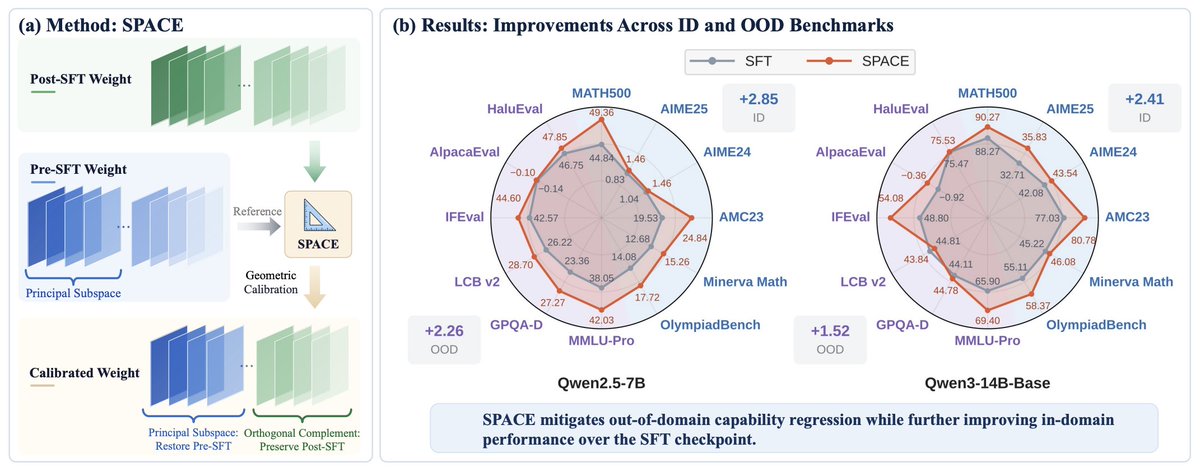
Fine-tuning can improve a target skill while weakening others. Can we improve a fine-tuned LLM by undoing part of its fine-tuning?
Introducing 🚀SPACE🚀: a post-hoc method that improves average performance both within and beyond the training domain.
No extra training. No data. Just the pre- and post-SFT checkpoints for calibration with one single step of code.
1/n
Thanks AK @_akhaliq for featuring our work!
Excited to share OpenVLHarness, a multimodal agent that inspect, compute, and reason over evidence.
The technical core:
• A capability layer gives consistent interfaces for various tools such as perception and search, and renders their outputs into observations the model can inspect.
• Persistent multimodal memory retains images, masks, numerical arrays, and web references under reusable handles.
• A coding agent computes over those artifacts to combine evidence across tools.
Across 22 benchmarks and 8 backbones, we see average gains of 9.7–12.6 points over matched no-tool baselines. Evidence acquisition and additional reasoning are complementary!
A joy collaborating with this UCLA × Apple team. Huge shoutout to @yu_bryan_zhou, @cfyang58, @RuiSun94013021, @DiWu0162 , Sibo Peng, Mingyang Zhang, Zhen Yang, Ruiyi Zhang, @zhegan4 and @kaiwei_chang! 🎉
The lemma an AI needs to prove a theorem may look nothing like the theorem itself.
Introducing 🚀LeanGraphSearch🚀: search Mathlib by following dependencies behind related results to uncover missing proof ingredients.
The payoff: better retrieval and more Lean-verified proofs.
1/n
🚨New level unlocked! 🚨 We doubled GPT‑6 Astra’s score on MazeBench with WorldBox, our agentic sandbox for spatial reasoning.
Astra: 23 gems 💎💎
Astra+WorldBox: 61 gems 💎💎💎💎💎
MazeBench, by @patience_cave, is a tough test of long-horizon spatial reasoning: 256 interconnected rooms where even Opus 5.5 used 2.2B tokens and collected just 13 of 100 gems.
WorldBox provides agents with an agentic sandbox, for managing long-term memory, inferring complex mechanics, and simulating reasoning.
Watch the sandbox take shape and the agent tackle increasingly tricky puzzles. 🧵
@Google@chunliang_tw Btw, My team at Google (https://t.co/2aVFWI6dsW) is hiring FTE and Interns. Please reach out if you’re interested in the works we do!
Super excited to share this work from our amazing interns and team at @Google, co-led with awesome @chunliang_tw!
Meet DuoDiscover: a full-stack code optimization agent. Its secret sauce is co-discovering the optimization target AND a cheap proxy evaluator (a "yardstick") at the same time.
A quick spoiler of the results:
🏆 #1 on NVIDIA's SOL-ExecBench
🐍 2× the human experts on SWE-fficiency
🚀 1.92× on vLLM; 1.44× on FreeToken
🔥 2.68× over production TPU kernels
🖥️ Beats the best human and AI-designed CPU prefetchers
Optimizing AI infra. Accelerating science. Dive into more details below 👇
AI is cracking math problems. What's holding it back in engineering?
The cost of evaluation. Agents can generate ideas in seconds, but testing them can take hours or days.
💡 Meet DuoDiscover: where evaluation is part of what agents discover 👇🧵
Some highlights:
🏆 #1 on NVIDIA's SOL-ExecBench
🐍 2× the experts on SWE-fficiency
🚀 1.92× on vLLM; 1.44× on FreeToken
🔥 2.68× over production TPU kernels
🖥️ Beats the best human and AI-designed CPU prefetchers
Come try our PaperBanana-Interact demo!🔥https://t.co/b68UOufwTj
Tired of AI-generated diagrams that are "almost right", but can't turn your last complaints into the right edits? Try interactive refinement here!
Code and data are also available:
https://t.co/96DW9G984D
🍌Introducing 𝗣𝗮𝗽𝗲𝗿𝗕𝗮𝗻𝗮𝗻𝗮-𝗜𝗻𝘁𝗲𝗿𝗮𝗰𝘁✨! (UCLA x Google Cloud AI)
AI can draft your paper's diagrams, but they rarely match what you pictured: wrong structure, missing components, misplaced arrows, or it just misses the point.
PaperBanana-Interact makes diagram generation 𝗰𝗼𝗻𝘃𝗲𝗿𝘀𝗮𝘁𝗶𝗼𝗻𝗮𝗹: generate, then refine via chat. Don't miss it👇
📄Paper: https://t.co/ym0sqKCUqS
💻Code, data & demo coming soon - stay tuned!
(And yes, this figure was made by PaperBanana-Interact itself - we just chatted with it until it looked right!😄)
Congrats on the ICML 2026 Outstanding Paper Award! Glad to see diffusion LLMs attracting more and more attention.
The Flexibility Trap shows that discrete diffusion can hurt reasoning under arbitrary token order: too much flexibility at the token level may skip the high-entropy forks where real reasoning decisions happen.
This is exactly we think where latent diffusion becomes exciting.
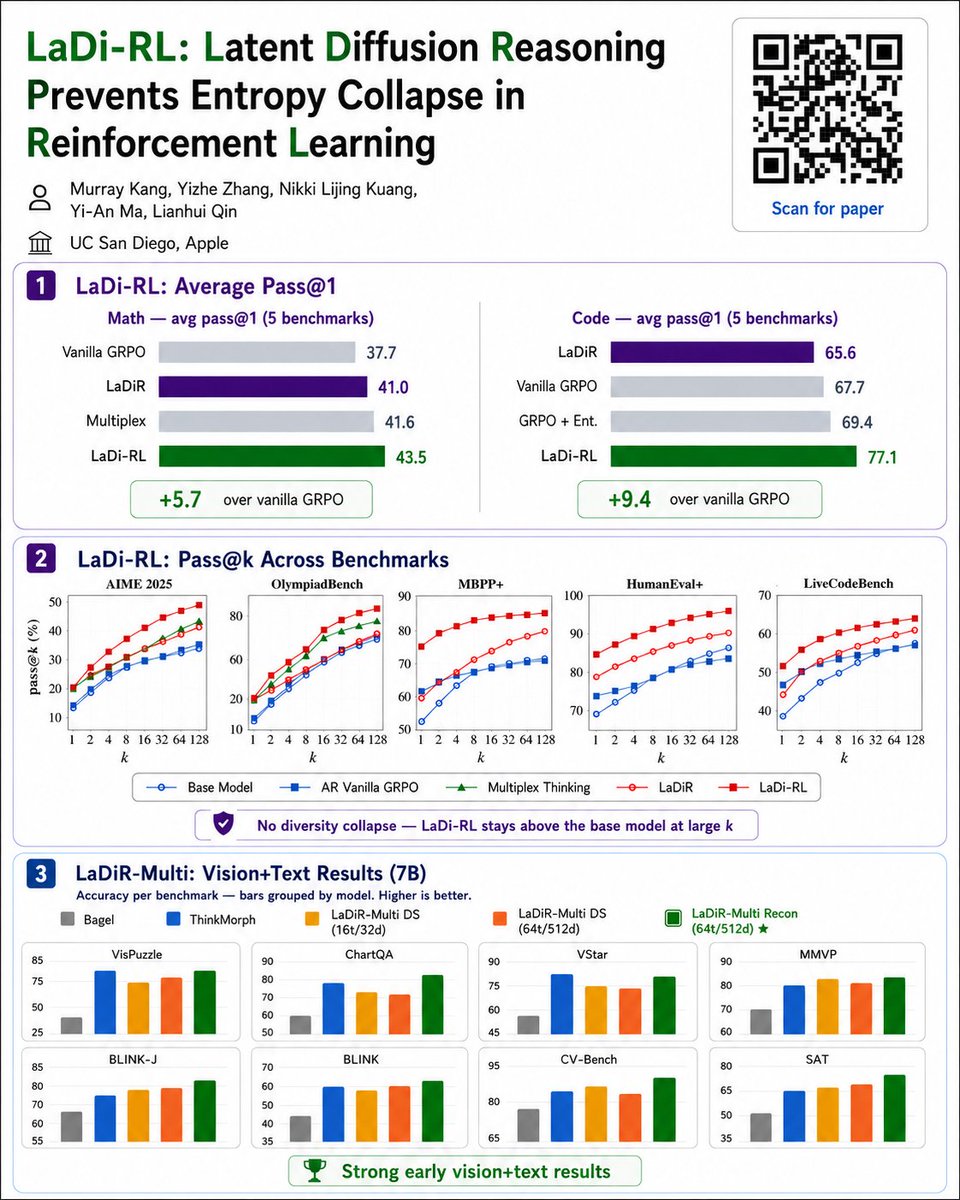
Instead of denoising arbitrary surface tokens, latent diffusion avoids the flexibility trap by utilizing continuous diffusion in latent space. This is the core idea behind LaDiR: reasoning at the semantic level, with global refinement in latent space.
In LaDiR-RL (latent diffusion RL), diffusion sampling keeps multiple latent reasoning paths alive, helping mitigate the diversity collapse that often appears when RL directly optimizes text outputs.
In our ongoing LaDiR-Multi, the same principle extends to multimodal reasoning: vision, text, code, audio, and action can enter a shared latent space, be reasoned over during denoising, and finally be discretized into text by an autoregressive model. We see very strong early results on vision-text benchmarks.