This is the biggest lie you’ve been told.
You’re told the West is falling apart because of migrants and minorities.
But who closed the factories? Crashed the banks? Launched the wars?
Here’s what really happened.
I’m excited to announce my documentary REMOVED: Black Erasure In Boston has been selected for Gary International Black Film Festival in Gary, Indiana! This is the 3rd selection for REMOVED. 🥳🥳🥳
So much of the problem in football is the inability to reason correctly. Chess, poker, mathematics, finance, economics—any field that demands you to reason super rationally gives you a huge leg-up in football.
Football organizations will do well to bring in thinkers from those fields.
Look at Pep Guardiola. The reason he is the best manager of all time is his ability to philosophize. Arteta, his greatest protege, is an American CEO type. They ARE RUNNING RINGS around traditional football thinkers.
The Michael Carrick rebuild is more Arne Slot than it is Mikel Arteta, but that's okay because you can still win major titles like that.
It's just more reliant on the players.
That's why recruitment/balance is key.
I talk about it below. Similar to Didier Deschamps, Carrick.
Michael Carrick and Manchester United are not too dissimilar to France stylistically.
Elite quality in attack so they can kill you at any moment. Their own fanbase also don't realise how good Mbeumo is just yet. Salah-lite.
So that alone means they can kill any low block or any team in transition irrespective of the game theme or state of the game.
They can press from goal kicks and although they are not flawless tactically in terms of their on-ball balance or their off-ball balance, they have enough quality to make up for it.
We don't see United attack with flawless positional play or transition from a mid-block into a man-to-man press with flawless cohesion and maximal aggression. We don't see elite distances from front to back or maximum compactness in every moment.
But it's not the biggest problem in the world because they can defend their box well and not being the most compact in the world invites the opposition to be aggressive with their passing. That can end up in United being exploited, sure, but it also increases high risk actions from the opposition which maximises the spaces United's elite attackers have to use. So, even though they are flawed, it almost makes them better. A bit like Klopp's Liverpool.
United need to maintain that quality where possible across the thirds. Carrick's game-model is one that is more reliant on the players than Arteta's or Klopp's, for example (although every game-model is obviously reliant on quality). That's why they need elite depth in attacking areas, a midfield capable of handling all types of game-states (they still need another physical player in there), and a back 4 that can defend their box but also manage open spaces. The back 4 is currently what worries me the most as I don't think Martinez and Maguire can manage open spaces, even though they defend their box well and both have incredible quality in possession.
What United miss from the France team is Rabiot in midfield and Upamecano + Saliba at the back. Otherwise, they are very, very similar. They need to target these players in the market but they also need to find elite strength in depth to maintain their attacking quality which is key to their identity and success.
All these France players need is basic balance and they have it.
4-3-3 base, fullbacks and wingers on different lines, Rabiot and Koné dictating the build-up, 4 of the best players in the world in attack, man-to-man from the goal kick, 4-4-2 low.
3 out of the front 4 work hard.
🇫🇷 France were EXTREMELY impressive yesterday.
Deschamps had a masterful tactical plan from the off despite illogical criticism on the timeline.
France had a clear idea.
4-3-3 which morphed into a 3-1-6 higher.
Tchouaméni, Rabiot, and the two centre backs handled the build-up high with the fullbacks making selfless runs off the ball into the final third.
Hernández and Koundé had very clear roles - make runs off the ball into the lane where Olise and Doué were not positioned.
For example, when Olise was inside, Koundé was wide. Or, when Doué was wide, Hernández was inside.
Dembélé also had license to roam and 'feel the spaces' in the #10.
We saw a lot of fluidity positionally amongst the French players too. Olise would often drop to get touches, Dembélé found himself all over the pitch, and Doué even drifted across from left to right at times. That level of freedom works IF the positional structure is largely maintained around it, and it was. Too much focus on positional play becomes too predictable to defend. Too much focus on fluidity prevents the team from being organised. Deschamps struck a nice balance in this regard.
Mbappé did a phenomenal job of being patient and staying away in the #9, too.
With all of the dynamism and creativity around him, France need a focal point in attack. Like Giroud in the past. Mbappé was positionally disciplined and he scored as a direct consequence of that in the second half with Olise creating something out of nothing for him in the #9.
In the second half, Deschamps tweaked things slightly dynamics-wise. He swapped Olise and Dembélé, likely because Olise was a little too 'free' with his movements which often caused Koundé to hold the width on the right. With Dembélé being more tactically disciplined, he held the width more often with Olise inside and Koundé continued to support with off-ball runs.
I also thought that France were excellent defensively, particularly in the first half (see next tweet for more).
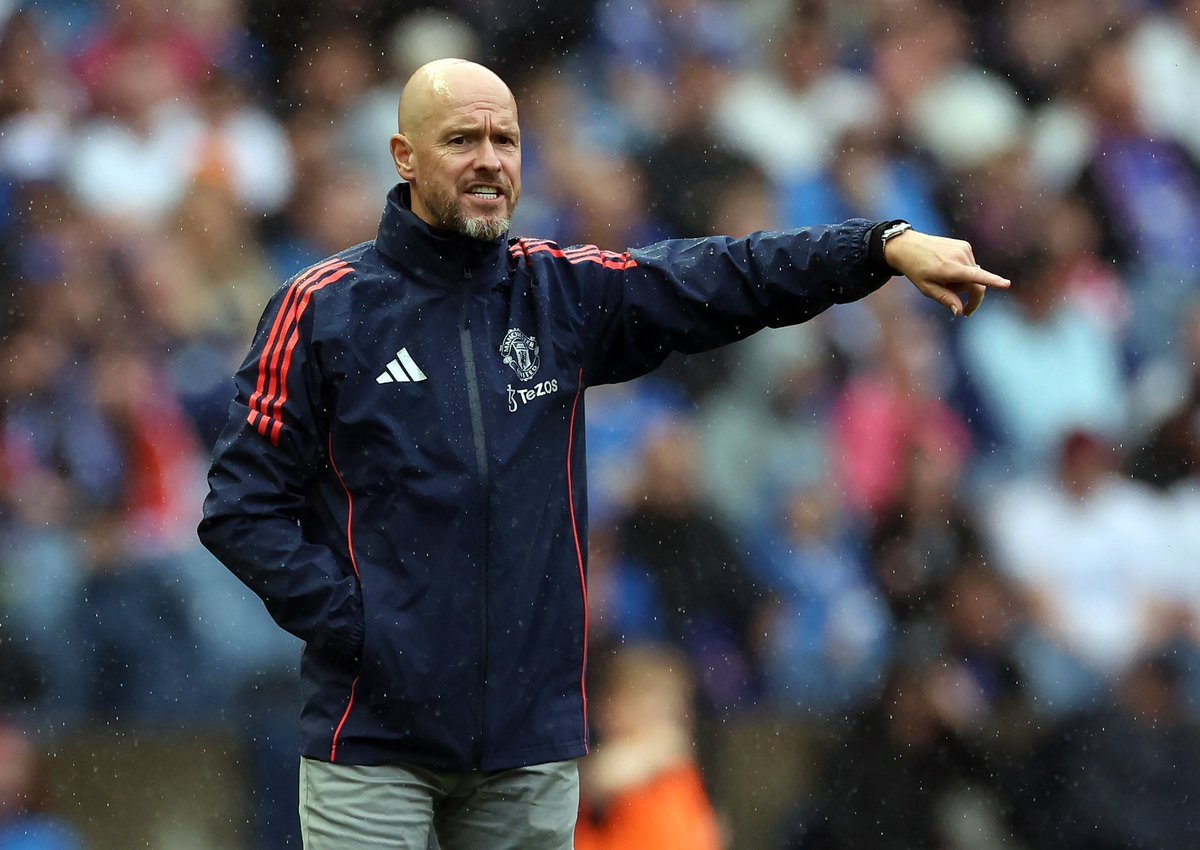
Erik ten Hag's pressing system against Brighton was Jürgen Klopp-esque.
Manchester United may have lost, but the high pressing was the best we have seen since ten Hag joined the club.
Let's take an in-depth look at how United pressed in ten Hag's new-look 4-4-2.
👇🔴
I used to believe “Football Starts at Home” wasn’t rocket science.
I’m no longer sure.
Over the years, I’ve presented Football Starts at Home to virtually every type of organization connected to the game, fifa, confederations, federations, clubs, leagues, academies, schools, coaches, governments, media, brands and communities.
Those conversations have taught me something important:
Developing football isn’t just about knowing what to do. It’s about understanding how everything connects.
If you want to become a football power, to consistently develop top players, build strong teams, and win, you have to see the entire ecosystem: players, coaches, clubs, schools, competition, facilities, families, communities, culture, and pathways.
They don’t operate independently. They influence one another.
And here’s what has surprised me most:
Very few people can explain how the whole thing actually works.
Even many of the strongest football countries struggle to articulate it.
Why?
Because their success has evolved organically. Football is embedded in everyday life. The environment naturally reinforces the behaviors, opportunities, expectations, and pathways that produce players and teams.
They don’t necessarily have to explain the system.
They live it.
And that creates a problem for countries trying to replicate their success.
You can copy the academy.
You can copy the training methodology.
You can build the facilities and hire the coaches.
But if you don’t understand how all the pieces connect, you’re not copying the system.
You’re copying the symptoms of the system.
That’s the real challenge of Football Starts at Home:
Not simply developing better players, but understanding, and intentionally building, the ecosystem that consistently produces them.
Because you can’t copy what you don’t understand.⚽️🙇♂️🙏
watched a 7-0 loss from hürzeler and came away impressed.
it’s unbelievably shameless, but i need this (undeserved) morale victory tonight. this game frustrated me greatly