GOOD NEWS 🚨 Tesla has engineered the ultimate winter survival system, uniting an 8-way valve, a super manifold, and a lossy compressor boiler to eradicate cold-weather range anxiety ❄️
Electric vehicles share a fundamental paradox. They are simply too efficient for their own good. Unlike a traditional gasoline engine that recklessly leaks waste heat to keep passengers warm in a blizzard, an electric powertrain converts almost all its energy into pure motion.
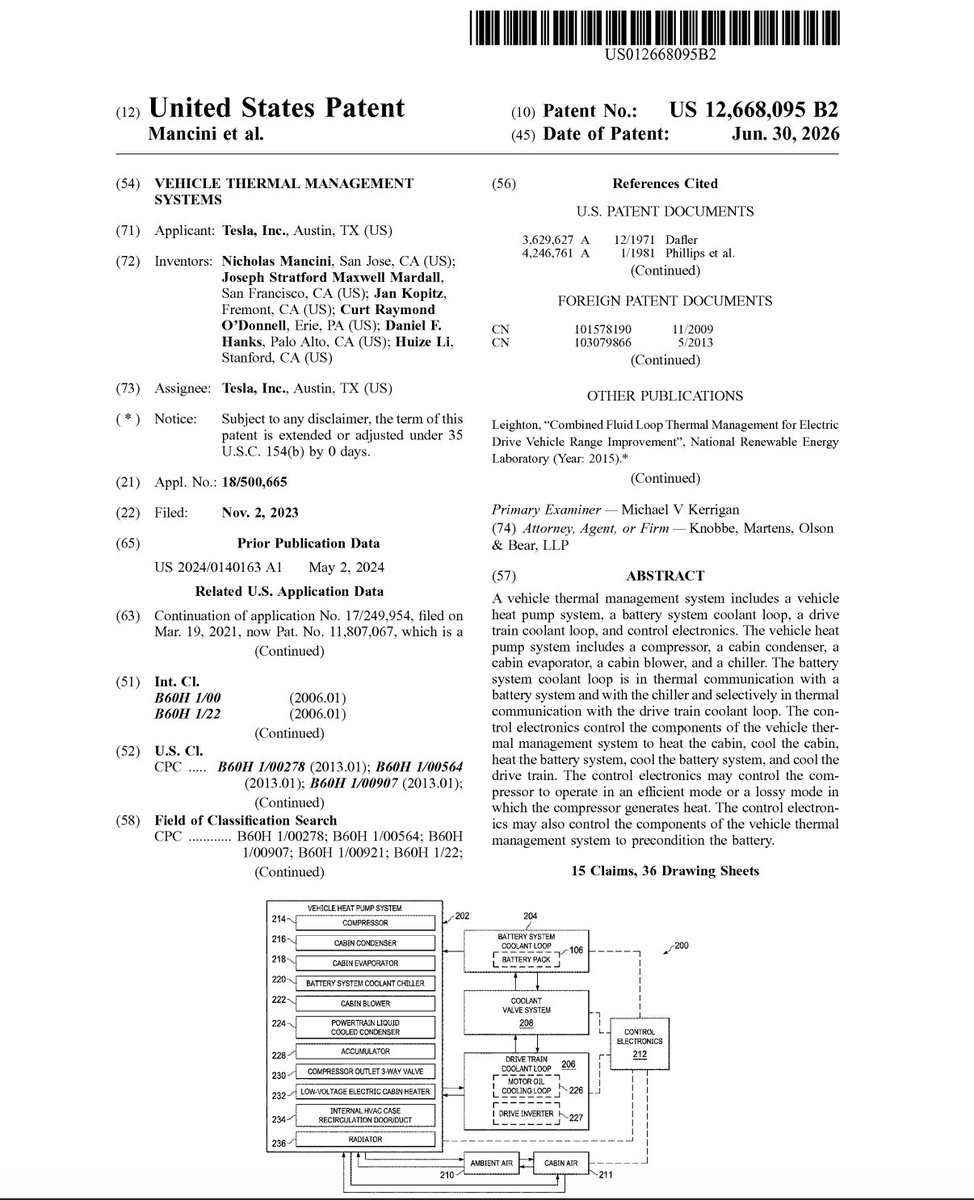
For years, the industry solution has been to cram a massive, range-devouring electrical resistance heater into the cabin. But Tesla has decided to play a completely different game. Published on Jun. 30, 2026, patent US 12668095 B2 unveils a radical architecture where Tesla is no longer just moving heat around. They are trading it.
By treating the car's thermal energy like a highly volatile financial market, this newly detailed system relies on thermodynamic arbitrage to scavenge, store, and seamlessly shift heat exactly where it is needed . The software constantly buys low and sells high, moving low-grade thermal energy from the powertrain, battery pack, cabin, and ambient loops to wherever it is worth more .
But what happens when the ambient air and the battery are simply too cold to provide any thermal energy to trade? This is where the engineering takes a wild and counterintuitive turn. To survive a brutal winter, Tesla engineered this system to intentionally force its air conditioning compressor and blower motors to run in a highly inefficient, lossy state . It is a brilliant blend of high-finance heat trading and intentional mechanical sabotage, turning the electric vehicle's biggest winter weakness into a beautifully solved problem.
To truly appreciate how radical this solution is, we first have to look at the severe energy deficit that created the crisis in the first place.
⚖️ The problem: Heat is a currency electric vehicles lack
An extremely large percentage of the world's vehicles run on gasoline using an internal combustion engine. These standard engines inherently produce a massive amount of waste heat, yielding a free and constant thermal dividend as a byproduct of burning fuel . For decades, traditional automakers simply dumped this surplus energy into the passenger cabin to keep occupants warm.
Because electric motors and batteries are incredibly efficient, they convert almost all their energy into forward movement and produce very little waste heat to spend on comfort. Early electric vehicles relied on massive high-voltage electrical resistance heaters to warm the cabin, effectively liquidating the battery's core energy reserves to directly fund passenger warmth . This acts as a massive drain on the pack's capital and drastically reduces the driving range.
Conventional heat pumps were later introduced as an external broker of sorts, designed to absorb ambient warmth from the outside air and deposit it into the cabin. However, these conventional heat pumps notoriously suffer from low heating capacity in extremely cold conditions . When temperatures plunge to minus 10 degrees Celsius, this outside thermal market completely freezes up, leaving the system bankrupt of energy to harvest in harsh winters.
Facing this stark winter deficit, Tesla realized it could no longer rely on external markets, prompting a complete rewrite of the vehicle's internal economics.
💡 Tesla's solution: A highly integrated trading floor
To overcome these historical shortcomings, Tesla created a unified vehicle thermal management system that acts as a centralized exchange . It connects the vehicle heat pump directly to the battery system coolant loop and the drive train coolant loop.
Instead of treating the cabin, the battery, and the motors as isolated silos holding independent accounts, this architecture uses a sophisticated coolant circulation system to dynamically share thermal energy across the entire car . When the cabin needs heat, the control electronics function as a shrewd investor by scavenging low-grade thermal energy naturally produced by the traction motor and transmission .
The system acquires this cheap, low-level motor heat and leverages the compressor to upgrade that thermal asset into a high-yield return. It ultimately pumps a concentrated surge of warmth into the cabin. If the drive train is currently cold but the heavy battery pack has retained some latent heat, the system can easily pivot to isolate the battery loop . By tapping into this massive physical structure as a stored thermal vault, the car rapidly warms the passengers using previously banked energy rather than spending new electrical capital .
But a trading floor is only as good as the entity running it, requiring an incredibly smart operator to manage these fast-moving energy transactions.
🧠 The brain: Predictive control and thermal economics
The true genius of this system lies in the software acting as the master broker. To balance the competing needs of the vehicle, the system uses a feed-forward predictive optimal control scheme . This functions much like an algorithmic trading bot that anticipates future market conditions rather than merely reacting to current deficits.
It constantly trades the long-term efficiency of the battery against the immediate heating capacity of the cabin using a specialized suite of software modules. These interconnected programs include the Cabin Comfort Module, Range Module, Battery Performance Module, Trip Timing Module, and Heat Pump State Module . Together, they act as dedicated risk analysts evaluating different sectors of the vehicle's energy portfolio. The software operates on a strict hierarchy of transactions. Cabin comfort and battery heating required for propulsion or charging are treated as firm demands that must be met, unless severe range limitations or noise constraints force a market compromise .
The overall system adapts its investment strategy based on meta data, absorbing high-level contextual variables like route duration and weather forecasts to inform its daily trades . For example, if the Trip Timing Module knows you have a short drive, the software will willingly sacrifice long-term battery efficiency . It effectively liquidates thermal capital to prioritize heating the cabin quickly for an immediate passenger payout.
Alternatively, if you are on a long road trip, the system shifts to a conservative growth strategy. It restricts cabin heating slightly, temporarily withholding thermal dividends from the passengers to ensure the battery reaches its optimal temperature . This ultimately compounds those initial energy savings to protect driving range.
While the software acts as the master broker, it still requires a revolutionary physical infrastructure to open the channels and move these liquid assets.
🐙 Hardware marvels: The 8-way valve and super manifold
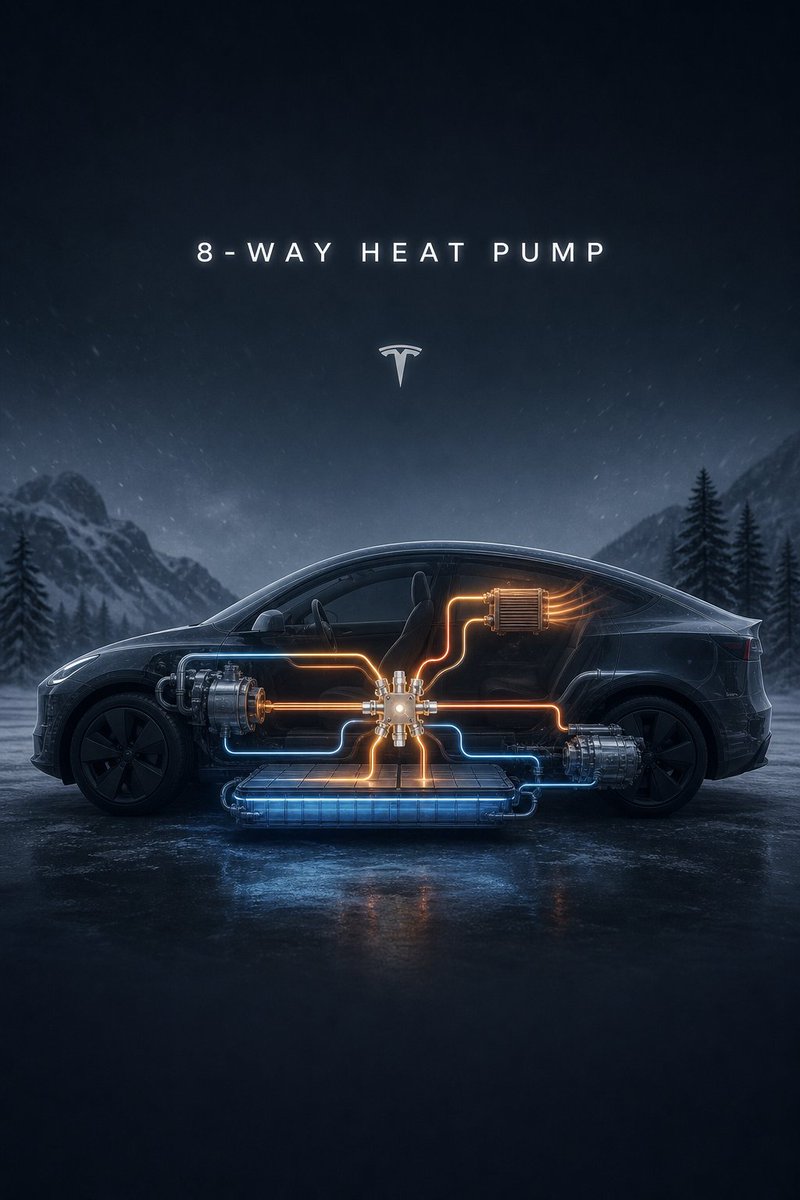
To execute these complex thermal transactions, the physical plumbing has to be incredibly advanced. The patent explicitly describes transitioning from standard coolant valves to an 8-way valve . This acts as a centralized financial clearinghouse that efficiently directs the physical coolant flow. This 8-way valve can be thought of as two independent 4-way valves packaged into a single part, operating to dramatically simplify the physical plumbing .
This single component allows the battery and drivetrain coolant loops to run in parallel, in series, or in partially blended states . By operating this way, the valve functions much like a portfolio manager that can either commingle all available funds to maximize total liquidity, or create walled-off thermal zones to protect specific energy investments when needed . To bypass traditional limitations, the system can execute thermodynamic short circuits to link the hot and cold sides of the system, trading thermal energy across three different working fluids including air, coolant, or refrigerant .
To reduce packaging complexity and keep physical overhead low, many of these individual pumps, valves, and chillers are packed into a single super manifold integration block . Acting as the unified corporate headquarters for all thermal exchanges, this consolidation is a massive manufacturing and engineering win that enables the system to route liquid assets with minimal heat loss and extreme precision.
With the clearinghouse and corporate headquarters firmly established, the system gains the ability to securely store massive amounts of thermal wealth for a rainy day.
🔋 Battery thermal storage: Treating the pack like a thermal vault
Tesla leverages the massive physical weight of the battery pack as an artificial thermal reservoir, offering a staggering 85 watt-hours of thermal storage per degree Celsius . This essentially uses the car's heaviest component as a secure, long-term savings account for heat. The thermal management system can efficiently top up the battery temperature while the car is plugged into a charger or actively driving, steadily banking thermal energy when it is cheap and abundant .
Later on, when cabin heating is required and freezing outside temperatures cause the external thermal market to crash, the heat pump can simply draw down that stored energy. This targeted withdrawal provides highly efficient cabin heating by relying on past investments rather than forcing the car to generate new electrical capital.
The system will even recover high-temperature thermal energy from a warm cabin after you park the car . Instead of letting those valuable thermal assets quietly escape into the cold ambient air, the system automatically transfers that residual warmth back into the battery vault. This ensures your thermal portfolio remains flush for the next departure.
Yet, even the most secure vault can run dry during a prolonged deep freeze, forcing the system to take desperate, high-risk measures to generate emergency capital.
🔥 Heat generation: Forcing inefficiency to create a boiler
When the ambient air and the battery are simply too cold to provide enough thermal energy to trade, the system is essentially facing a total market freeze with 0 liquid assets. In response, the system control electronics can operate the air conditioning compressor and the cabin blower in a lossy mode .
This deliberately executes an aggressive, high-loss strategy to generate capital. By intentionally driving the electric motor of the compressor with a sub-optimal phase angle, the system purposely sabotages its own electrical efficiency . It rapidly burns through power to yield a massive, brute-force return of excess heat.
The patent details an extreme version of this waste heat mode where the system pushes its hardware into a high-stakes liquidation event. It forces the compressor motor and inverter to act as a literal refrigerant boiler, marking the most extreme method of short-circuiting the system . By deliberately overflowing the accumulator, a flood of high-liquid content refrigerant washes directly over the hot compressor motor and inverter . The immense heat from the motor perfectly boils this liquid refrigerant into a vapor right before it enters the scroll inlet .
This high-pressure conversion provides a massive, immediate bailout of heat for the cabin. However, this is an incredibly risky trade. If there is a transient imbalance between the heating and the refrigerant flow rate, the excessive liquid could wash away critical oil films or instantly destroy the compressor, acting as a literal mechanical margin call . By utilizing this extreme compressor boiler mode, Tesla completely circumvents the need to carry a heavy, high-voltage electric heater. The system retains a small low-voltage heater, roughly 1 kilowatt in one example, to help spark the cold-start process .
Once this massive initial bailout of heat is injected into the system, the vehicle immediately shifts focus to protecting that fresh capital from leaking away.
🌬️ Smart air recirculation: Trapping the investment inside
Another clever technique detailed in the document is the use of an internal heating ventilation and air conditioning case recirculation duct to actively protect these hard-earned gains . Instead of constantly drawing in freezing outside air and squandering precious new energy to heat it up, the system can simply reinvest its thermal dividends.
It achieves this by routing a controlled amount of warm exhaust air from the cabin condenser directly back into the cabin blower . This creates a tightly closed thermal loop that functions much like a compounding interest account, allowing the interior to warm up incredibly fast without leaking capital.
Acting as a diligent risk manager, the system expertly balances this internal recirculation with just enough fresh air to prevent the windows from fogging . This ensures the vehicle maintains maximum heating power and portfolio growth without ever compromising passenger safety or comfort.
However, keeping the cabin air heavily sealed inside introduces a dangerous new liability that can completely blind the driver if left unchecked.
🌫️ Advanced moisture control: Defogging and reheating
Winter weather also brings visibility challenges, forcing the system to hedge against sudden external risks using unique moisture control strategies. To defog the windshield without taking on the massive energy debt of drawing in freezing outside air, the system can deliberately and partially freeze the cabin evaporator core .
This action effectively puts the physical moisture into a temporary escrow account. It traps it safely while allowing the system to maintain a tightly closed thermal loop completely insulated from the volatile outside market.
When the system needs to dry the air for dehumidification but the passengers still demand a steady return of warm air, it executes a brilliantly calculated thermal wash trade. It first loops the incoming air through the evaporator to chill and dry it, essentially stripping away the physical liability of the moisture . Then, it immediately pushes that dry air through the interior cabin condenser to reinvest and reheat it. This dehumidification with reheat process ensures maximum passenger comfort and clear visibility without ever squandering precious battery capital.
This ability to hedge against extreme cold is only half the battle, as the exact same trading floor can be inverted to liquidate massive thermal surpluses in the dead of summer.
🏎️ Extreme cooling: Supercharging and track modes
While the winter heating tricks are an impressive display of generating capital out of thin air, the patent also outlines brilliant cooling modes designed to manage massive thermal surpluses during summer and high-load scenarios .
If you are supercharging in extreme ambient conditions like 43 degrees Celsius, the vehicle's standard radiators might not possess enough bandwidth to liquidate the excess thermal liabilities building up in the battery . In this scenario, if the cabin is empty, the system can actually execute a massive off-book transfer. It dumps the excess battery heat directly into the passenger cabin via the cabin condenser .
By running the blower at full speed and drawing in a fresh global cabin air state to flush the interior, the car rapidly offloads this thermal strain into the open market . This allows the battery to safely maintain its peak charging rates without interruption. Similarly, under heavy performance demands like track driving or steep hill climbing, the system can temporarily borrow against the cabin's cooling capacity. It redirects liquid assets to prevent the high-stress motors and inverters from defaulting and overheating .
Zooming out from these intense high-load scenarios reveals a blueprint that fundamentally alters the financial and operational future of the company.
🚀 How this patent contributes to Tesla's now and future
This patent firmly cements key inventions like the 8-way valve, the super manifold, and the compressor boiler mode as the foundational infrastructure of Tesla's ongoing energy dominance. By effectively mastering thermodynamic arbitrage, Tesla has eliminated the need for a dedicated high-voltage cabin heater . Removing this bulky component clears unnecessary physical weight. For a global fleet numbering in the millions in 2026, liquidating this single physical liability yields a billion-dollar-class component-cost opportunity at fleet scale while significantly simplifying the assembly process.
For the consumer, this technology directly translates to protecting their driving range portfolio. Traditionally, heating an electric vehicle cabin consumes approximately 10% of the total energy available, but in freezing conditions around 0 degrees Celsius, that energy tax can spike to 25% or more . While old resistive heaters trade at a flat 1 to 1 ratio, Tesla's heat pump generates a return of 1.5 to 5 times the useful heating power for every unit of electricity spent . Real-world fleet data in 2026 shows that while average electric vehicles routinely lose 20% to 30% of their range in freezing temperatures, the 8-way valve's smart routing can claw back a meaningful share of the heating-related loss.
Furthermore, the intentional lossy compressor boiler mode ensures that even when temperatures plummet and the system defaults to a 1 to 1 efficiency ratio, the vehicle can still force up to an additional 50% surge in raw heating power simply by manipulating the refrigerant's vapor quality down to 0.8 .
Looking ahead, as Tesla aggressively scales its next-generation platforms like the Cybercab and the Semi, these exact thermal management strategies will be absolutely critical. Smaller, cost-constrained autonomous vehicles like the Cybercab benefit immensely from the low cost and compact packaging of this system. Meanwhile, massive hauling platforms like the Semi require the high-load thermal control provided by the extreme cooling modes to keep their powertrains from overheating under stress.
By guaranteeing that every drop of waste heat is banked and reinvested, this patent ensures Tesla's future platforms will remain financially viable and maximally efficient, regardless of how cold the market gets.
@dhaval_shroff I learned from Isaacson’s book that you were the visionary that advocated for a neural network approach. Congratulations on changing history