Business Owner. YBF Performance consultancy services. Working with performance orientated athletes and practitioners in sport and business - see Linkedin
The step up is one of the lower body exercises we use most frequently because I think it’s an incredibly valuable way to train quasi unilaterally.
There are so many ways to progress or regress it, manipulate joint angles and loading, or incorporate it into contrast training.
40 7th grade girls learning to RDL in just under 20 minutes.
Watch this whole video.
Feet under hips
Calves on bench
Break at the knee
Flat tight back
Butt back until hammies stop you
Bar touching all the way down and up
Or bar touching head, t spine, and rear
Then real RDL
If you’re slow, that ends today!
You just need the right exercises
Save these & go get fast!
10 of my fav non sprint exercises to build speed
1. Bounds/hops
2. Loaded SL broad jump
3. Dynamic rack pulls
4. Heavy sled pushes
5. Drop jumps
6. Sprinter ISO pulls/pushes
7. Heavy trap bar dead
8. Dynamic partial ROM split squat
9. Sprint sled drivers
10. Depth to broad jump
If I wanted to get an athlete noticeably faster in the next 12 months
These are the 10 non negotiables we’d program
Every damn week…
Save this must, use it:
1. Hill sprints
2. Loaded 10 yard sprints
3. Maximal 10 yard sprints
4. Flying 15 yard sprints
5. 40-50 yard sprints
6. Box/broad jumps
7. Pogo jumps
8. Depth landings
9. 2 heavy compound lower body lifts
10. Heavy sled drag or push
If you’re only doing conventional broad jumps and vertical jumps in your training…
You’re missing out on serious athleticism
Here are the 12 best variations I use with my athletes to build real, 360-degree explosiveness
Save this
Most athletes stay one-dimensional because they never train multi-planar explosiveness
The horizontal, lateral, and rotational power that actually transfers to first-step quickness, cuts, and game speed.
Add 2–3 per lower body or speed session.
Which one are you adding first?👇
Sprinting has always been the ultimate plyometric to me.
High forces + short ground contacts.
In the recent paper, they compared sprint vs some plyos and found sprinting produced ~2.0x bodyweight in average vertical GRF, compared to ~1.65x BW in the drop jump condition, with
Soviet sport scientists spent decades trying to solve one problem…how do you take the strength you build in the weight room and actually get it to show up in competition?
Their answer was the bridge. General means build the foundation and Special strength exercises carry
13 REAL plyometrics for athletes!
1. Band assisted pogo jumps
2. Drop jump into band accelerated vertical
3. SL vertical into SL broad
4. Repeat SL broad jump
5. Triple hurdle jump
6. SL drop jump
7. Standard drop jump
8. Drop jump to vertical jump
9. Depth jump
10. Depth jump to broad jump
11. Box “double jump.”
12. SL drop jump to SL broad jump
13. Hurdle to box jump
Learn the “Wall Drill” in 60 seconds! 🧱⏱️
For Sprinters: This is the secret to ground reaction time and quick-twitch power. Perfect for mastering those start block angles and building elite stability.
For Every Athlete: Your bones and tendons need a workout too! Bone density depends on "impact" signals like plyos. If you don't challenge your frame, it won't stay strong. 🦴✨
Simple drill, massive results! 👏👏
Box Squats are one of the most effective Squat patterns for Athletes…
1. Enhanced Neural Drive
2. Faster Recovery
3. Greater Rate of Force Development
4. Consistent Range
5. Greater Stability
Box Squat heavy and often!💪🏻📈
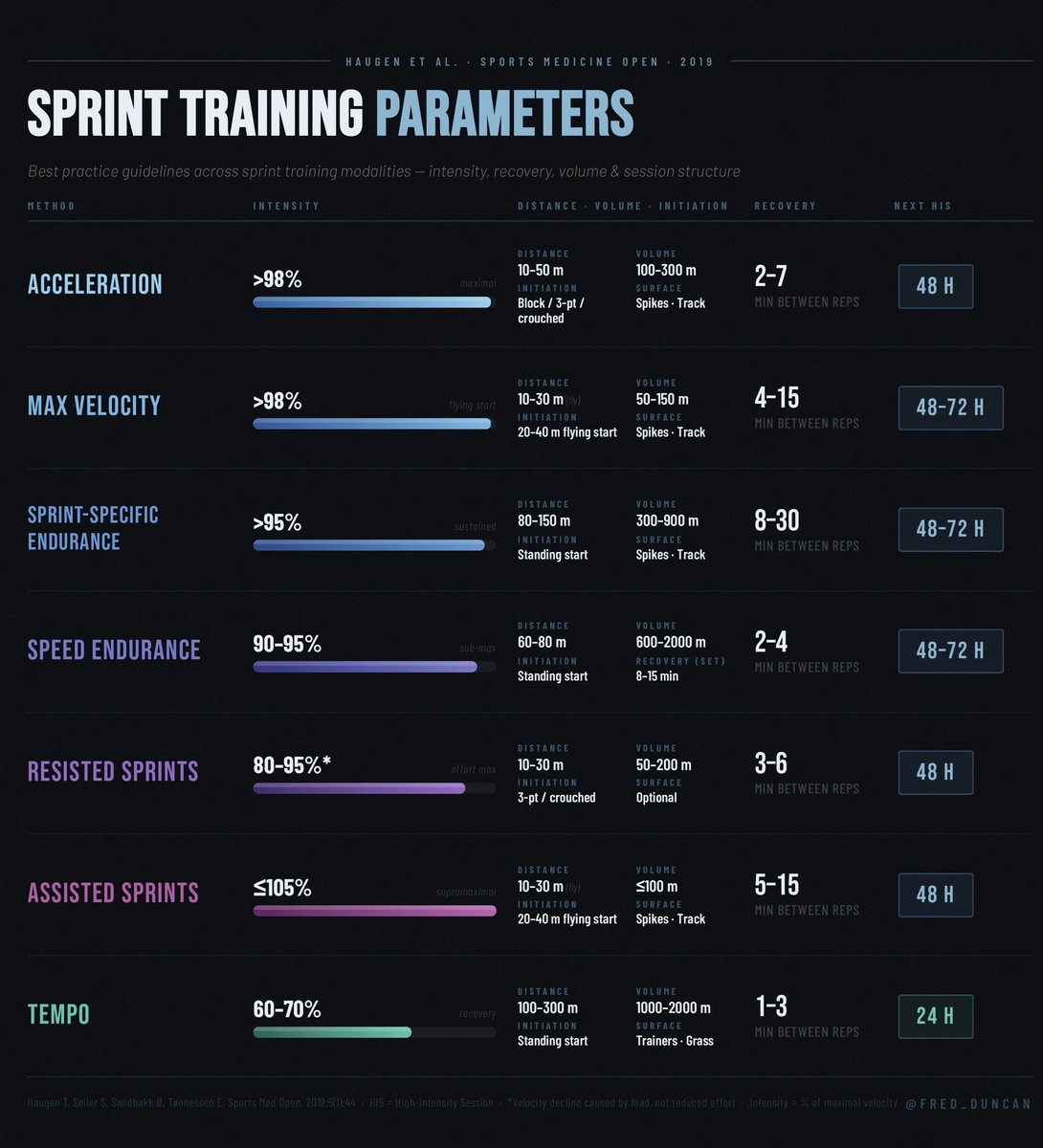
Elite sprint development requires real structure.
Specific intensities, volumes, and recovery windows that produce the right stimulus and the adaptation that follows.
This is from Haugen et al, laying out the key parameters behind what elite sprinters actually do. It’s a great