Let me confess: there is a crack in my chest
It quakes the walls of the home
where my heart lives, thundering through me,
shaking the foundation I once thought unshakeable.
.…
mathematics is not just symbols.
it is language for compressing structure.
> numbers
> sets
> functions
> spaces
> limits
> transformations
we understand them by building mental bridges between ideas.
how we understand mathematics by jacek woźny
looks at how mathematical meaning forms through conceptual integration.
the important idea:
math is not only calculation.
it is metaphor, abstraction, language, and mental modeling working together.
> a line becomes a function.
> a function becomes a machine.
> a space becomes a set of possibilities.
> a proof becomes a path through logic.
most people struggle with math because they only see notation.
real understanding begins when symbols turn into concepts you can move around in your head.
It is dangerously easy to build a neural network today without actually understanding how it works.
We live in an era of 'import torch'. You can train a model in three lines of code, but the moment you need to debug a collapsing loss function or a vanishing gradient, syntax won't save you. You need first principles.
I recently went through this notebook collection by Simon J.D. Prince, and it is the antidote to tutorial hell.
Instead of just showing you the code, it forces you to visualize the mechanics:
1./ The Math => It builds the intuition for shallow networks and regions before adding complexity.
2./ The Optimization => It doesn't just use an optimizer; it compares Line Search, SGD, and Adam so you see why they behave differently.
3./ The Modern Stack => It connects the dots from basic backpropagation all the way to Self-Attention and Graph Neural Networks.
Move from running code to engineering systems => this is a goldmine.
"The USSR Olympiad Problem Book"
320 unconventional problems in algebra, arithmetic, elementary number theory, and trigonometry.
Archive link: https://t.co/4FtwIV9BF9
I first met Clark Reynolds when he was just three years old at our Black History Month reception at the White House.
Over the last ten years, it's been wonderful getting updates about his life through his letters. Check out how he’s doing now:
@chetaslua@GeminiApp Check second 4 and second 5 on the video. The instructor places a half square around 1. And in next shot that half box is gone.
The symbols look correct but Fin integral (x)=1/sqrt(x)=0 is nonsense.
So good, not great.
The most important equation in statistics is the Normal Equations AᵀA x̂ = Aᵀb. It's the foundation of linear regression.
Professor Gilbert Strang, MIT.
This works really well btw, at the end of your query ask your LLM to "structure your response as HTML", then view the generated file in your browser. I've also had some success asking the LLM to present its output as slideshows, etc.
More generally, imo audio is the human-preferred input to AIs but vision (images/animations/video) is the preferred output from them. Around a ~third of our brains are a massively parallel processor dedicated to vision, it is the 10-lane superhighway of information into brain. As AI improves, I think we'll see a progression that takes advantage:
1) raw text (hard/effortful to read)
2) markdown (bold, italic, headings, tables, a bit easier on the eyes) <-- current default
3) HTML (still procedural with underlying code, but a lot more flexibility on the graphics, layout, even interactivity) <-- early but forming new good default
...4,5,6,...
n) interactive neural videos/simulations
Imo the extrapolation (though the technology doesn't exist just yet) ends in some kind of interactive videos generated directly by a diffusion neural net. Many open questions as to how exact/procedural "Software 1.0" artifacts (e.g. interactive simulations) may be woven together with neural artifacts (diffusion grids), but generally something in the direction of the recently viral https://t.co/z21CP5iQfu
There are also improvements necessary and pending at the input. Audio nor text nor video alone are not enough, e.g. I feel a need to point/gesture to things on the screen, similar to all the things you would do with a person physically next to you and your computer screen.
TLDR The input/output mind meld between humans and AIs is ongoing and there is a lot of work to do and significant progress to be made, way before jumping all the way into neuralink-esque BCIs and all that. For what's worth exploring at the current stage, hot tip try ask for HTML.
LLM Wikis + HTML Artifacts are insanely powerful.
You should seriously consider this in your workflows.
LLM Wikis captures all the important information that lets you and your agents do meaningful work.
HTML artifacts present that information in interesting ways that allow you to take important actions along with your agents.
My HTML artifacts sit on top of my LLM wikis. They are dynamic and are easily extended as needs arise.
I have hooked my Artifacts to talk to my agents, and similarly, the agents can talk to artifacts.
This has allowed me to build powerful artifacts that reduce my inbox to zero, keep me updated on any topic of interest, fast prototyping, do deep research, design/trigger new experiments, generate figures to improve understanding, schedule research, search relevant information, discover topics, and so much more.
What you see in the clip is not a website. It's a simple interactive HTML artifact.
HTML artifacts are useful for designers, engineers, researchers, students, and anyone working with agents.
Lastly, HTML doesn't replace Markdown. They are a much better combination working together.
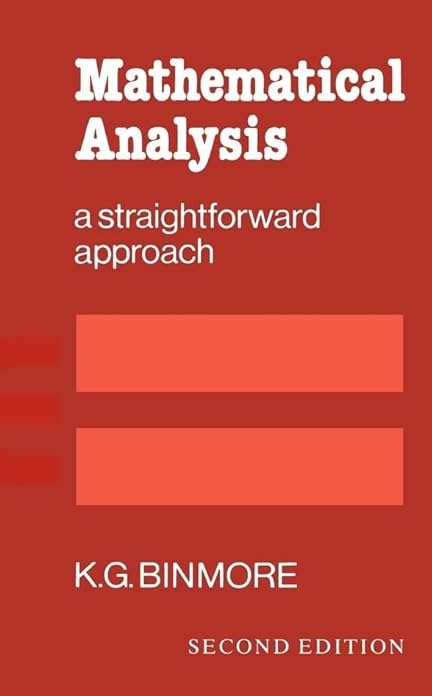
This, by the great game theorist Ken Binmore, is all I ever needed.
More analysis than you need for MWG, Varian, daddy Kreps.
A math textbook in the liberal arts tradition, a joy to read and reread.
A Lens That Takes Derivatives
US Patent Basis: US8610839B2 - Optical Processing System for Computing Derivatives.
In a 4f Optical Processor, the first lens takes the incoming field and forms its Fourier spectrum. At that middle plane, a tiny optical mask multiplies the spectrum by iξ. This is the derivative operator written in Fourier language
u(x) -> U(ξ) -> iξU(ξ) -> ∂u/∂x
Then the second lens brings the field back to the real space. What comes out is no longer just a focused beam. It is the spatial derivative of the input field, computed by light as it propagates.
So, this is the serious promise of optical computing. A physical optical train can perform operations that usually live inside numerical code: differentiation, filtering, convolution, edge detection, correlation, and many other linear transforms.