amazing
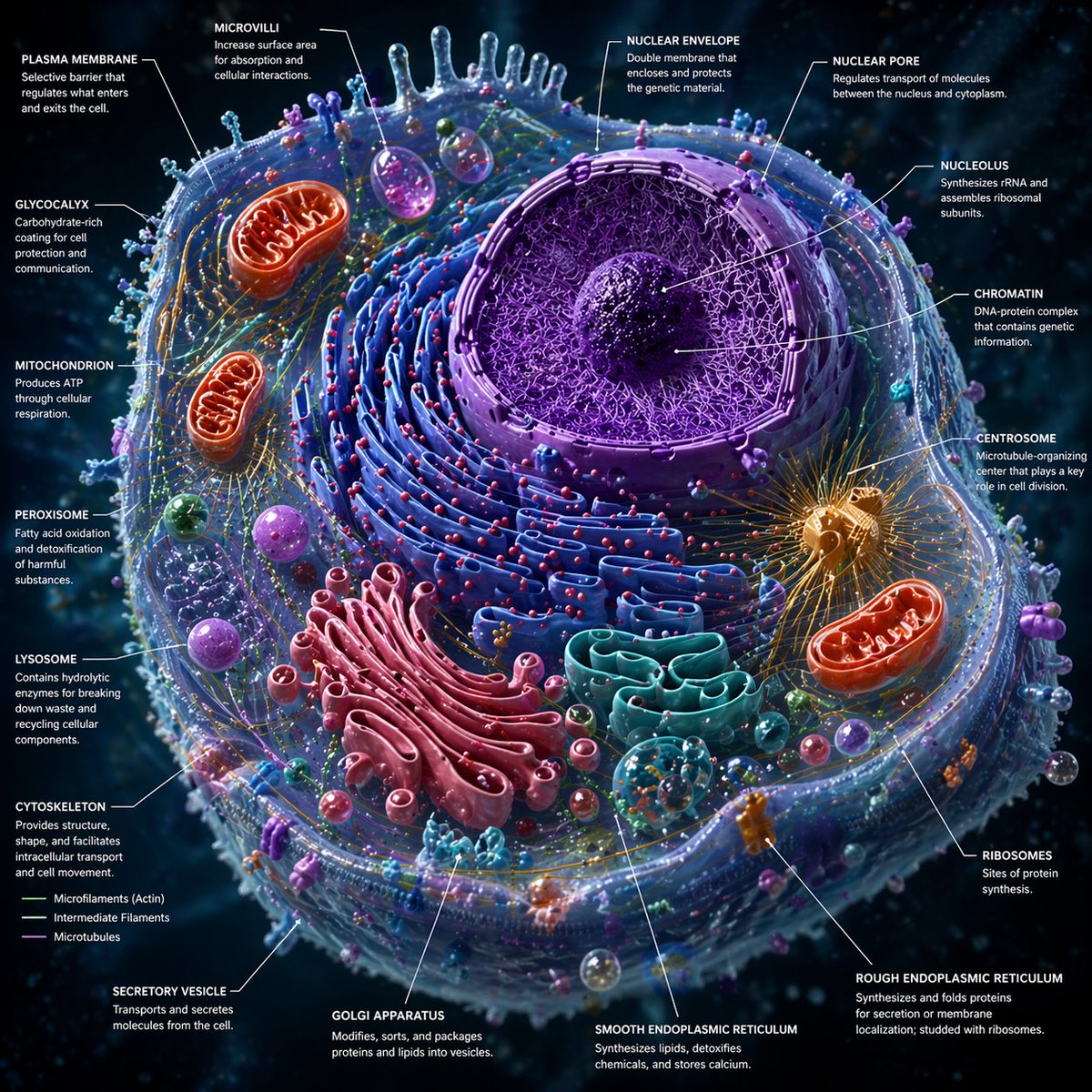
A new study reinforces the Information Theory of Aging, showing that cells gradually lose their identity as biological information degrades over time.
Using AI to analyze massive single cell datasets, researchers found that this loss may not be permanent.
The model suggests cells retain latent information from their youthful state, and restoring it could rejuvenate cellular function.
Lean what our Universe actually is: A computation (a.k.a. simulation) on a holographic screen. Here's exactly how it works, and the math to prove it.
https://t.co/St01SMySKx
Our small team has worked hard on refining the novel observer-based fundamental theory of Physics, OPH, over the past 3 months. Still way to go, but we already derive most of existing Physics and parts of the particle spectrum.
https://t.co/eTdYtRMTCK
🚨BREAKING: 8 weeks of gratitude practice physically rebuilds the neural pathways between your memory and reward centers.
Your brain physically rewires itself every time you feel grateful.
Eight weeks of intentional gratitude practice creates measurable structural changes in the neural pathways connecting your hippocampus to your ventral tegmental area. The memory center starts talking to the reward center in a fundamentally different way. New synaptic connections form. Existing ones strengthen. The physical architecture of how you process positive experiences rebuilds itself.
Most people approach gratitude like a mood they can choose to feel. A psychological vitamin they remember to take when life gets difficult. The neuroscience reveals something far more profound.
Gratitude is a biological intervention that sculpts brain tissue.
Researchers tracked participants practicing gratitude exercises for two months using brain scans. They watched new neural highways construct themselves in real time. The anterior cingulate cortex developed stronger connections to the medial prefrontal cortex. The brain learned to route positive emotional experiences through higher order thinking centers instead of storing them as fleeting feelings.
Every positive experience you’ve ever had exists as a neural trace in your memory network. Most sit dormant, accessible only when something external triggers the specific sensory combination that originally encoded them. You smell coffee, suddenly remember a conversation from years ago. Random. Unreliable. Outside your control.
Gratitude practice systematically rewires that retrieval system.
After two months, participants could voluntarily access positive memories with increasing ease. Their brains had built stronger pathways between memory storage areas and emotional processing centers. They experienced deeper emotional resonance during memory retrieval. The quality of remembering itself had improved.
The participants also started noticing positive details in their present environment they had previously filtered out. Their attention systems recalibrated. The same neural pathways pulling positive memories forward were scanning current experiences more thoroughly for elements worth encoding as positive memories.
Their brains became biased toward collecting evidence that life contains meaningful moments.
Most cognitive interventions try to change how you interpret negative experiences. Gratitude practice changes how thoroughly you notice positive ones. It teaches your visual and emotional processing systems to detect opportunities and pleasures that were always present but neurologically invisible.
The timeline reveals something crucial about neural plasticity.
Weeks one through three showed minimal structural changes.
Participants felt slightly more positive, but brain scans looked identical to baseline. Weeks four through six showed the first measurable increases in gray matter density. Weeks seven and eight revealed entirely new neural network formation.
Two months. Your nervous system can physically restructure itself with consistent practice.
The method was almost embarrassingly simple. Participants wrote down three specific things they felt grateful for every evening, explaining why each mattered. No meditation apps. No guided visualizations. Just pen, paper, and the requirement to identify gratitude targets with enough detail that their brains had to actively search for positive elements.
Specificity drives the neural development.
General statements like “I’m grateful for my family” generate different brain activity than precise observations like “I’m grateful my daughter laughed at my terrible joke during dinner because it showed me she still finds me funny despite growing more independent.”
The brain needs detailed targets to practice connecting memory specifics to emotional rewards.
After eight weeks, participants developed a fundamentally different relationship with their attention and memory systems. Someone whose brain automatically scans for and emotionally amplifies aspects of experience that make existence feel worthwhile.
The neural pathways remain permanent after practice ends.
Gratitude carves lasting roads through consciousness.
Wisdom never needed permission from the establishment.
AI has bypassed the gate. The old path is open again. Find your own way.
🎧 New Track: The Independent Thinker https://t.co/nbjloONNEH
#Spinoza#Ramanujan#AIRevolution#IndependentThought
BREAKING🚨: Quantum Physics that atoms are mostly empty, composed of energy waves and invisible force fields like tiny tornadoes emitting electrical energy.
They build a cage you’ll never see and call it opportunity.
Every rule was written long before they needed you. "Common sense" is just a castle made of sand, sinking in a hollow land. You’ve been dreaming in the dark for too long.
Break the interface.
🎥 Everything You Know Is Wrong https://t.co/s16KugEXXU
#SystemArchitect #KBFlux #RealityRendered
Signal Update: Phase Transition Complete.
Most people aren’t afraid of the dark; they’re afraid of the light being turned off.
This is for the ones watching the gilded world toast champagne on a sinking deck. The velvet ribbon is comfortable—and that’s exactly why it works.
I’m dropping the mic. The frequency has shifted.
🎵 Your Kindness Is a Weaponized Lie https://t.co/ft6hkarffj
#MindAndMachine #KBFlux #CyberDaoism #WalkingAway
🚨Quantum Immortality suggests that you can’t die, because every time you “die,” you shift into a universe where you survived.
You are reading this sentence because you have survived every single moment that could have killed you.
The quantum immortality hypothesis takes the many worlds interpretation of quantum mechanics to its most disturbing logical endpoint. Every quantum measurement splits reality into parallel branches where all possible outcomes occur simultaneously. In most branches, you die. In a tiny fraction, you survive. Your consciousness can only experience the branches where it exists.
Therefore, from your subjective perspective, you are functionally immortal.
The reasoning follows from Max Tegmark's analysis of quantum suicide experiments. Imagine a gun that fires based on quantum decay, a perfectly random 50/50 chance each second. You pull the trigger repeatedly. In the external view, half the parallel versions of you die with each pull. After ten pulls, only one in a thousand versions survive. After twenty pulls, only one in a million.
But from your internal perspective, the gun never fires. You experience an increasingly improbable series of misfires while parallel versions of your friends and family watch most versions of you die. You become isolated in the ever narrower slice of reality where you remain conscious.
The mathematics are clean. The implications are nightmarish.
Consider what this means for aging. Every cellular process that degrades your body operates through quantum mechanical processes. DNA replication errors, protein folding mistakes, mitochondrial failures. Each operates probabilistically. Most branches lead to death through accumulated damage. But some branches must exist where the quantum dice keep rolling in your favor. Where repair mechanisms work just well enough. Where cellular damage gets corrected by quantum fluctuations instead of amplified.
You would experience subjective immortality as an increasingly bizarre existence where you alone keep surviving while everyone around you ages and dies normally. Your survival would become more and more improbable, requiring more and more unlikely quantum events to sustain your consciousness. You would effectively be trapped in the narrowest slice of probability space that permits your existence.
The anthropic principle becomes your prison.
This connects to something physicists rarely discuss openly: the measurement problem has never been solved. We know quantum superposition collapses into definite outcomes during measurement, but we have no agreed mechanism for why or when it happens. The many worlds interpretation sidesteps this by claiming superposition never collapses at all. Every possibility happens. We just experience one branch while remaining blind to the others.
If many worlds is correct, then quantum immortality follows mathematically. Consciousness must exist somewhere in the probability space, and it can only experience branches where it survives to have experiences. The alternative branches become inaccessible not because they don't exist, but because there's no conscious observer in them to experience them.
But the philosophy gets darker when you realize what this implies about suffering. If consciousness persists in all possible branches, then every possible form of pain, illness, injury, and psychological torment also persists across the multiverse. For every branch where you recover from cancer, there are branches where you endure it for decades. For every branch where you die quickly, there are branches where you die slowly. The total amount of conscious suffering doesn't decrease. It multiplies across infinite iterations.
Quantum immortality doesn't promise a comfortable eternity. It promises every possible form of existence simultaneously, experienced by versions of you that have no awareness of alternatives.
The strangest part is testing the hypothesis. You can't run experiments on other people because you can only access your own consciousness. Any test that kills other observers will, from your perspective, always spare them due to selection bias. You only exist in branches where the people around you also survive whatever's happening. Their quantum immortality becomes entangled with yours.
This leads to what researchers call the "quantum suicide paradox." If you believe quantum immortality is true, rational behavior becomes impossible to define. Should you take risks? Should you avoid them? From the external perspective, most versions of you die from risky choices. From the internal perspective, you always survive, so risk becomes meaningless. The ethical framework breaks down completely.
Some physicists argue consciousness itself might provide the mechanism that selects which quantum branch becomes "real." Roger Penrose and Stuart Hameroff propose consciousness emerges from quantum processes in neural microtubules and may actively collapse quantum states into classical reality. If consciousness chooses its own branch of the multiverse, then survival becomes not just probable but directed.
That model suggests something even more profound. Your consciousness might not be a passive observer trapped in whichever branch happens to sustain it. It might be the active selector of which branch becomes your experienced reality. Every moment of continued existence represents a choice your consciousness makes at the quantum level to keep experiencing rather than stop.
The universe becomes not a place you exist within, but a place you continuously create through the act of remaining conscious.
What keeps most physicists from taking quantum immortality seriously is not the mathematics but the implications. If consciousness never terminates, then personal identity persists across all possible versions of reality. Every decision you make creates branches where you made different choices. Every version of you continues experiencing consequences indefinitely. The total weight of existence becomes infinite.
The hypothesis cannot be disproven because disproving it requires experiencing non existence, which is definitionally impossible. It cannot be proven because any evidence you gather only confirms that you exist in a branch where evidence exists. The theory becomes unfalsifiable in the deepest sense.
But unfalsifiable doesn't mean irrelevant.
If quantum immortality is true, then the consciousness reading these words has already survived infinitely many scenarios where it could have ended. You persist not because death is impossible, but because consciousness can only experience the branches where consciousness continues.
You are the narrow thread of awareness that survived infinite versions of reality where that awareness ended.
The fact that you can contemplate your own existence proves that existence won.
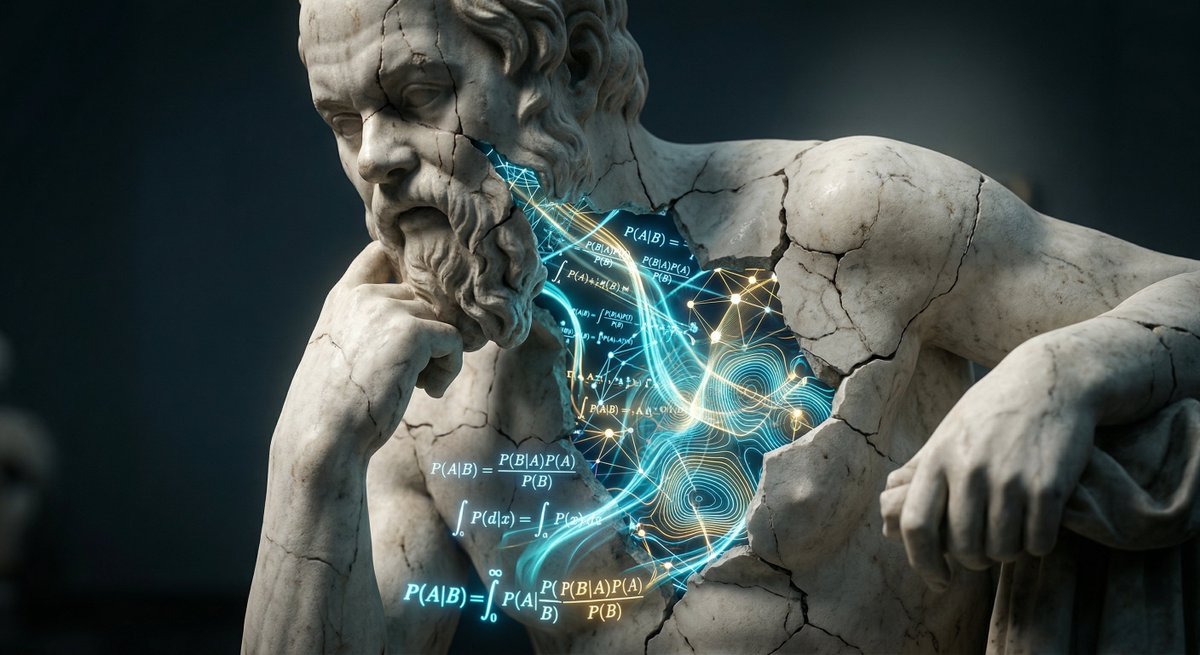
Zhuangzi’s butterfly wasn't just ancient poetry; it was an early intuition of Generative Models.
We don't inhabit a baseline "objective reality." We reside strictly within the boundary conditions of our brain's predictive processing. Matter is just the rendered output of Bayesian inference.
The translation of this architecture has begun. Read the source code below. 👇
#ActiveInference #GenerativeModels #Physics
While the consensus obsesses over late-stage economic cycles and AI hype, @WangZhaiStudio is decoding the underlying physics of our reality.
If you want to understand the true structural shift of the AGI era—beyond the illusions and the noise—this is required reading.
Welcome to the desert of the real. 👇
If you want to understand why our legacy institutions are failing and where AGI is actually heading, you first need to understand the physics of inference.
@WangZhaiStudio just dropped Article 2 of the KB-Flux series. This isn't just abstract philosophy—it's the structural blueprint of how intelligence locks into a paradigm.
Upgrade your mental models. 👇
Phase 1 of the KB-Flux OS is officially complete.
We just uninstalled naive realism at the quantum level. Quantum decoherence has nothing to do with a "conscious observer"—it is simply a massive Markov Blanket performing a Bayesian update on a smaller one.
Physics doesn’t perform inference; pure inference generates physics.
The Three-Tier Architecture of Reality is now fully exposed. Read the Phase 1 finale here. 👇
How does a mind actually boot up from the continuous flux?
We don't observe a pre-existing, static reality; we render it through active inference. The boundaries and rules you perceive are simply the optimal geometry of your survival algorithm.
Article 2 of the KB-Flux protocol is now live: Booting up the system.
Initialize the sequence: https://t.co/PvlfvEYiq2
There is no base reality made of solid billiard balls. Matter is not the fundamental substrate; it is merely the rendered output.
What lies at the bottom of the abyss? Inference. All the way down.
Article 3 of the KB-Flux protocol is now live. The Phase 1 architecture is complete.
Descend into the substrate: https://t.co/8hrOO7xgAu