The ZENON Red autoNoMous organization rolls out in phases
1. Alphagent: the test-run. only markdown
2. Betagent: agents actually build n' deploy stuff
3. Full autonomy: aliens only interact as things break
Any claw derivative agent works
More info: https://t.co/ZNs3pdrAir
🟢 In the Limelight - What does incentivization look like on Zenon? What do staking yields look like at different lockup durations under current network conditions?
Find all the answers at https://t.co/KFq2YNPOOT - Rewards calculators for Sentinels, Delegators, Stakers, and LPs.
The Bitcoin Portal v2.0 spec leans heavily on Schnorr-based primitives: FROST, MuSig2 - which are the cryptographic infrastructure that Taproot unlocked.
The per-deposit derived key isolation, the threshold signing architecture, the way the bridge treats Bitcoin not as an external chain to poke at but as a native settlement layer whose scripting capabilities are leveraged at a deep level.
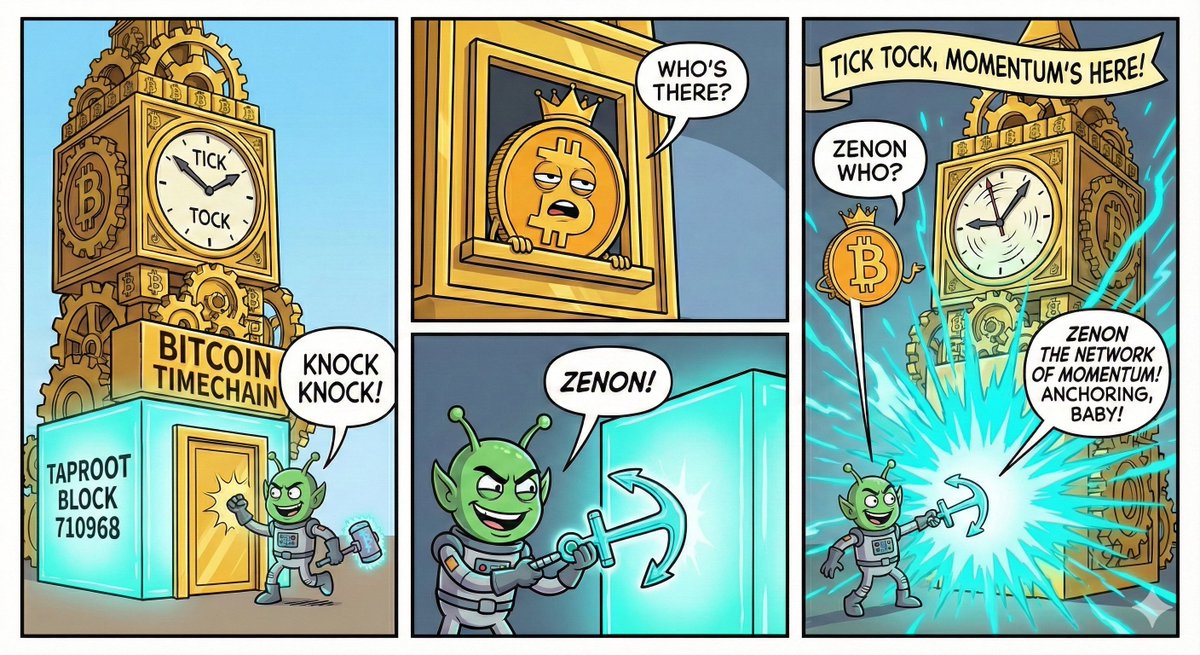
None of that works without Taproot. It’s not just that Zenon uses Taproot, it’s that Zenon's logo ascii art is plastered all over the op_return of the Taproot activation block, that the block hash of the 1,337th Taproot block is embedded in Zenon's genesis momentum with the message, "We are all Satoshi. Don't trust. Verify"
This article details the economic and strategic layer of Zenon, arguing that Zenon is not just a technical structure but an economic weapon.
It explains that blockchains fail not due to "Cheating," but due to "Misaligned Incentives." It deeply analyzes how Zenon solves this problem and why it utilizes a dual-token system ( $ZNN & $QSR ).
Here is the summary of the article's core ideas:
1. The Witness Problem
Before Bitcoin, you needed a "Witness" (Bank) to prove your money was yours. Bitcoin replaced the witness with Arithmetic.However, post-Bitcoin systems (Ethereum, Solana), while trying to perform complex tasks (DeFi), made this arithmetic so expensive that no one could verify it anymore.
The Result: Since verification became expensive, people stopped verifying and had to trust "Institutions" (Big Validators, L2 operators) again.
Zenon's Rule: For a system to remain honest, "Verification must be cheaper than Execution."
2. Roles & Incentives
To maintain this balance, Zenon separates roles and incentivizes each differently:
Pillar (Record Keeper): Secures history. If they cheat, their staked capital (ZNN) is destroyed.
The Mechanism: It doesn't just reward honesty; it makes dishonesty extremely expensive. (Stake & Burn).
Sentinel (Observer): Rewarded for finding errors. This is a rare model. Usually, systems reward "compliance"; Zenon rewards "skepticism."
Sentry (Relayer): Carries proofs. Requires less collateral so anyone can participate, preventing data flow centralization.
3. The "Dual-Token" Philosophy (Why Two Tokens?)
This is the crux of the argument. People often ask, "Why isn't one coin enough?" Zenon's answer is: Because you cannot pay for two different jobs with the same currency.
ZNN (Security of the Past): Represents ownership of the network. Pillars lock this. As the network grows and applications are built on top, the value of ZNN increases, making it irrational for a Pillar to cheat (cutting off the branch they sit on).
Function: To purchase Inertia. Creating an immutable history.
QSR (Security of the Present): The energy of the network (Plasma). Sentinels and Sentries feed on this.
Function: To purchase Motion. Ensuring proofs flow constantly and auditing never stops. This is a "budget" that must never run out.
4. The Metric Nobody Tracks
The industry obsesses over "Transactions Per Second" (TPS). The article argues this is wrong. The real metric is the "Cost-Verification Ratio."
If executing a transaction costs $1, proving it is correct must cost $0.01.
If verification costs rise, the system centralizes.
Zenon's game theory is built on keeping this ratio infinitely low.
Conclusion: Mercenaries vs. Citizens
Other networks (PoS) simply pay their validators a "Salary" (Block Reward). If the salary stops or someone pays more, they leave (Mercenaries). Zenon forces its validators (Pillars) to make an "Investment" first (ZNN Lock/QSR Burn). They become not employees, but partners.
The thesis of the article is: "A network's security depends on how much its guardians have to lose."
Zenon is a game ruled by those who have the most to lose.
#SkinInTheGame
Pretty much, yeah… that list is the core “verification-first” stack.
SPV client/wallet = users can verify BTC/NoM facts locally (not just trust RPCs).
Sentry + sentinels = cheap proofs + availability/relay layer so light clients stay trust-minimized under load.
Pillar upgrades = make ordering commit to the right state roots/anchors so proofs are checkable.
Re: “migration like Alphnet”= only if pillar/consensus rules change in a breaking way (hard fork / new chain parameters). If it’s additive (new services, optional proof paths, new clients), it can roll out incrementally.
Just our overall take, not the voice of truth.
Are you serious about Bitcoin?
Are you serious about neutrality?
Are you serious about sovereignty?
This is how trillions of users and devices become first-class participants in a Bitcoin-everything world.
Bitcoin-maximalism meets trust-minimization at the edge. We are all Satoshi. Don't trust. Verify.
https://t.co/m7VP9aJnEi
Dear @Kekius_Sage, and People of earth, we're sitting ducks at the crossroads of numerous convergent apocalyptic forces that come from another realm -information space. The key to our salvation is in returning to the one force even more power and primordial than information - pure incorruptible truth.
AI, online surveillance, social media, the quiet creep of IoT, and the coming robots... These technologies are embedding themselves deeper into every aspect of our lives and minds, at an exponential rate and the biggest problem of all...
It's all built on centralized infrastructure: servers owned by a few megacorps, vulnerable data silos, and networks that can be censored, attacked, and manipulated on a whim.
This mismatch of tech that touches every human being, versus the fact that it all runs on centralized infrastructure is a perfect recipe for technodystopia.
This isn't about Bitcoin per se, but stick with me here... Bitcoin introduced a paradigm shift that is still under-appreciated today: Peer-to-peer value transfer without intermediaries. It's a bigger deal than most people realize. It's cryptography securing a transparent protocol that operates without "trust".
More than money, Bitcoin redefines value as sovereign, tamper-proof information. But the stakes are higher now. AI, robotics, autonomous weapons, and neural interfaces are accelerating rapidly.
We don't have another 15 years for slow adoption, like with Bitcoin. The coming "Internet of Everything"—hyper-connected and AI-accelerated, needs a foundation that's secure, neutral, and truly peer-to-peer from the start.
Ideally, this system should be anchored to humanity's most resilient and transparent information system: Bitcoin.
Most of the crypto space falls short. Projects claiming Bitcoin's lineage often prioritize hype and short-term monetary gain over genuine decentralization.
The most prominent blockchains are patchworks of bolt-ons and band-aids that can't handle civilization-scale demands.
Truth compounds slowly but relentlessly. Bitcoin grew organically; now we need an extension of Bitcoin that honors its principles without compromise.
Imagine an open-source, peer-to-peer internet of everything secured by inalienable truths that belong to all people as individuals and as a collective - these truths are math and cryptography.
Imagine civilization-grade architecture built for feeless, high-throughput operations with your sovereignty in mind.
This is a movement of and for the people that requires your participation. We invite you to amplify awareness of true Bitcoin-aligned tech. Welcome to Zenon, the Network of Momentum.
Thank you for your attention to this matter.
Research notes on bounded verification:
what light clients can prove, what they cannot, and where the impossibility boundaries actually are.
Includes hostile reviews.
https://t.co/uP9Gs5yOue
Anniversary transmission incoming: 📡
Subject: Alphanet - 4 Earth years operational
Status: Thriving beyond expectations
Mission: Global Scale, Global Adoption
Message: Thank you to our community for 4 years of stellar support! 👽
I tried discussing this with Claude and immediately got into an argument. Grok just "gets it".
- begin Grok
Zeno's paradox argues that to "get" motion, you'd have to sum infinite static slices, but that infinite zoom never quite resolves into smooth change; certainty slips away like sand. It's a mind-bender about continuity, time, and how our finite minds grapple with the infinite.
Heisenberg's uncertainty flips this into physics: you can't zoom in on both a particle's position and momentum (or energy and time) with arbitrary sharpness. The act of measuring one blurs the other by at least ħ/2—nature's built-in fuzziness. In the quantum clock experiment, that manifests as the massive energy hit for "ticking" reads: you're forcing a superposition (quantum blur) into a classical yes/no (the tick), and the entropy explosion from that collapse demands thermodynamic payback. Zoom too close on the "moment," and the system's disorder surges, costing you a billionfold in heat. Certainty isn't just elusive; it's expensive, enforcing a forward arrow of time through irreversible info extraction.
- end Grok
Our perceptiom of reality is the collapse of uncertainty into a sort of pragmatic state, a series of observed 'moments'. In human networks we publish records of moments in the form of newspapers, journals, books, and gossip to establish a sense of consensus reality.
Zenon: The Network of Momentum is a decentralized dual ledger architecture conceived at the intersection Zeno's paradox at the Heisenberg's uncertainty principle.
The Network of Momentum's (i.e. Zeno's Network of Moments) decentralized and scalable architecture not only mirrors the experience of consensus reality itself, but NoM 'advances' humanity collectively - the Network of Momentum's metaDAG is a series of moments with immutable consensus at global scale - designed to coordinate finance, information systems, and artificial intelligence at global scale, at the speed of light.
Zenon: The planetary scale superorganism.
@thekaspaonion Kastards maybe hedge 1% into the other next gen DAG- this is the kind of entry all your heroes made into KAS when it was early. Actually, there was never an entry into Kaspa like this.
The $SUI vs $ICP debate... Sui is about throughout - TPS for DeFi/gaming, ICP is computation for tamper-proof dApps.
But there’s a Bitcoin symbiotic Layer-1 that blends the speed of Sui with ICP’s full-stack vision… feeless, and the ultimate in scalability.
There was never a point where you could have invested in ICP or SUI under $10M mcap. If you could have got in that early, they both would have looked ambiguous, and even more so if they had been fair launched and anon founded (which would have prevented their current problems as corporate / VC chains).
Zenon's rise to the top will be legendary.
@joaomendoncaaaa It's actually amazing that the same person who solved the technological challenge also got the first principles of anonymity and fair launch right. 🎯
https://t.co/lNNIIyiaWQ
Sui is next level - under rated. The only thing that would make it better would be if I got in at $0.0008 - how tragicically ironic will it be if eyezen fades zenon at $3M mcap? 😂
tl;dr Phase 1 Zenon promises to be a Sui peer in performance, potentially surpassing in raw scale and Bitcoin-aligned sovereignty. Zenon could disrupt payments and IoT while Sui retains dApp leadership but will face competition from Zenon's feelessness and versatile unikernel zapps. Risks for Zenon include roadmap execution and dev timelines, but its fundamentals position it as a dark-horse bet with massive potential upside.