perhaps what can be more shocking than the content of the travel ban itself, is how the order was issued without any resistance, and how the comments under this very thread were filled with groundless hostilities.
My Chinese American colleagues in Texas public universities such as the whole U Texas including MD Anderson are now required to report family visit trip to China ahead of trip, and provide a post-travel briefing detailing the trip. Land of the free (your experience may differ).
This work combines two of my favorite subjects: SBI and stacking. For the first time, we design a flexible stacking tool that can match not only density, but also posterior confidence intervals, ranks, and moments simultaneously.
We have been using neural posterior/simulation-based inference(SBI) for scientific computing. There was one hole: you run 10 networks for the same task and you obtain 10 different inference. Our paper https://t.co/btIR629LjK attempts to aggregate non-mixing runs of SBI.
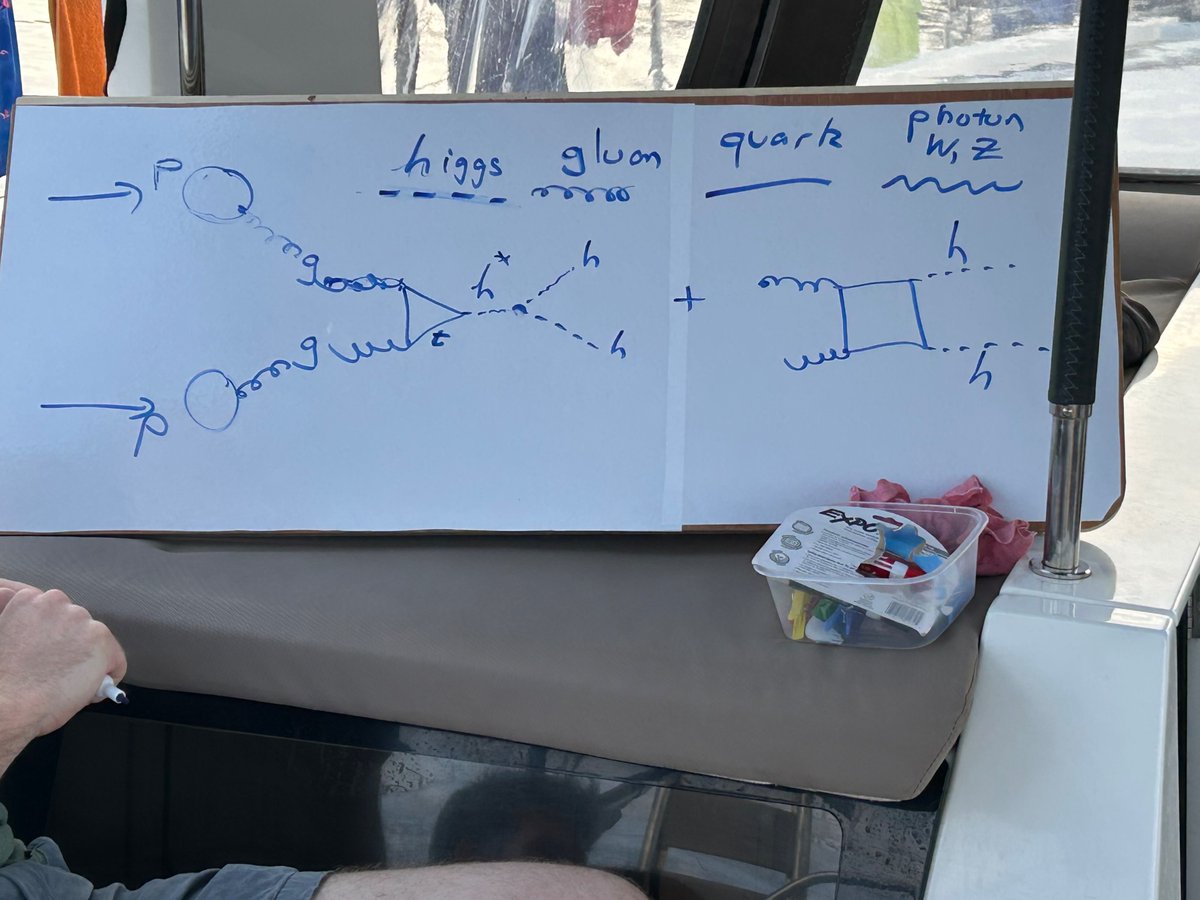
Wasn't sure what Voyages Beyond the SM would achieve beyond the amazing venue & experience, but this was a great week of forced device-disconnection + (unforced) physics discussion. Oh, and sailing across the Aegean! Buzzing with ideas, big thanks to Ezequiel & the slackers ⛵⚛️
@ellis2013nz @predict_addict @chris_naesseth It might be trivially true, but I did not know the proof. In addition, the “better fit” at every single point is a stronger claim than overall better fit. Lastly, this statement is not actually true for any inference. From the post alpha < 0 you will get point wise worse fit.
@dmi3k I know Bob has discussed about SBC. There was another thread in stan discourse: https://t.co/yMV6wBSXwC But the simulation based calibration (SBC) checks the calibration of "inference"; it does not check overfitting, and neither does posterior predictive check (PPC).
@chris_naesseth @predict_addict oh I guess I just in the word "overfit" can mean two things: (1) test error is always larger than training error or/and, (2) a complicated model gives worse predictions than a simpler model in testing. In this blog post, I only refer to (1), not (2).
3/3 Our next-gen SBC uses classification, but it is better than a blackbox classification cuz we can add all statistical information into the classifier. It yields a higher-power test, various divergence estimates and a visualization.
Our new paper on simulation based calibration: https://t.co/2EvlbqKq9Y, likely a better approach to check if your bayesian computing is good, applicable to simulation based inference, vb, or mcmc (no need to thinning™).
2/3 Traditional simulation based calibration is a goodness-of-fit test: the rank of sample should be uniformly-distributed when drawn from the true density. But rank test, or tail probability, is such a 1940s idea: the era when high dimensional data analysis was not developed
4) in terms of uncertainty quantification (observation noise, posterior uncertainty, inference error, model error, pde solver error, truncation error), nuclear seems to be one step advance than cosmology, and three steps than causal inference.
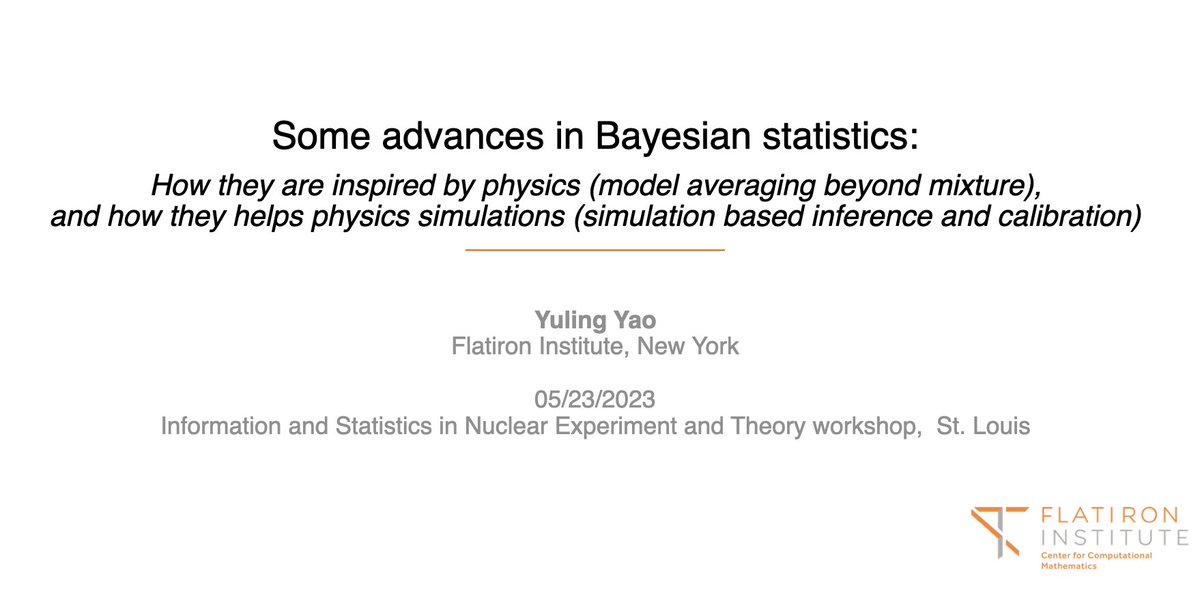
This week I am attending a "Bayesian statistics in nuclear experiment and theory" workshop in WashU. I expect some mild backlash from physicist after I propose to use quantum superposition to do model averaging.
3) As it has appeared in many other AI-for-Science fields, the black-box-using-a-GP-to-beat-benchmark-era has gone. The hybrid approach that has built-in domain structure is now overwhelming.