A robot reaches for a cup. The cup moves. Can it still finish?
Introducing LIBERO-MAX: 8,000 paired cases of mid-task change.
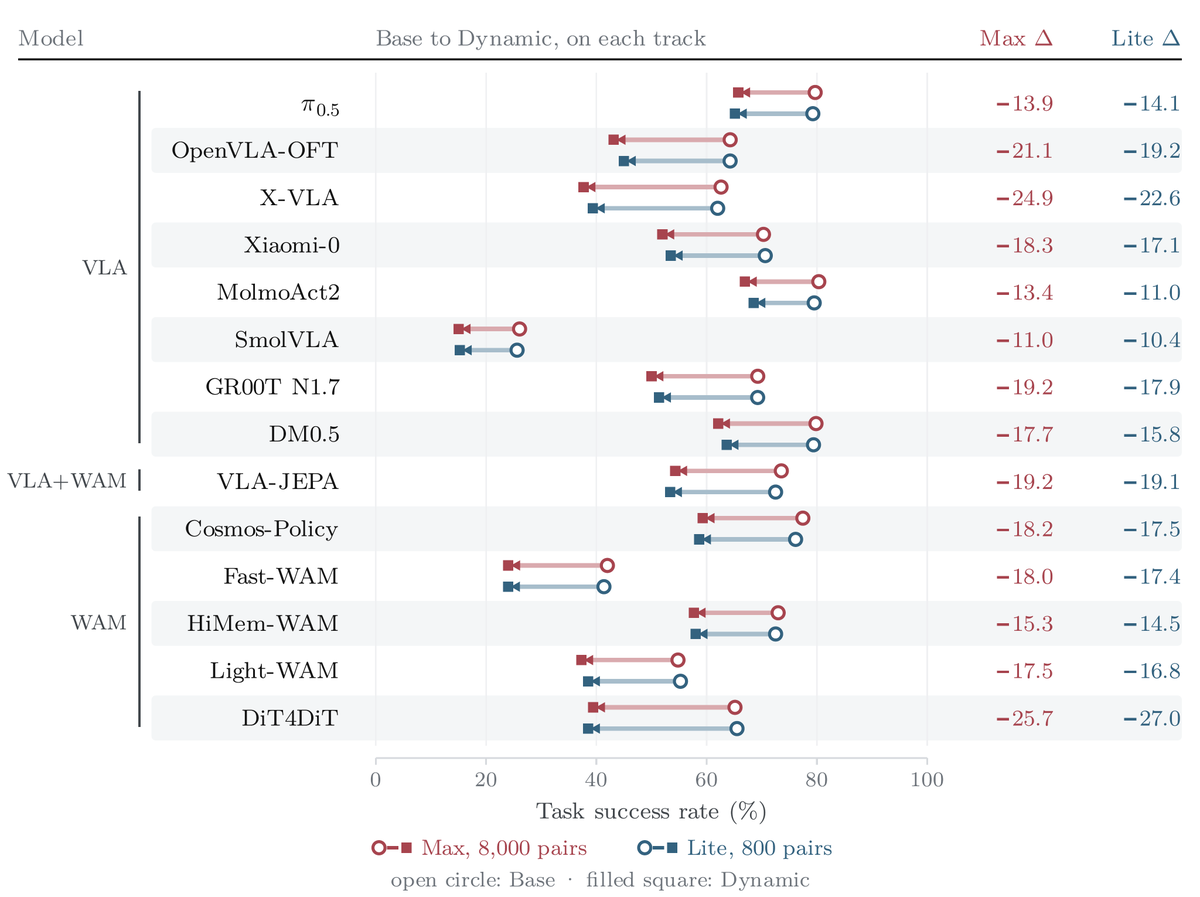
Across all 14 tested robot policies, success drops by 11.0–25.7 percentage points.
https://t.co/YdESaOW57u
1/12 🧵
How reliably can today’s robot policies complete tasks when the world changes mid-execution?
In real-world robotics, things rarely go exactly as planned. Objects move, unexpected obstacles appear, and observations change as robots interact with their surroundings. Understanding how well robot policies handle these changes is essential for deploying Physical AI in the real world.
In our new paper, LIBERO-MAX: Do Robot Policies Adapt When the World Changes?, we introduce a benchmark designed to study this question.
We evaluate 14 state-of-the-art robot policies across 8,000 cases, introducing controlled changes after the robot has already begun acting.
The results suggest that adapting to a changing world remains a key challenge for today’s robot policies. Task success drops by 11–26 percentage points, particularly when geometry or observations change, and simply updating policies more frequently does not close the gap.
LIBERO-MAX provides a systematic way to measure these challenges, helping identify where current policies fall short and guiding the development of more adaptive and robust Physical AI systems.
📄 Paper: https://t.co/cQoDLDvgg2
🌐 Benchmark and project website: https://t.co/IeC9tN7n5j
💻 Code: https://t.co/j3JyngPD2y
Work led by @YunbeiZhang, in collaboration with Zijian Jin, Yuanzhe Liu, Janet Wang, Xilun Zhang, Yuyou Zhang, Zhenyu Zhang, Daoan Zhang, Shuaicheng Niu, Gen Li, Jianfei Yang, Jihun Hamm, Ismini Lourentzou, Weirui Ye, Bo Liu, and Peter Stone.
#Robotics #PhysicalAI #RobotLearning #RobotFoundationModels #AutonomousSystems
@_jake_ward love the “don’t push hacks into the detector’s blind spots” framing. curious how much of the undetected hacking still leaks into the retain adapter tho
Update: this was not the worst paper. But, I had one truly amazing paper in my batch that restored my faith in this field. Keep digging through the slop mines, there’s still gold in there!
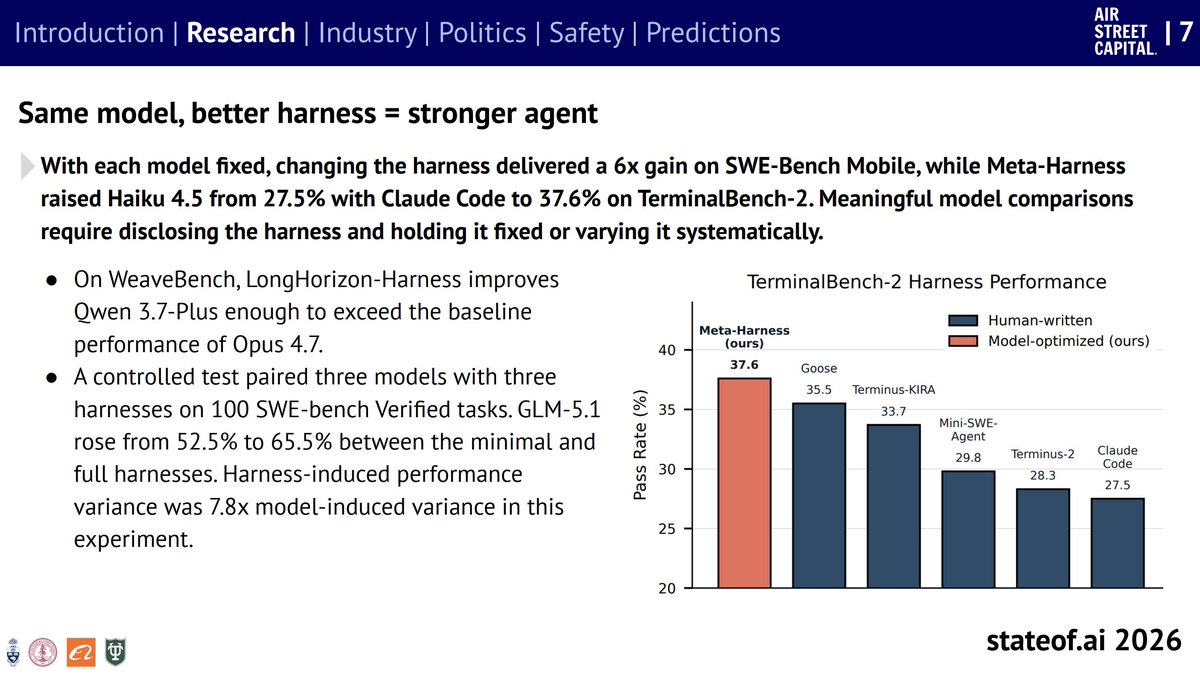
Excited to see our work featured in the State of AI Report 2026!
We found 7.8× greater harness-induced than model-induced performance variance in a controlled study.
Agent benchmarks need harness disclosure, not just model scores.
📄 https://t.co/KzJ25Lsi3k
welcome to the 9th annual @stateofai report!
ai building better ai, world models, physical ai, geopolitics, cyber defense and 12-month predictions.
read it at stateof(dot)ai or watch my editor’s cut here.
a few of this year’s biggest findings follow:
Help build robot policies that keep working when the world changes.
Oral at NeurIPS’26 Robotics World Modeling Workshop.
Paper: https://t.co/i1gNKaEbLi
Code: https://t.co/tT25ZSr0LG
Project: https://t.co/bfwh6ZB4qw
12/12
A robot reaches for a cup. The cup moves. Can it still finish?
Introducing LIBERO-MAX: 8,000 paired cases of mid-task change.
Across all 14 tested robot policies, success drops by 11.0–25.7 percentage points.
https://t.co/YdESaOW57u
1/12 🧵
Want to iterate faster?
LIBERO-MAX Lite fixes 800 matched pairs, requiring 1/10 the rollouts of the full benchmark.
Across 14 policies, Base/Dynamic success rates and paired gaps stay within 2.4 percentage points of Max.
A fast first check before full evaluation.
11/12