@atelicinvest That may be true but you can only focus on what is in your control: relying on your system, treating everyday as a learning oppty, practicing gratitude, and choosing how to play the table regardless of the cards dealt.
@mark_dow Were* the gold standard. Ken G was spot on when he said the American brand is eroding. While I agree that erosion has been accelerated in recent months, it’s been ongoing since at least GFC
@jiratickets@Kipao5 Not all HF performance is measured against S&P500. It’s great if your fund does outperform the S&P, but in many cases that’s not the goal.
Most funds follow strict risk constraints that cap position size. This makes it hard to beat top heavy indices like the S&P500.
@jbulltard1 Agreed - $HOOD is a category killer imo.
People are overlooking the importance of establishing primary bank relationships w/ an already highly engaged user base. The lift to user LTV via improved monetization should be a huge win
Summary:
While I believe this last week in March should be positive for the S&P given greater than normal pension fund rebalancing, I believe Q1 earnings season will be rough as estimates get lowered. I doubt corporations in particular will be making major spending decisions with reciprocal tariffs looming on April 2nd. Given weak consumer confidence surveys, consumer spending is also likely biased lower with recent airline industry negative pre-announcements a confirming datapoint.
Unfortunately, guidance disappointments have so far been met with continued selling in general despite lowered expectations over the past month. Reaction on Friday (3/21) to results by four very different companies $MU (-8% on Friday), $NKE (-5%), $LEN ( -4%) and FDX (-6%) with all but Micron hitting new 52 week lows reconfirmed my fears.
Details:
My 2025 Top5 Picks starting the year included Cash and no Magnificent 7 stocks given my concerns over fundamentals, valuations and new government policies.
Since mid-2024, revenue estimates for $AMZN, $MSFT, $AAPL, $TSLA having been coming down with $GOOGL barely higher but investors do not care as much about fundamentals or valuation when stock charts look good and the Fed is cutting. As I have brought up since mid last year as my thesis for an AI digestion phase in 2025, this is also one of the main reasons that $NVDA’s stock is lower than where it was in mid-2024. Their main customers have seen revenue estimates go down despite ramping AI capex.
To start 2025, six of the Magnificent 7 saw forward revenue estimates get cut when CQ4:2024 was reported but the Fed is no longer cutting and valuations are high.
High valuations and estimates coming down is the reason that the S&P has been struggling relative to MSCI All World Country Index excluding the US which is up 8% YTD through 3/21/25. When inflation has been between 2.5-3.0% exiting the year, the trailing S&P multiple has been 19x versus 24x today. All four metrics of core or headline PCE/CPI are between 2.5-3.1% today versus the 2% target for the Fed.
If tariffs were the main reason for the US stock market issues then why is $EWW (Mexico ETF) up 10% YTD and $EWC (Canada ETF) up 1% YTD which are the two countries that have the most to lose in a trade war with the US? Even in the US, if tariffs were the main issue, the S&P industrial, materials and consumer staples sectors should not be flat to up year-to-date. Tariffs have much less of an impact on S&P informational technology sector given they sell less physical goods but it is down 10% YTD.
In addition, $KWEB (the China internet ETF) is up 22% YTD versus the 13% decline for the Magnificent 7 so this is not hatred for tech stocks in general. The emergence of DeepSeek in China earlier this year, low relative valuations, multi-year avoidance of China internet by investors and consumption stimulus by China’s government could certainly give this sector room to run further.
As for AI capex, contrary to the popular media belief that it is strong, companies are slowing spending dramatically on a sequential basis from mid teens in 2024 to mid single digits at best for 1H:25. For example, while headline spending for Microsoft (the biggest capex spender at over $85B in FY25) is up nearly 60% year-over-year for their fiscal year ending in June, spending has been guided flat sequentially for the next two quarters from +16% on average for C24. FY26 capex has also been guided to be more in-line with revenue growth which is in the mid-teens.
On the macro front, the Fed seems to want to cut because rates are meaningfully restrictive and they consider inflation once again transitory but they are in no hurry to do anything because of uncertainty.
1) 1/29/25: current policy is "meaningfully restrictive,"- Powell
2) 3/7/25: “We do not need to be in a hurry, and are well-positioned to wait for greater clarity."- Powell
3) 3/19/25: “It can be the case that it’s appropriate sometimes to look through inflation, if it’s going to go away quickly, without action by us, if it’s transitory.”- Powell
The Magnificent 7 Outlook:
$AAPL: The stock has nearly a 30x PE for 5% cumulative revenue growth for the past 3 calendar years versus a 21x PE for the S&P for CY25. The multiple has expanded over the last couple of years despite disappointing revenue growth as hope has sprung eternal on the hope for an upgrade cycle. But Apple recently pushed out again AI features for Siri to 2026 so I doubt that occurs this year. Multiple compression seems likely but time will tell.
$AMZN: AWS, the biggest public cloud vendor, revenue growth is likely to slow given less than expected ROI by customers. Training revenue growth is likely to slow while inference revenue is not big enough yet and accelerating enough to make up the slack. In addition, the retail business is likely to be impacted by weakening consumer confidence and tariffs.
$GOOGL & $META: Both are likely to be impacted by declining ad spend in a slower economic environment. But $GOOGL revs are modelled by Wall Street to accelerate to 17% growth in 2025 from 15% in 2024 despite the lack of Olympics or election spend which seems unrealistic. At the lowest valuation among the Mag7 and a discount to the S&P, the stock is tempting if estimates come down enough. $META, however, is using AI the best to drive their own business through ad monetization and content recommendation. But revenues are modelled to slow from 22% growth in 2024 to 15% in 2025 which seems more realistic. The valuation is also only at a slight premium to the S&P and the second lowest behind Google within the Magnificent 7.
$MSFT: Microsoft has now guided forward revenues below the street estimates the last three times they have reported results driven by Azure disappointment despite their 49% economic interest in OpenAI. Recently, they have been distancing themselves from OpenAI and have said they are looking forward to being a renter of capacity versus a builder in a couple of years. This implies the issues with revenues might not be over.
$TSLA: EV deliveries were down in 2024 for the first time in over a decade and are likely to be down again in 2025 versus current street forecasts for growth. A ~100x PE is hard to stomach for a GARP investor such as myself despite my belief in autonomous robots, robotaxis, FSD and the appeal of a lower priced EV model in the future.
$NVDA: Customer capex growth slowing to mid-single digits q/q is hard to reconcile with Nvidia revenue estimates that are modelled by Wall Street to grow 10-11% q/q for all of 2025. There has also probably been some pre-buying of chips to get in front of export controls as well and this should normalize later this year. From a longer-term perspective, I still believe a surge in growth from inference spending is yet to come. But until there is a consumer "killer app" for the smartphone or PC, I believe revenue growth estimates are biased lower in 2025 from plateauing training spend.
In previewing 2025, I wrote: “It is not the strongest nor the most intelligent of species that survives, but the one that is most adaptable to change.” – Charles Darwin. Clearly with the constant shifting in the political landscape (especially around tariffs) and concerns about inflation and growth, this remains true today.
@jevgenijs Insanely stupid to slam ur closest comp before IPO lol. Also history shows $WMT is a terrible fintech partner - see Syncrhony, Capital One, and Green Dot
The point of this exercise is to show that the growth in traditional asset prices over time can’t just be explained away by monetary debasement (which is a favorite pastime of some bitcoiners). Case in point is the chart below of the real money supply and the real S&P 500. If the growth in stocks is an illusion of money creation, the slope would not be positive. So, if you are going to adjust your favorite asset for monetary debasement, consider using the price of money instead of the supply of money. /5
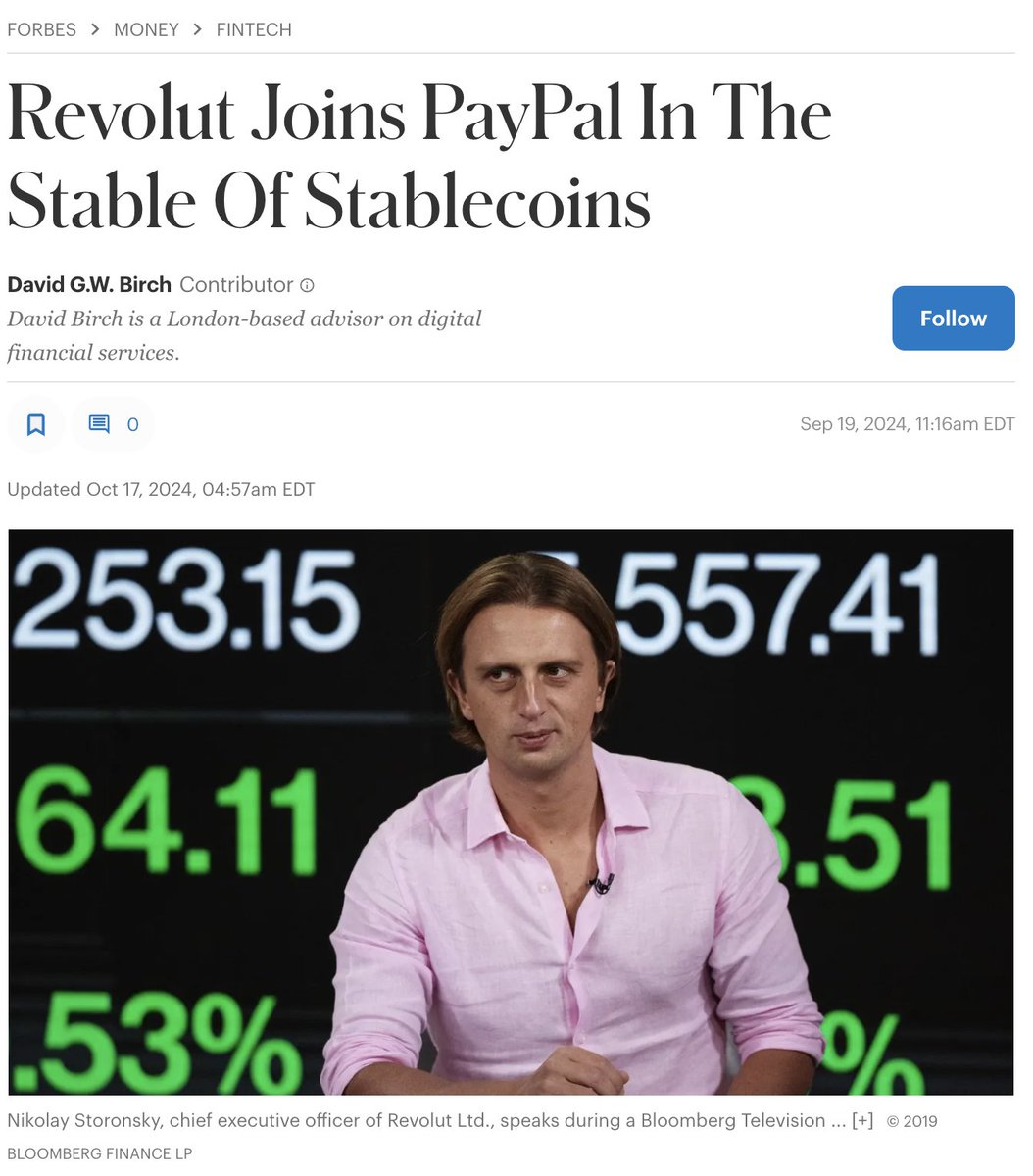
3/ Bottom line? This isn’t a winner-take-all game. Once stablecoins are standardized by law, they’ll become just another flavor of money. The real victors will be those who use stablecoins to complement bigger platforms—think Stripe, PayPal, and the fast moving neobanks.
Power law continues to play out in public markets, with the big getting bigger. I don't think its unreasonable to assume that mega caps continue to deliver elevated economic profits and returns on capital.
These digital monopolies / utilities are almost a tax on global growth, as they are embedded in every consumer and enterprise in one way or anther. Its almost impossible to go through your day without interacting with these companies.
From there, excess returns come by taking market share in massive categories. Google $GOOGL and Meta $META in digital ads, Amazon $AMZN, Microsoft $MSFT, and Google in cloud, Amazon in e-commerce, etc.
I don't see any reason why these disruptions wont continue. Additionally, scale creates a moat both from capital (ability to spend / invest) and engagement (network effects, monetization pathways, etc.), both of which further entrench competitive advantage.
Many fund managers be like: "Adjusted metrics are fictional!"
Only to write in the annual letter: "We outperformed the S&P 500 equal-weight when excluding Nvidia."
Still coming up to speed on $HOOD, but I think you’re looking for: 1) rev mix shift to other consumer finance/wealth mgmt products - manifesting thru the accumulation of user assets across DDA/HYS, crypto, 401K/IRA, etc.; and 2) improved monetization of AUM thru NPI and cx-sell
I think you have to buy into the belief that $HOOD is best positioned to capture churn at Legacy providers by providing a better digital UX
Key drivers of AUM growth include Boomer wealth transfer and retirement/wealth management for younger demos
I’ve been thinking about this chart a lot.
What’s most striking is that there are *no outlier data points*.
100% of the time when forward P/E ratios have been at current levels the S&P returned ~0% over the next 10 years.
What confounds this is… (1/2)