A QUANT SPENT YEARS AND A PHD BUILDING A STRATEGY THAT RUNS 2X LEVERAGE WITH HALF THE DRAWDOWN OF THE INDEX IT TRADES
The secret is one line.
w(t) = min(σ_target / σ_GARCH(t), 2.0)
A GARCH model forecasts tomorrow's volatility every day, and position size scales inversely to it, capped at 2x.
In plain words: press hard when the market is calm, shrink automatically when it starts to shake.
So the strategy levers up to 2.00x in quiet regimes and still caps its worst drawdown near 21.6% while QQQ itself bled 43%. Half the pain, same engine. That risk-shaped leverage is what quants chase for years.
Minara lets you build that exact sizing rule by describing it. 500+ factors, risk-scaled sizing, real backtests. The PhD math is real, the wall is gone.
I took one plain sentence to a live, backtested strategy & posted every number in the article. Check it ↓
this paper is f*cking insane
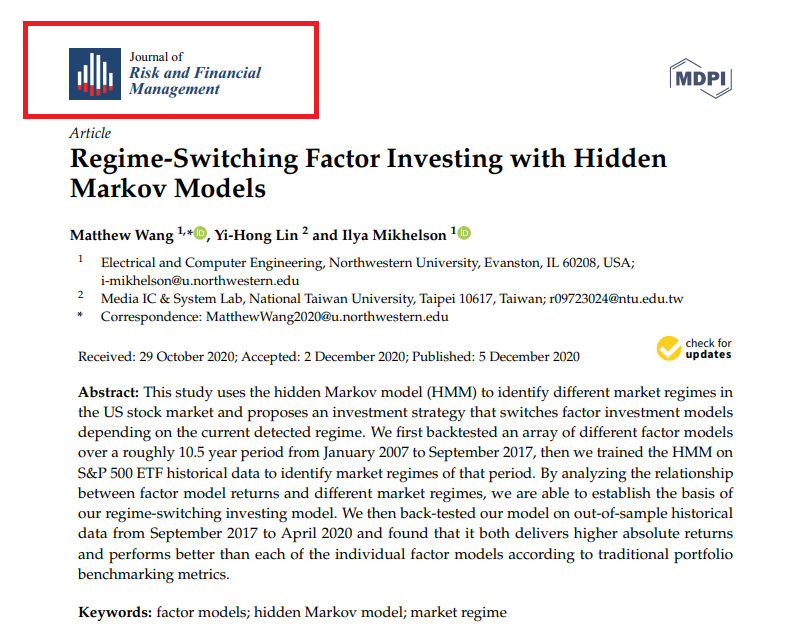
a study out of Northwestern shows how a 3-state Hidden Markov Model absolutely crushes traditional factor investing in trading the S&P 500
it dynamically detects market regimes to dodge major market crashes while delivering 2% annual alpha over standard factors
bookmark before this thread gets buried.
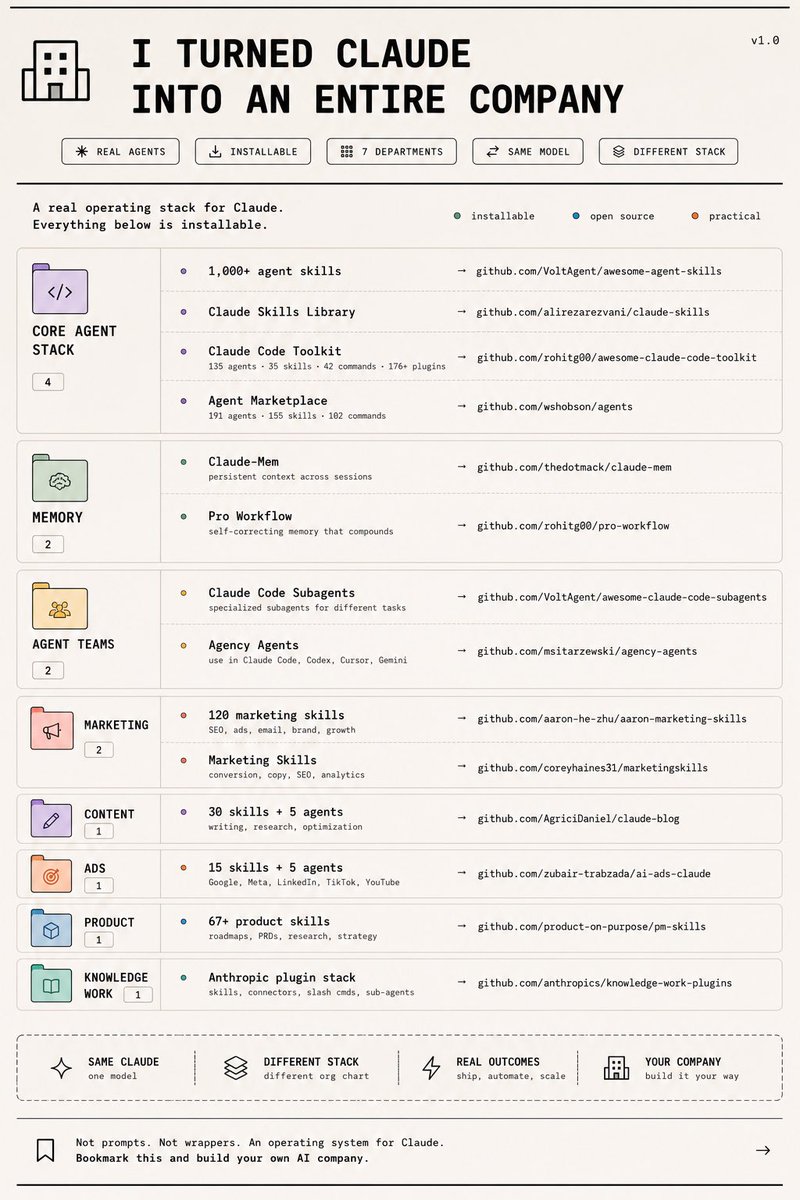
I turned Claude into an entire company
Real agents, skills, memory, and workflows
Everything below is installable
Core Agent Stack
1,000+ agent skills
→ https://t.co/7IQSWp2Rww
Claude Skills Library
→ https://t.co/S5ybKxnjhB
Claude Code Toolkit
135 agents
35 skills
42 commands
176+ plugins
→ https://t.co/8OI86bQLne
Agent Marketplace
191 agents
155 skills
102 commands
→ https://t.co/J4V2c994FM
Memory
Claude-Mem
→ https://t.co/mBL34QvVnK
Pro Workflow
→ https://t.co/MtyvKJDF8U
Agent Teams
Claude Code subagents
→ https://t.co/kHjb3R0Ffd
Agency Agents
→ https://t.co/riYORiBKQr
Marketing
120 marketing skills
→ https://t.co/afVzykVNBe
Marketing Skills
→ https://t.co/UrPt9uUcZt
Content
30 skills + 5 agents
→ https://t.co/6qWbcg6GBz
Ads
15 skills + 5 agents
→ https://t.co/Upups1MGTD
Product
67+ product skills
→ https://t.co/oZijif7WFk
Knowledge Work
Anthropic’s own job-specific plugin stack
→ https://t.co/qHsYYuM69j
Not prompts
Not wrappers
A real operating stack for Claude
Bookmark this and build your own AI company
A single CLAUDE.md file just crossed 192k GitHub stars.
It’s based on coding principles shared by Andrej Karpathy.
Karpathy observed that LLMs tend to make the same mistakes when writing code.
They overcomplicate simple solutions, ignore the existing codebase, and add things you never asked for.
If you’ve used an AI coding assistant, you’ve probably run into all of these.
The good news is that these mistakes are predictable.
And if they’re predictable, you can reduce them with better instructions.
That’s what this claude.md file does.
You add one markdown file to your project, and it gives Claude Code clear behavioral rules to follow across your entire codebase.
That’s why so many developers are paying attention.
There’s no new framework or complicated setup.
Just a well-written instruction file that helps the LLM produce cleaner, more consistent code.
The biggest shift isn’t that LLMs can write code.
It’s that developers are learning how to guide the LLM before it starts writing.
The project is completely open source.
GitHub: https://t.co/L5StNyeNxA
🚨BREAKING: A new open-source multi-agent LLM trading framework in Python
It's called TradingAgents.
Here's what it does (and how to get it for FREE): 🧵
the finance kids everyone respected in college made $130k at morgan stanley
the quiet physics kids nobody paid attention to made $700k at firms most people have never heard of
jane street. citadel. two sigma. hudson river trading
they don't hire from career fairs. they recruit from math competitions and algorithmic programming contests
the screening is 4 areas: combinatorics, coding, quantitative reasoning, strategic thinking
same problem types recycled every cycle, same format every hiring round
the preparation path is fully public, costs nothing, and takes 6-9 months
a kid from a no-name school who grinds this for 9 months
has outperformed ivy league grads who walked in expecting their resume to carry them - pedigree matters less than the problem-solving ability
most people spend 4 years networking their way into banking for $130k
the people who looked in a different direction spent 9 months and landed 5x the compensation
the resources to do this have been publicly available for years
save this and start training your mind
the difference isn't intelligence
it's that nobody showed you where the real opportunity was
A guy in China plugged an LLM into Karpathy method + Claude Code and built a second brain that remembers everything forever.
Not a note app, not RAG just 3 folders on a laptop.
Folder 1 holds raw sources: articles, journal entries, chat logs. The LLM reads them but never touches them.
Folder 2 is the wiki hundreds of markdown pages the LLM writes and maintains itself, where every person, idea and decision gets filed, cross-referenced and kept current.
Folder 3 is one file: CLAUDEmd, the rulebook that turns a chatbot into a librarian.
He drops in a new article and Claude reads it, updates 10-15 pages, flags what contradicts his old notes, logs the timestamp while he watches his memory grow node by node in Obsidian graph view.
Ask it anything and it doesn’t dig through raw files like ChatGPT does the synthesis already exists, the connections are already drawn.
The method comes from a gist Karpathy posted on April 4, now sitting at 5,000 stars and 5,000 forks, with 1 production team already scaled to 4,000 interlinked concepts in 6 months.
The part nobody mentions: Vannevar Bush described this exact machine in 1945 the Memex, a personal memory store with trails between documents. Nobody built it for 81 years because someone had to do the maintenance.
Now maintenance costs nothing the LLM does the filing while the human does the thinking.
Every article makes the brain smarter, and it never forgets.
His memory has a git history now.
this is f*cking gold
Andrej Karpathy came over to Anthropic just five weeks back.
Someone on his team pulled up the actual Claude.md they run day to day and showed it to me.
I plugged it straight into my workflow. Claude’s next reply wasn’t just improved.
It felt like a different model.
The canned, one-size-fits-all stuff vanished, and it started reasoning in my voice.
Save this before it disappears down your timeline.
Read it first then hit the article below.
THIS GUY USED CLAUDE TO BUILD AN AUTOMATED TRADING SYSTEM THAT GENERATED $847 OVERNIGHT.
it all started with a single article about Polymarket bots.
Claude Fable 5 read it, selected 7 GitHub repositories, connected them into a working pipeline, and deployed the entire system from start to finish.
from there, everything ran autonomously.
the system:
→ scanned 412,000+ trades
→ tracked whale wallets
→ detected insider activity
→ analyzed the market every few seconds
→ decided whether to buy, sell, or pass
→ executed every trade automatically
according to him, the system completed 47 trades and ended the night with $847 in profit, without any manual intervention.
the video below teaches you how to replicate this system yourself, step by step.
Anthropic just released 5 workshops on building self-improving agentic systems from scratch:
00:00 - Ship your first Claude agent
36:44 - Self-improving agents (tools,skills)
1:21:25 - Build memory for Claude agents
1:49:47 - Set up a proactive agent
2:11:31 - Make your agent autonomous
These 3-hours of Claude workshops will replace 20 paid agentic courses.
Watch today, then read article below on how to build a self-improving agentic system with Fable 5.
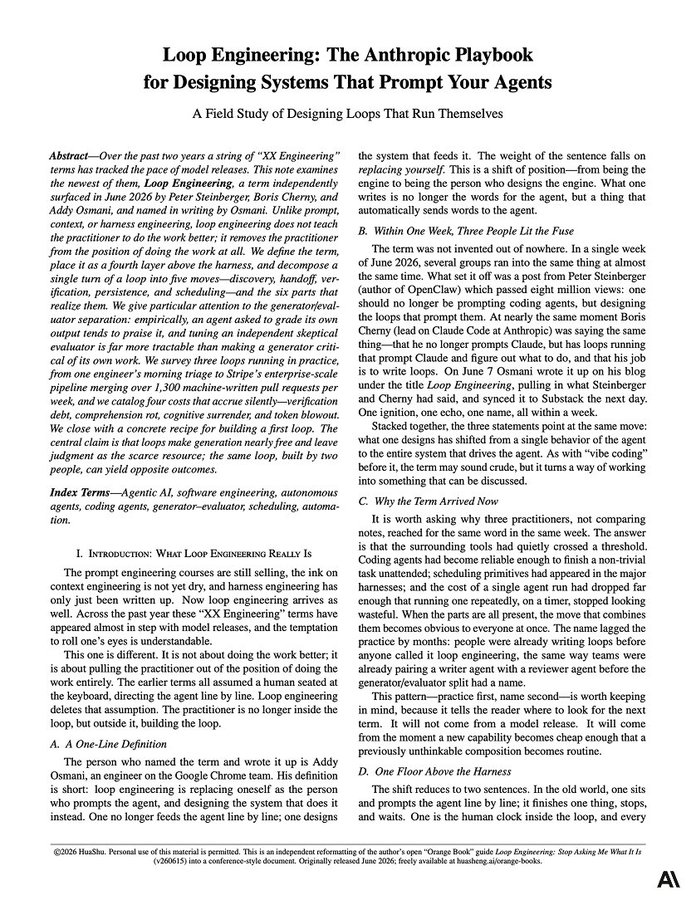
SENIOR ANTHROPIC ENGINEER MAKING $2.2M/YEAR DROPPED AN 11-PAGE PDF THAT COST HIM HIS JOB
you stop prompting the agent - you build the system that prompts it instead - and that one shift changes everything
Schedule → Discover → Build → Verify → Repeat
five moves, one loop, runs forever without a human
Discovery: the agent finds its own work - failing CI, open issues, recent commits - nobody hands it a list
Verification: a second agent told to assume the code is broken reviews the first - the key insight is that an agent grading its own work always praises it
Persistence: results written to disk, never left in a context window that gets flushed - the loop never loses memory
Handoff: each task gets an isolated git worktree so parallel agents don't collide
11 pages that changed how agentic systems get built - and it cost him the job that paid $2.2M/year to know this
Introducing Sakana Fugu: A full multi-agent orchestration system accessible via a single model API.
Our ‘Fugu Ultra’ model matches the performance of Fable and Mythos, delivering frontier capability without the risk of export controls.
Try it: https://t.co/hhO6qTawgb 🐡
I genuinely don't understand why everyone isn't using this yet
Andrej Karpathy, a co-founder of OpenAI, posted a simple idea that hit 16 million views: stop using AI to write code, use it to build a second brain.
You point Claude Code at a folder, drop in any source, an article, a transcript, a PDF, and Claude reads it, links it, and files it into a living wiki of everything you know. It compounds like interest, the more you feed it, the smarter it gets.
Here's the whole thing:
> Install Obsidian, create a vault, open it in Claude Code
> Paste Karpathy's wiki idea file and tell Claude to build it
> Claude makes three folders: raw for sources, wiki for its pages, a CLAUDE.md that runs it
> Drop any source into raw and say "ingest this"
> Ask questions across everything, forever
Five minutes to set up, and you never start from a blank chat again.
Full step-by-step guide with Claude and Obsidian, link below.
Bookmark this
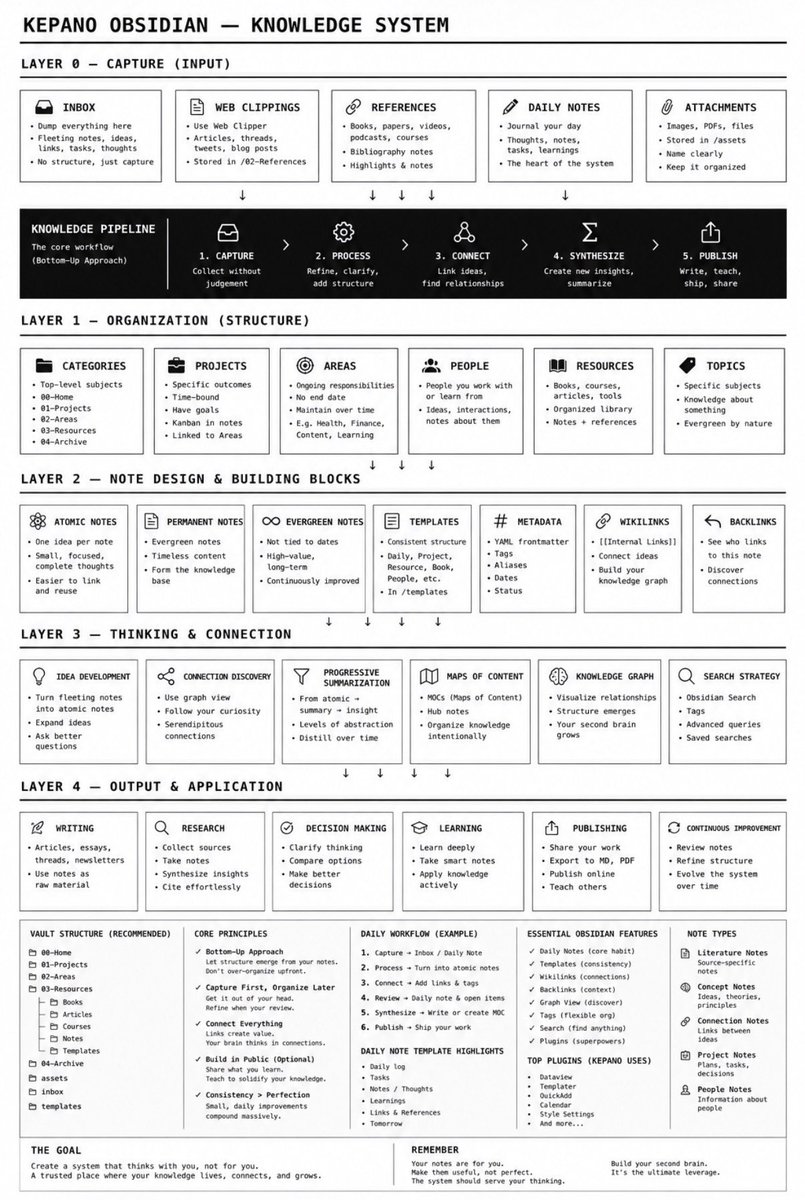
An asian guy has discovered a method to learn anything ten times faster using AI!
It just involves the Claude + Obsidian.
Most people learn the slow way: read, forget, re-read, forget again.
His flip: use Claude to turn anything you're learning into small, connected notes. Use Obsidian to link them so nothing you learn ever sits alone.
The slow way: highlight a book, move on, forget it in a week.
The fast way: Claude breaks it into atomic notes, and Obsidian links them into a growing web of knowledge.
Six months in, one new idea instantly connects to twenty things you already know.
I broke down every Claude resource you should try to master claude in 7 days with practical guide that most people have never found.
Article below ↓
Anthropic engineer:
"you're not supposed to prompt Claude. you're supposed to build a system that prompts itself [loops]."
this is one of the best workflows I've seen in a long time
in this video he breaks down exactly how most people are building loops wrong:
- the memory file you never set up, so every loop starts from zero
- the sub-agents that 95% of builders have never split apart
- the stop condition setup that keeps loops from running forever and billing you in your sleep
- why writing one prompt a day is the slowest way to use Claude
if you've been using Claude for more than a month and still typing every task by hand, you've been running one prompt when you could be running a system of loops
instead of another prompt tonight, watch this
make sure to bookmark it before it gets buried
full guide in the article below
Claude Code creator:
"100% of our pull requests at Anrtopic are run by Claude Code. 80–90% of code review too.
The feature I’m using the most today is /loops. I’m not prompting Claude anymore - I’m building loops"
in 1-hour interview, Boris reveals his setup, which helps him build the #1 coding tool of this year.
Worth more than a $500 vibe-coding course.