Marine veteran scaling security pipelines across thousands of codebases. Sharing tactical insights on low-level systems, eBPF, and AI runtime guardrails.
@chamath Withholding a model for fears of misuse is illogical as it will also keep the ‘white hats’ from building or learning proper techniques in the AI era. Hampering the good guys to stave off the bad guys (who will find guardrail workarounds) will not end well.
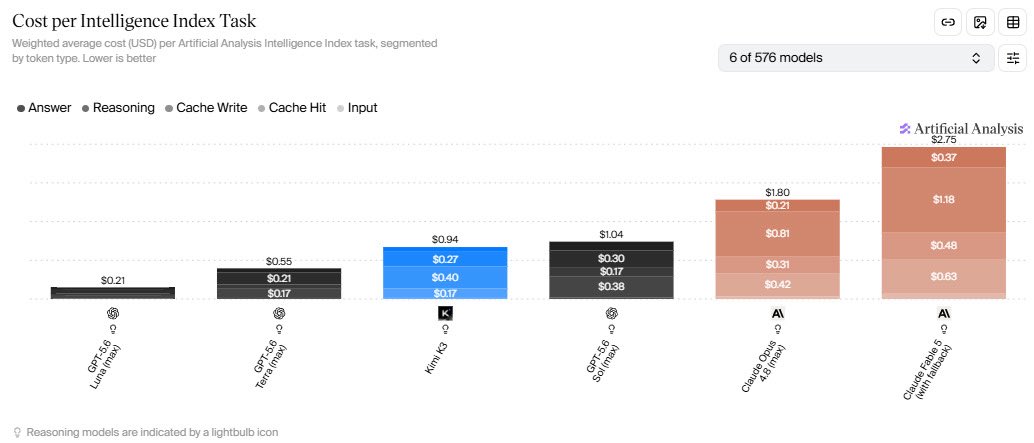
Kimi K3 may be an important inflection point for AI. Potentially negative for Anthropic and OpenAI while being net positive for essentially every other company in the world. I mean that very literally. Although the real “Sputnik moment” would be an open-source frontier model that was also token efficient unlike Kimi K3 which is 50-70% more expensive to run than GPT 5.6 per Artificial Analysis.
Rationale:
A world where there are only 2-3 dominant frontier labs with 90% inference margins is net negative for every other layer while being awesome for those 2-3 labs. Those labs would become monopsonies for power, data centers, semiconductors and hyperscalers and would obviously vertically integrate over time into all those layers while also completely subsuming the application/software layers.
Anything that lowers margins and increases competition at the model layer is good for every other AI layer: power, semiconductors, hyperscalers, neoclouds and yes even software.
This is why Jensen is so supportive of open-source. An open-source model requires the *exact* same amount of compute to run as a closed frontier model of similar size and architecture. Kimi K3 is roughly the same price as GPT 5.6 Terra on a per token basis, which actually suggests that it is less computationally efficient as I am sure that GPT 5.6 is priced to a higher margin than K3. And given that K3 is a token wastrel, i.e. token inefficient, it is significantly more expensive per task than GPT 5.6 and Grok 4.5, which are much more token efficient. Cost per token and token efficiency (i.e. intelligence density per token) are the drivers of intelligence per unit of cost. The winning AI companies will be those that offer the most intelligence per $ over time.
Lower margin % at the model layer = more margin $ at every part of the infrastructure layer and is a godsend for software. This can happen either through open-source models like K3 at the frontier *or* having a vertically integrated model company like Meta, SpaceX or Google at the frontier. Both outcomes result in a lower margin % at the model layer as vertically integrated model companies don’t really care where the margin $ come from. This is why it was so painful for OpenAI and Anthropic when Google was right there with them from a model competitiveness perspective and why Grok 4.5 and Muse 1.1 were just as important as Kimi K3.
The reason Kimi K3 is only *potentially* negative for Anthropic and OpenAI is 1) the @ericvishria point that the Claude and ChatGPT products and harnesses may be more important than their models today and 2) the hypothesis that they have much more advanced model checkpoints internally that are already being used for RSI. In the latter scenario, reaching RSI even a few months ahead of other labs might be enough to cement a permanent lead.
Time will tell on both points. And likely fairly quickly.
Caveat would be that since Kimi K3 is not token efficient and thereby actually more expensive than ChatGPT 5.6, we may need to see a more token efficient open-source model at the frontier or see Grok 5/Composer 4/Muse 2 at multiple points on the Pareto frontier for this potential risk to Anthropic and OpenAI to play out. And I am sure they will both vertically integrate as quickly as possible while continuing the product/harness strength they have shown over the last 8 months.
Distillation = using a top AI (like Claude Fable) to spit out millions of answers, then training a cheap smaller model on those outputs so it copies most of the smarts without spending billions.
Chamath is saying: the big labs trained on the whole internet without permission and called it fair use. Now the same trick is being used against them. Morally inconsistent. Legally it's mostly "you can't do that" in their ToS contracts, which are tough to enforce. Real issue is economic — someone can steal ~80% of a $1B model's value for $5M and undercut them. It's a moat problem.
@tweet_tj@DavidSacks That’s true, the open source models essentially have a dependency on the us ai shops to build at frontier levels. But there no way the frontier labs stop… the only antidote here is for the us labs to distill from the Chinese models
Currently building Custos -> A blazingly-fast, kernel-bypass gRPC firewall. Protects AI inference backends from binary exploits and GPU-starvation DoS attacks at the packet layer, before they even hit the container.
@kunchenguid Agreed! I have a funny feeling that the whole git upload controversy was totally missed by the beta testers and wouldn’t have made the final cut if found earlier. Not a good excuse though!