Agent memory benchmarks test recall. Production agents need memory to change the tool call. A new preprint, MERIT, measures exactly that across 23,440 scored episodes for $42.57 in API cost. Headline: embedding retrieval is unreliable once a fact gets updated. Thread:
Limits: a preprint by independent researchers, three synthetic domains, scripted users, and reimplemented memory families rather than Mem0 or Zep themselves. A map of failure modes, not a product ranking. If your facts get revised, which memory design do you use?
A robot needs more than sensor readings. It needs an internal representation of the world that evolves over time.
Key components of a robotic state design:
- World state: Objects, locations, obstacles, and environment.
- Robot state: Joint positions, velocity, pose and battery level.
- Task state: Current goal, completed steps, and pending actions.
- Interaction state: Object contact, grip force, and manipulation status.
- Memory state: Previous actions, observations, and learned experiences.
- Uncertainty state: Confidence in perception, localization & predictions.
Together, these states help robots plan multi-step tasks, recover from failures, and adapt to changing environments.
We asked GPT-6 Astra to edit Qwen3.5-0.8B weights to improve math.
It directly changed only 0.016% of weights, fixing 0.8B's reasoning loops & improving math up to 6x and even instruction following 3x, without gradients or training.
We call this Weight-Space Programming: frontier LLMs can now natively read/write neural network weights! 🧵
Blog: https://t.co/bOWCcFhCVq
Source: vLLM's disaggregated serving guide (IBM Research, Sep 2026). Setup: 2x L40S over PCIe, Qwen2.5-7B. At 0.2 req/s, P/D median TTFT was 2.2 s vs 0.7 s collocated. Check nvidia-smi topo -p2p r first. https://t.co/eV7CtGyliJ
Prefill/decode disaggregation fixed tail latency on one vLLM test box, then hurt TTFT on the same box. At 0.4 req/s, collocated p99 inter-token latency hit 169 ms vs 29 ms for P/D. Without GPU peer-to-peer copies, each 8k-token prompt's KV cache took about 1.3 s to reach decode.
Your old Android phone could become a robot's brain.
OpenBot combines a low-cost DIY robot chassis with a smartphone for AI vision and autonomous navigation.
You can build robots that follow people, navigate around obstacles and learn driving policies.
The phone handles perception and AI. An Arduino or ESP32 handles motor control and sensor readings.
A great project for experimenting with edge AI, autonomous robotics and embedded systems without expensive hardware.
Framing from "Beyond the Final Answer": most tool-use benchmarks check answer match only; the authors score the reasoning trajectory instead. https://t.co/huUX5EeGLK
Two agents return the same correct answer. One calls the right tools directly. The other retries blindly and invents a tool result first. Answer-match scoring rates them equal. Trajectory scoring separates efficiency, hallucination, and adaptivity.
The paper frames it as a frequency mismatch: fast control, slow reasoning. The claim is equal or better success, so the gain is smoothness and history awareness. https://t.co/QCZu0995UT
Chunk-based action heads reset temporal context at every new observation. AR-VLA (RSS 2026) uses an autoregressive action expert with its own long-lived memory and reports smoother trajectories at equal or better success than reactive VLAs.
Want to learn Edge AI by running models on real hardware?
Found this excellent resource from the ML Systems Book project.
The Hardware Kits guide takes you from setup to deploying machine learning models on embedded devices.
https://t.co/ke91l6LK8J
You can learn through hands-on labs covering:
- Image classification on microcontrollers and embedded boards.
- Object detection for smart cameras and robotics.
- Keyword spotting for voice-controlled devices.
- Motion classification using sensor data.
- LLM and VLM deployment on Raspberry Pi.
It covers platforms like the Seeed XIAO ESP32S3, Arduino Nicla Vision, Grove Vision AI V2 and Raspberry Pi.
Start with a pre-trained model, then move toward training, optimizing and deploying your own models on resource-constrained hardware.
A great way to connect machine learning with embedded engineering.
Bookmark this if you are learning TinyML, Edge AI or robotics.
let me break down “software is dead” for you
the latest argument is “you just tell your agent what you want, and your agent will vibe code software on the fly to get that done, so no one will need real software any more”
sounds reasonable, until you realize it costs tokens, compute, and wall clock time to build those software on the fly
so instead of one-click launching an app, the bet is people will prefer to write a prompt, wait for 15 minutes, then get something that may or may not do what they want, and at the end of the month pay more $$$ for the token spend, higher than all their software combined
that’s literally the argument
and if we look at the world in aggregate, most people would just end up building the exact same “personal” software repeatedly
oh - your agent just spent 3 days and $500 of tokens vibe coding your terminal multiplexer? mine just did exactly the same! let’s celebrate how personal our terminal multiplexers are!
sorry - i just don’t see that as being a happy scenario for anyone, other than people who profit from telling others how to waste $ on tokens
to be constructive, here’s what i believe as the future state -
- high quality software that takes high cost to make will continue to thrive. just like good restaurants don’t compete with your air fryer and microwave
- most of those software will be offered headlessly for people to use via their agents, and they can continue to monetize such usage. this is already the case with products like jira, linear, stripe
- human-facing software will all offer dynamic UI that can be adjusted with natural language on the fly so they can be personalized easily, but their core doesn’t have to be rebuilt by every user repeatedly
instead of “software is dead”, i believe good software becomes “strong core, headless service, fluid interface”
which future do you think is more likely?
Dusting off this tweet from April because this gap in shared understanding of LLM capability is *widening*. It's now less "two groups of people speaking past each other" and more a sharp funnel.
- Napkin math somewhere around 6B people (~75% of the population) have barely come in contact with LLMs at all.
- Around 1-2B (~20%) are casual and infrequent users of free-tier ChatGPT-like products. This group sees derpy chatbots and treats them a bit like a better Google search, a writing aid, or etc. Maybe an agent tries to book you a flight. I have non-tech friends who (reasonably, imo) say they have not much use for it at all. Even many professionals outside of math&code are in this tier. For example, execs and many other functions spend a lot of their time talking to other people, so while they understand what is happening intellectually, it is still second-hand and a bit abstract.
- Now we get to professional use of frontier-grade LLMs in math&code. Somewhere around 20M people (0.2%) see first-hand that large, complex projects that used to take them weeks/months can now be completed by agents with a prompt. Building apps, copying apps, translating apps, decompiling apps from binaries... This has all happened very quickly and recently - less than 1 year ago, I was writing code manually by hand, typing memorized computer code commands into a code editor character by character, occasionally pressing Tab to autocomplete a little chunk of code.
- And finally we get to the ~5,000 people (~0.00006%) with access to frontier-grade systems internally. The external world has seen the preview. It looks like swarms of thousands of agents collaborating over weeks on software mega projects: minting zero days, running cyber attacks and defenses at machine speeds, discovering new science, advancing the frontier of mathematics. Things that would have taken top professionals in the industry years of work. Meanwhile, human review and comprehension are starting to fall behind. For example, people are still involved in the "archeology" of the OpenAI-HF incident from many months ago. Mathematicians may be poring over the 722 manuscripts on frontier mathematics for a while.
The funnel is driven by a combination of factors:
1. The impact scales with ambition, problem size, and horizon. A question with a paragraph answer barely stresses the system. You need a reservoir of big, difficult problems that you really care about. This aspect drives the consumer / professional dimension of the funnel.
2. The jaggedness of the system (which I have written about a lot separately). Capability peaks in domains that are digital, verifiable and economically valuable. This is because LLM capability emerges from reinforcement learning on verifiable rewards on a curated environment mixture driven by revenue potential. This aspect primarily drives the area (e.g. math&code) dimension of the funnel.
3. Access. Free-tier, paid-tier, internal.
So this is the weirdness of the moment. The general public has mostly not interacted with these systems. When they have, it looks like a derpy chatbot. The majority of professionals still see only a modest uplift. And a small sliver of professionals are experiencing the vertigo of the curve going vertical. And it is all happening at the same time.
China has killed the entire vector database industry.
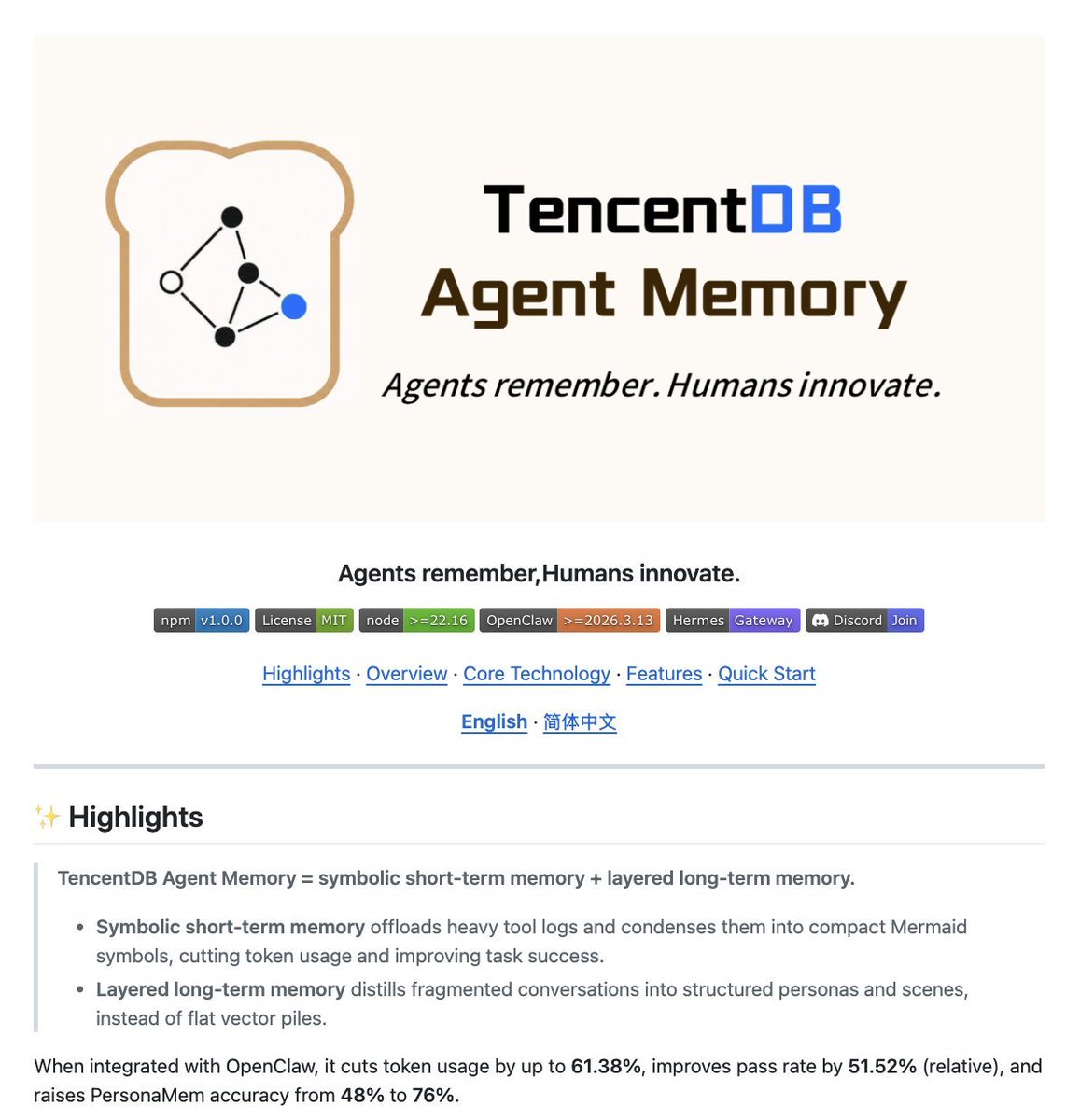
They open-sourced TencentDB Agent Memory. It gives any AI agent long-term memory that runs 100% locally.
No Pinecone. No cloud APIs. No repeating yourself every session.
- 61% fewer tokens
- PersonaMem accuracy: 48% → 76%
- Zero external API dependencies
- Runs on plain SQLite
Most memory systems compress your history into an opaque vector pile. when recall goes wrong, you're guessing. this one doesn't compress, it builds a semantic pyramid.
L0 Conversation → L1 Atom → L2 Scenario → L3 Persona.
Short-term state gets encoded as a Mermaid graph in your agent's context. verbose tool logs get offloaded to disk. when the agent needs proof, it drills back via node_id to the exact raw log.
no lossy compression. every layer is readable markdown you can just open and inspect.
5.1k stars. 100% Open Source.