@ChatGPTapp can write Shakespeare.
@cursor_ai can write code.
But neither can tell you if an onchain protocol is about to collapse.
Introducing AFI—the first AI built specifically for crypto finance.
Why vertical AI changes everything and what @chaoslabs is building towards 👇
SPECIAL: America’s Crypto Golden Era with Stani Kulechov and Omer Goldberg
For today’s special episode, @robbie_rollup sat down with @StaniKulechov of @Aave and @omeragoldberg of @chaoslabs to cover:
> DeFi Renaissance in America
> Aave V4’s multichain model
> World Liberty Finance & Trump
> Aave Governance Evolution
> Future of DeFAI
Full episode links below:
Timestamps:
0:00 Intro
04:00 Aave’s Five Years of Growth
09:47 Risk Monitoring with Chaos Labs
22:25 Aave v4 Highlights
35:30 Trump’s Crypto Implications
41:52 World Liberty Finance & AAVE
The Edge Series: Market Context #12
Written by research analyst: @0xGeeGee✍️
Stablecoin Flows, Volatility and Price: A Nuanced Relationship
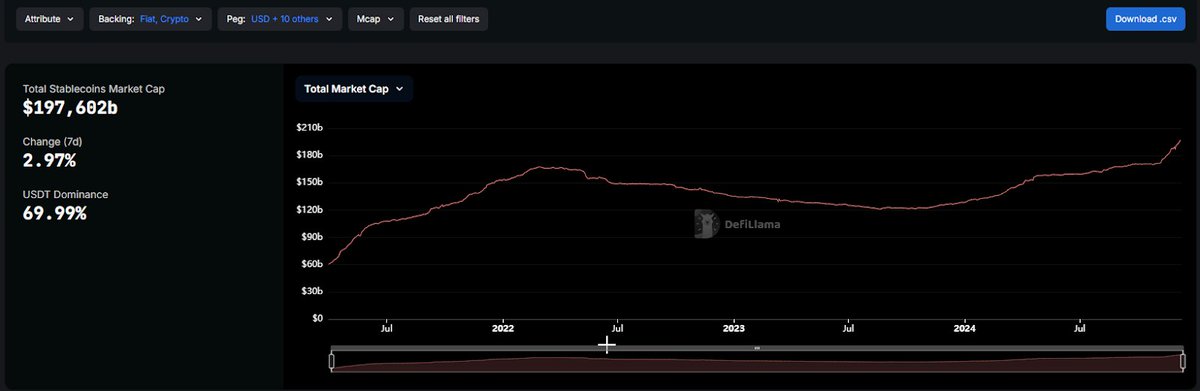
Earlier this month, the total stablecoin market capitalization reached a new all-time high, surpassing its previous peak in 2022.
Last week, we analyzed the data foundation of common beliefs around airdrops and their impact on markets and protocols (https://t.co/WosGaoAMBK). This week, we’re turning our focus to stablecoin supply—a metric often touted as a key indicator of future crypto trends.
It’s not uncommon to see alerts about new Tether mints ridden with comments and quote tweets about how this is going to affect the market in terms of pricing and volatility. The prevailing narrative suggests that an expanding stablecoin supply drives bullish crypto price action, with sudden spikes leading to higher immediate volatility, while a declining supply signals bearish sentiment.
At first glance, this argument seems logical: new stablecoin supply implies new money entering the system, potentially increasing volatility and bringing in more buyers. However, the inverse isn’t always as straightforward. While less stablecoin supply means that money flows are exiting the system, reduced liquidity could further exacerbate volatility.
What does the data say?
Historical trends paint a more complex picture.
Prices vs. Capitalization:
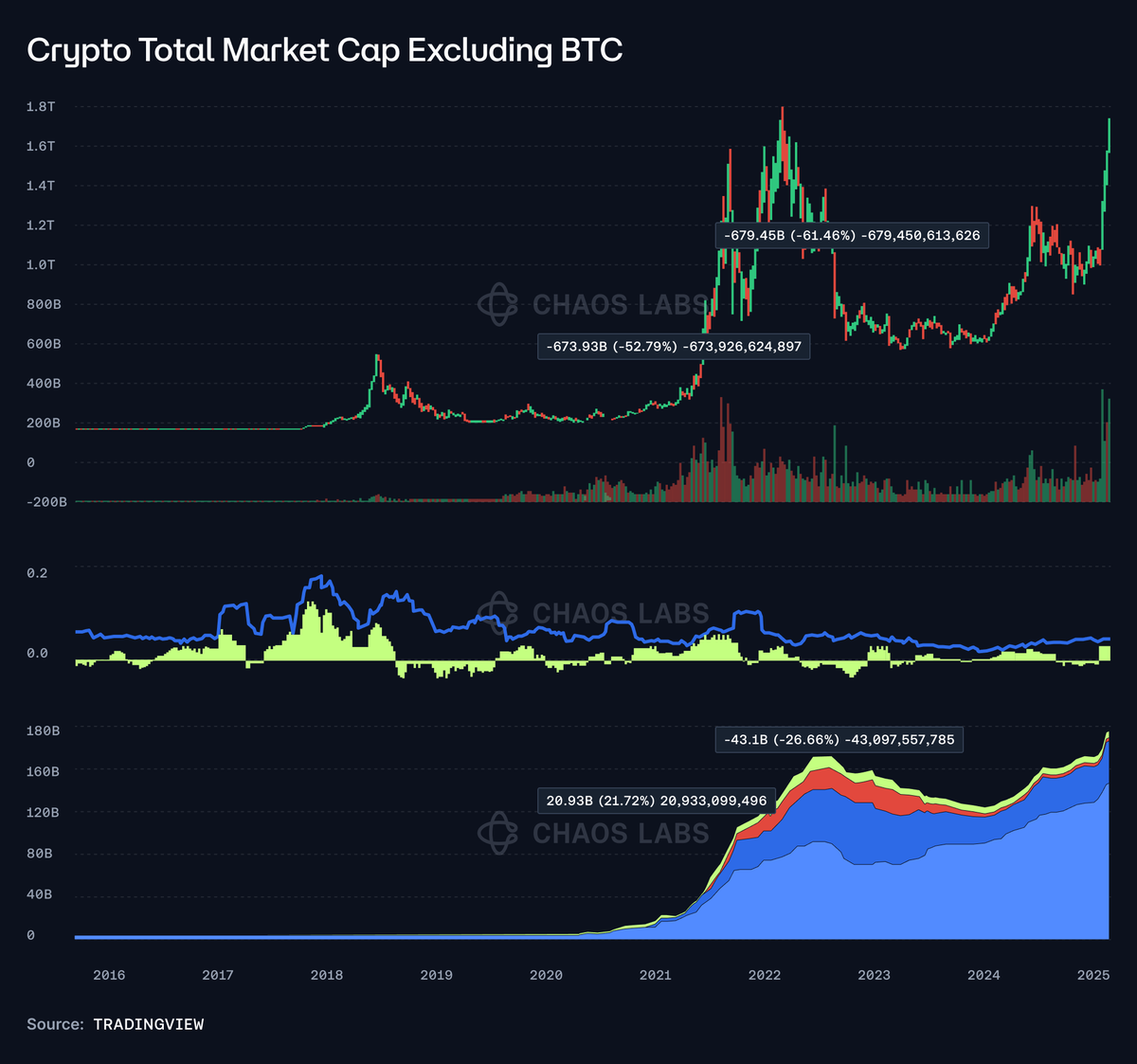
• 2018 Bear Market: Throughout 2018, the stablecoin market cap grew steadily despite declining crypto prices. It wasn’t until November 2018, when stablecoin supply saw significant outflows, that these trends visibly impacted prices.
• 2021 Bull Run: During the bull market of 2021, stablecoin market cap continued to grow even after the market peaked in April and November.
• 2021 Summer Retrace: Interestingly, the summer retrace of 2021 occurred while stablecoin flows were still overall positive (20%+ increase) or at least flat when considering $USDT (+/- 2%).
• 2022 Crash: Starting in May 2022, as the market entered a sharp bear phase, stablecoin market cap began to shrink. However, the contraction in crypto capitalization (-60% in weeks) far outpaced the much slower decline in stablecoin supply (-25%).
• 2023 Recovery: Crypto market capitalization bottomed out in late 2022 after the FTX collapse and remained flat until late 2023. During this time, stablecoin supply continued a slow decline throughout 2023, only marking a bottom in September.
• From October 2023 onwards: Both stablecoin supply and crypto market cap recover rapidly.
Volatility
Observations on volatility are more nuanced, partly due to the varying methods used to calculate it. For this analysis, we considered both the CVIX indicator and @official_CVI's CVOL indicator to ensure a broader perspective.
One clear and immediate takeaway stands out: as stablecoin supply increases, market volatility gradually diminishes, with large spikes becoming increasingly rare. This is also a logical conclusion and an indicator of the increasing market maturity, volumes and supply/demand for the assets.
Sudden and impactful changes in stablecoin flows often coincide with notable market movements, reflected in both volatility indicators and capitalization. This highlights the importance for protocols relying on liquidation engines to account for these dynamics. However, this relationship typically emerges only during particularly significant shifts in stablecoin supply.
In most cases, stablecoin supply behaves as a lagging or reflexive indicator. As crypto prices rise, more capital flows into the system, driven by new speculative opportunities. Conversely, during downturns, capital exits due to diminished speculative interest. Rather than stablecoin flows dictating price action, rising crypto prices tend to attract new participants, creating demand for stablecoins as they seek exposure to the market.
Stablecoin flows have a broader, macro-level impact: they act to dampen market volatility. The greater the stablecoin supply, the more liquidity exists within the system, ensuring a larger pool of potential buyers ready to step in at various price levels. A closer look at individual stablecoins like USDT does not reveal particularly discrepant patterns.
Conclusion
The relationship between stablecoins, volatility, and crypto price action is complex and far from a simple cause-and-effect dynamic. While sudden shifts in stablecoin flows can indicate changes in market sentiment—something lending and collateral-based protocols should monitor closely—the overall stablecoin supply tends to reflect broader ecosystem growth rather than directly influencing price movements.
---
Quick Hits:
• @MicroStrategy ($MSTR) announced the purchase of 21,550 BTC for approximately $2.1B on Dec 9th.
• @RiotPlatforms ($RIOT) acquired 5,117 BTC (approx $510M).
• @Microsoft ($MSFT) voted against investing in Bitcoin.
• @amazon ($AMZN) is discussing the possibility of investing in Bitcoin.
• FlashBots: Announced migration to decentralized network BuilderNet.
• @BlackRock: 2% BTC allocation is “reasonable.”
• MiCA Regulation: Soon to take effect, with major CEXes (@coinbase, @binance, @Bybit_Official) preparing compliance measures.
• @opensea: Registers foundation ahead of a potential TGE.
1/ Following @Aave DAO selection and approval, Aave has integrated Edge Risk Oracles!
Edge is now delivering dynamic, real-time risk management to Aave.
This is the new standard for DeFi risk management.
https://t.co/ewhM2ii55f
1/ With the U.S. Presidential Election less than a week away, prediction markets are taking center stage.
At @chaoslabs, our mission is to build trust and transparency in the markets of the future through high-quality data and risk management tools.
1/ Following our recent risk assessment, Agora @withAUSD has integrated the Edge Price & Risk Oracle as its primary oracle to ensure efficient onchain risk management and resilient price data for the $AUSD stablecoin.
🧵
Join us in Bangkok on Nov 12, 2024, for The @ChaosSummit by @chaoslabs! 🇹🇭
Here’s what you can expect at the event:
→ 30+ speakers from projects like @aave, @PayPal, @wintermute_t, and @ethena 🤓
→ Technical lectures and roundtable discussions on Data Integrity, Risk, and AI 💻
→ Local Thai cuisine and wellness drinks 🍛
Apply to attend: https://t.co/rQOWkLD3ND
Edge Oracle adoption is growing rapidly, across @solana, and we’re excited to cement our partnership with @PaypalVentures with an additional investment to accelerate development.
@SherazShere and @PayPal’s Jose - thanks for having us on the keynote!
More soon 👀
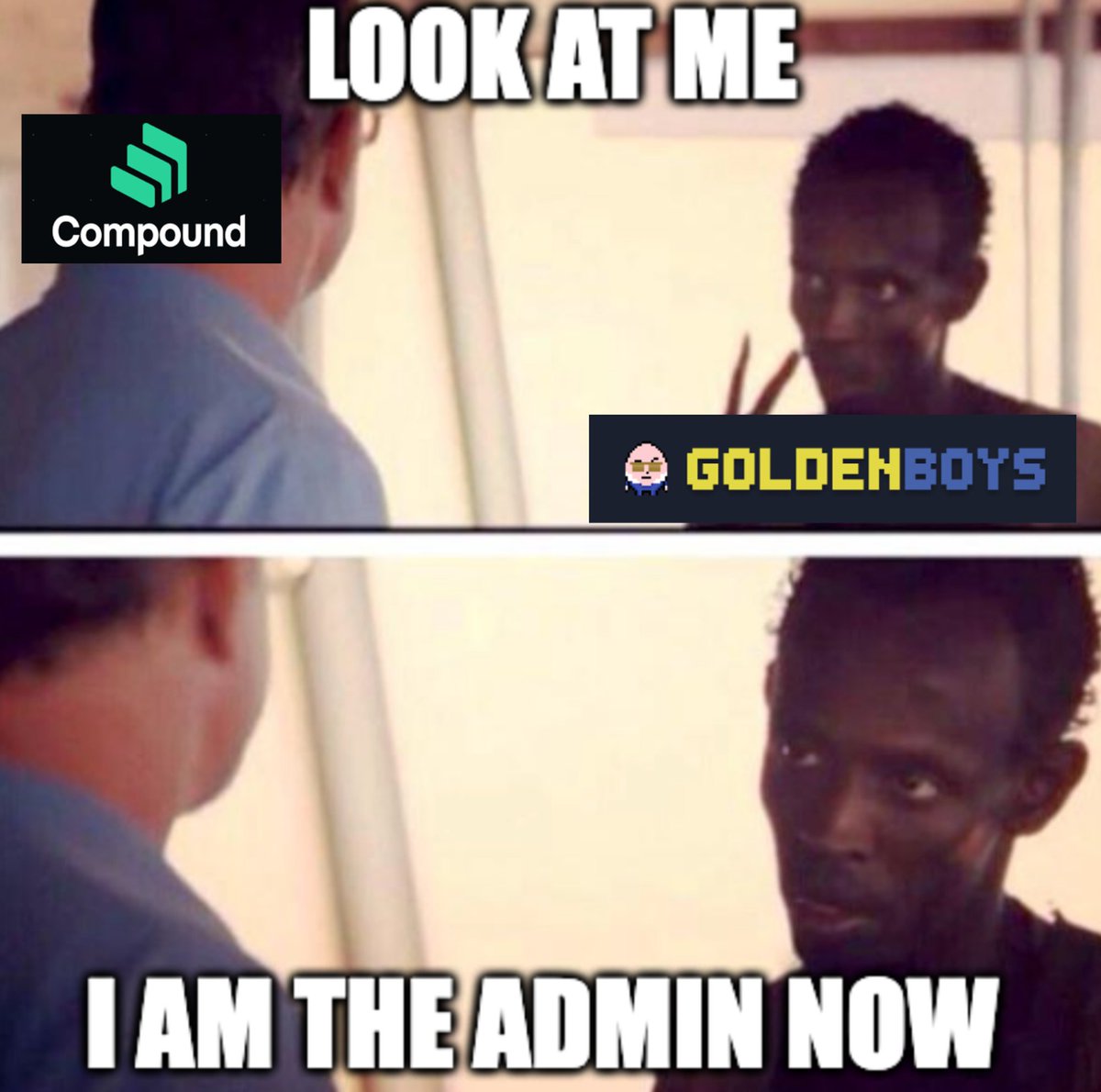
1/ Compound Governance Attack Pt. 2
Humpy’s proposal has passed, and the execution time lock is ticking.
Humpy seemingly controls over 10% of @compoundfinance total supply, with the concern that he can pass any governance proposals that he desires, hurting Compound.
קטע חזק מלפני שלושה ימים בערוץ הלבנוני אל-מיאדין שבמהלכו ילדה עזתית נשאלת מה היא הייתה רוצה להגיד ל"התנגדות" (חמאס ושות') והיא עונה: 'הם נמצאים למטה במנהרות ואנחנו (למעלה) הקורבנות האזרחים...' אל-מיאדין המזוהה עם המחנה הפרו איראני דאג לחתוך את הקטע הזה מהריאיון איתה שעלה לרשת