Taylor smart cryptocurrency trading assistant #ICO is live NOW. Visit the website for details. #TaylorTokenSale#TokenSale https://t.co/2sJW639Xph
https://t.co/YFLtcOy49H
Here are some great books to read on holiday - as riots shake British cities, as we celebrate the release of Russian dissidents and Putin welcomes his assassins, the Bangladeshi despot shoots students in the streets, famine war and slaughter intensify in Sudan, the US election hots up and the Middle East quakes as Israel awaits the revenge of Iran and its terrorist vassals, here are some great history books for reading pleasures this summer. Ones I have relished this year. This doesn’t include fiction – I ll do another list of those sometime.
The Eastern Front @nick_lloy Prof Nick Lloyd is one of the books of the year and a masterwork. Izabela the Valiant is a work of such urbane and worldly charm and delight a biography of the great 18thC collector and Polish patriot and lover Princess Izabela Czartoryska by Adam Zamoyski. All His Spies The Secret World of Robert Cecil is a biography of the chief minister of Elizabeth and James I and it is one of the greatest biographies, a masterwork beautifullyand intensely written and researched by Stephen Alford. Theodoric is one of my favourites because it tells superbly a period of Roman history that is always left out @uli_wiemer. Steve Coll’s Achilles Trap is simply brilliant on Saddam, his life and career and his relationship with America. House of Lillies the history of the early French kings is the best sort of dynastic history @mediaevelrevolt and on the same period The Middle Kingdoms a new history of central Europe is really superb by Martyn Rady. From Genghis Khan to Tamerlane the Reawakening of Mongol Asia is really a proper biography of Tamerlane which is so much needed and its excellent by Mongol maestro Peter Jackson. Two books on post colonial states explains how Egypt and Indonesia plays special parts in the creation of the world we see today. Indonesian history is little covered usually: David van Reybrouck’s Revolusi tells the history of the creation of Indonesia – again a much over looked story. @davidvanrey. On Middle East history, Nasser is a titanic fascinating gifted figure and in We Are Your Soldiers: how Nasser Remade the Arab World @alexjrowell tells Nasser’s history through his oft disastrous effect not only on Egypt but on Iraq Lebanon and Yemen & Syria. An outstanding read is also Damascus Events by Eugene Rogan on how the Druze – Christian clashes and massacres in the Ottoman vilayets that are now Lebanon and Syria helped create the countries we see today. Kings of Algiers about the Jewish families that played key roles in the Barbary states is v enjoyable original and fascinating @juliekalman. Herod the Great is a short but excellent biography of the last great Judean king – essential for understanding todays Jerusalem and Israel by the great Martin Goodman. On the modern history, the best indeed the essential and compelling read is Palestine 1936 The Great Revolt and the Roots of the Middle East Conflict @orenkessler. On the ancient world, I adored these: the new biography of Justinian @peter_sarris is superb and as a companion I hugely enjoyed the excellent double biography Belisarius and Antonina by David Alan Parnell. Emperors of Rome by Mary Beard is great fun and greatly authoritative @wmarybeard and Tom Holland’s Pax is just the latest in his brilliant series on Imperial Rome – I could put either down of these - both are wonderful @holland_tom.
Finally I must mention a masterwork that is about to come out: Helen Castor’s The Eagle and the Hart: the Tragedy of Richard II and Henry IV - its superb @hrcastor .
And I am just starting Nexus A Brief History of Information Networks from the Stone Age to AI by the great world historian Yuval Noah Harari that even in its earliest pages is already outstanding @harari_yuval ….
I am sure i have forgotten a few so i may add them but anyway....
There. A few books for the beach. Enjoy
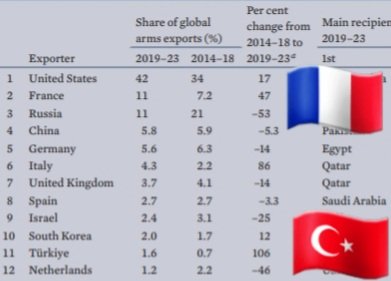
#ArmsExports 📡🚢🛰 tell you who is powerful, technologically advanced, credible (equipment protecting others) and favoured by foreign sub-contracts ⤵️
🇹🇷 Turkish (+106), 🇮🇹🇪🇺 Italian (+86) and 🇫🇷🇪🇺 French (+47) arms exports are booming in part due to the above points.
🇹🇷 #Türkiye's share of global arms exports is growing between 2014-18 and 2019-23 (+106). However it still only accounts for 1.6% of global share.
The 🇺🇸 #US has grown from 34% (2018) of global share to a whopping 42% (2023), while 🇷🇺 #Russia has gone from 21% (2018) down to 11% (2023), overtaken now by 🇫🇷 #France.
🇨🇳 #China's arms exports are very small (compared to its economy and size) and has stagnated in terms of sales as it looks like there are few international buyers.
In 2018 🇨🇳 #China's global arms export share was 5.9% and in 2023 it was 5.8%.
All data from @SIPRIorg ⤵️
This interview, with outgoing Bulgarian PM, makes an essential point: Russian political interference enters political systems through corruption https://t.co/mUVCExHdUK
Wolf pups begin howling as early as 3 to 4 weeks old. As they get older, they learn to use their howls to coordinate with other pack members.
This is what it sounds like.
[📹 Certified Floof]
(POLL) Musk has just announced that he may institute a monthly fee for all Twitter users—a universal paywall—after this site has been free for 17 years.
How much would you pay to use this social media platform as it is now, approximately a year after Musk bought it?
Please RT.
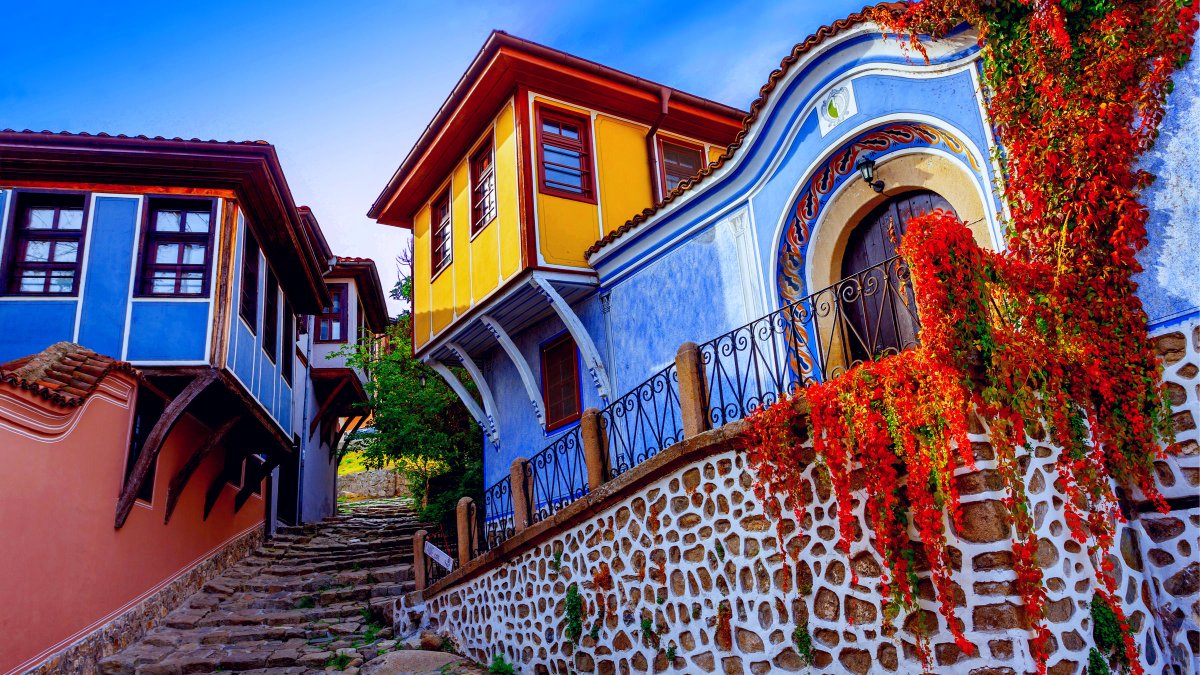
Plovdiv in Bulgaria is one of the most beautiful cities you've (probably) never heard of.
Why? With more than 3,000 years of wild history and architecture influenced by three different continents, there's simply nowhere else like it.
So, here is the brief story of a hidden gem.
In 342 BC King Philip II of Macedon (father of Alexander the Great) founded a city in modern-day Bulgaria and called it Philippopolis. He picked a naturally advantageous site, what with seven steep hills (just like Rome) rising up around the Maritsa River, all within view of the Rhodope Mountains to the south and the Balkans to the north.
There had already been a town in the area since 6,000 BC — it was also once ruled by Xerxes of Persia — and Plovdiv is still filled with ruins left by the ancient Thracians who lived in it so for so long. But it was Philip who established the first truly major city there and settled a mix of Thracians, Macedonians, and Greeks within it.
Over the next two thousand years Plovdiv (which has had many names) was fought over, captured, sacked, and rebuilt several times. Thracians, Macedonians, Persians, Romans (including Marcus Aurelius), Huns, Bulgars, Byzantines, Crusaders, Ottomans, and Russians have all fought over or found their way to this old and storied city.
And what has survived is an architectural and cultural delight. Plovdiv is scattered with ancient ruins, from the tumbled masonry of Thracian and Byzantine walls on Nebet Tepe (one of the seven hills, known as tepes, from Turkish) to the Roman theatre — one of the most complete in Europe, which regularly hosts musical & theatrical performances — and the great stadium which once held 30,000 spectators.
Medieval fortifications have survived too, such as the Hisar Kapia Gate, and as with many Balkan cities Plovdiv has places of worship belonging to Orthodox Christians, Catholics, Jews, Protestants, and Muslims. The Dzhumaya Mosque, built by the Ottomans when they conquered Plovdiv in the 14th century, is the oldest mosque in Europe outside of Iberia.
Its Old Town, which stands on ancient and Medieval foundations, was further developed in the mid-19th century during the Bulgarian National Revival — as national consciousness awakened and the desire for independence from the Ottomans grew ever stronger — hence its profusion of traditional architecture.
Those timber-framed houses, with their jettied stories and projecting windows, are typical of Medieval Bulgarian architecture. And the result is a labyrinth of brightly painted houses and churches built along the cobbled lanes of a Medieval street plan, all raised several hundred feet above the surrounding landscape on the three hills of Nebet Tepe, Dzhambaz Tepe, and Taksim Tepe.
The city was blessed with a new wave of architecture in the late 19th and early 20th centuries, when Bulgaria had revolted from the Ottomans and become an independent kingdom. Then, influenced by the Central European architecture of the Austro-Hungarian Empire, Plovdiv's streets were filled with the colourful stucco and eclectic historicism of cities like Vienna.
Soon enough a neighbourhood called "Kapana" emerged, the cultural and artistic heart of Plovdiv — which, to this day, is filled with artisans' workshops, galleries, cafés, and exhibition spaces. After that came the USSR and a host of Communist-era edifices. In other words, this city has become an architectural palimpsest of the highest order.
Plovdiv is an aesthetic delight, a city of colour and shape, of narrow alleys and shimmering squares, of temples and fortresses and of a vibrant, living culture. And it is also a prime example of architecture's power to tell the whole story of a city.
Each street is lined with thousands of years of war, religion, politics, cultural exchange, revolution, technological progress, and artistic evolution. This is one of the reasons why architecture is so important; it's like a language which brings the world to life. The buildings of Plovdiv are a physical story waiting to be read.
Plovdiv's Old Town also speaks to the profound cultural significance of architecture. Those traditional houses were about a reawakening of Bulgarian identity after five centuries of enforced sleep under Ottoman rule. And this, if anything, is architecture's greatest significance: that the way things are built and how they look matters to people, that in buildings can be manifest identity, meaning, place, and purpose.
Plovdiv is a beautiful city partly because of the unpredictable twists and turns of its history, caught as it was between the cultural and geopolitical cross-winds of countless different empires and peoples down the centuries — and partly by intention, because of how the people who live there have chosen to build and design their wonderful city.