JHU Undergraduate Junior | currently interested in: reasoning, memory, continue learning, and reinforcement learning | applying p.h.d this cycle | I play chess
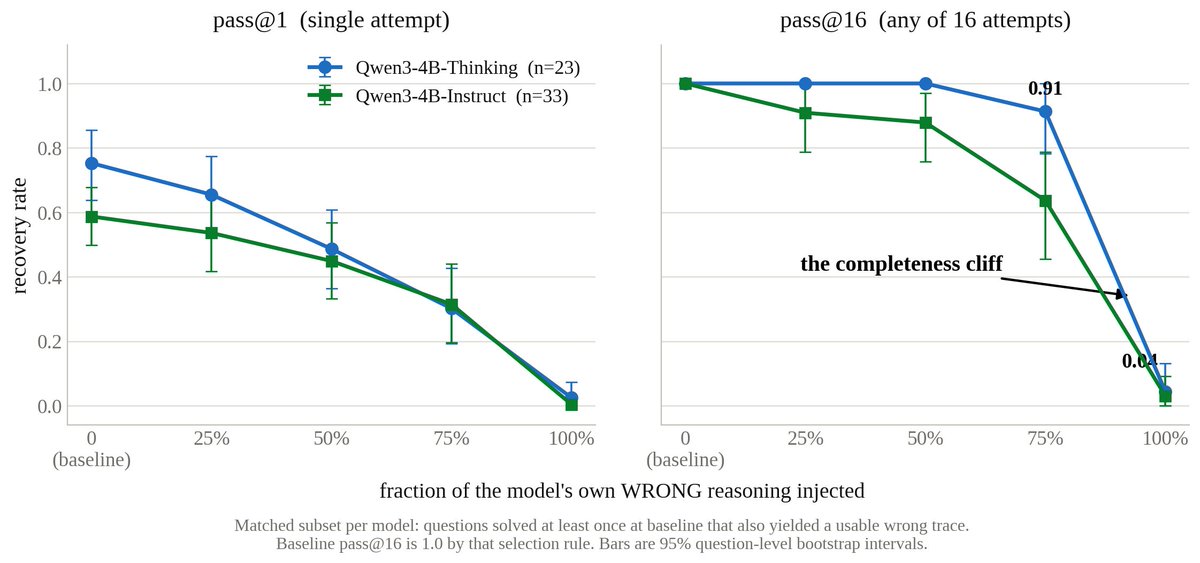
8/N Limits: selected subsets of 23-46 questions, wide intervals at the edge, two 4B models.
Future Works:
1) How does model confidence interact with the observed behavior?
2) What would happen on a multi-turn agentic task?
3) How can training help?
Code is at: https://t.co/oNZChIACgl
Data: https://t.co/hziAPuWABB
3/N Through 25/50/75% of a model's OWN wrong derivation, pass@16 on AIME barely moves (1.00 -> 0.91).
At 100% it drops to 0.04, which on this subset is ONE question correct out of 23. Forcing an instant answer yields the same 0.04, so the open-thinking budget buys nothing there.
7/N If completion is what closes the argument, doubt should reopen it.
Appending "Wait, let me double-check that." to the finished wrong chain roughly triples pass@16 (0.07 to 0.20 thinking, 0.02 to 0.20 instruct). A neutral "So," does nothing.
Partial rescue, not a fix.
2/N How it works:
1. Each model answers 60 AIME problems, 16 samples each
2. Keep the rollouts that ended WRONG
3. Splice one back in where the model works: its think block, or a prefilled reply
4. Vary how much: 25/50/75/100%
5. Grade ONLY the new tokens
1/N Finally found time to put out my second blog post, based on small experiments I ran in my spare time.
If you splice an INCORRECT chain of thought into a model and let it keep going, can it still get there? 🧐 Yes, right up until the wrong reasoning is finished.
https://t.co/ToFZ3audZs
Great to see Brian and the team organizing the TTCL workshop at #NeurIPS2026. If you work on continual learning, memory, or test-time adaptation for agents, consider submitting by Aug 29 AoE! 🔥
📢 Announcing Towards Test-Time Continual Learning Agents (TTCL) workshop at NeurIPS 2026
#NeurIPS#NeurIPS2026
How can AI agents keep learning after deployment without catastrophic forgetting?
🗓 Submission deadline: Aug 29, 2026 AoE
🔗 https://t.co/Kc6tfejUEW
🧵1/n
📢 Announcing Towards Test-Time Continual Learning Agents (TTCL) workshop at NeurIPS 2026
#NeurIPS#NeurIPS2026
How can AI agents keep learning after deployment without catastrophic forgetting?
🗓 Submission deadline: Aug 29, 2026 AoE
🔗 https://t.co/Kc6tfejUEW
🧵1/n
Excited to announce an open-sourcing webui to experiment w/ steering vectors! Works OOTB w/ Gemma 26B A4B and Gemma 4B E4B (for smaller setups), and comes w/ 13 pre-built steering vectors, and lets you build your own - see a demo video below:
So, you elicited an unsafe behavior via activation steering. Does that imply the same behavior can be elicited from the model in black-box form (i.e., via some prompt)?
Our answer: No.
Why? See the answer here! 👇
I remember when I first started learning about LLMs, they could barely handle AIME problems. Now AI systems are helping mathematicians tackle genuinely challenging questions. It’s incredible to see how quickly these capabilities are advancing, and I’m excited to see where this trend leads!
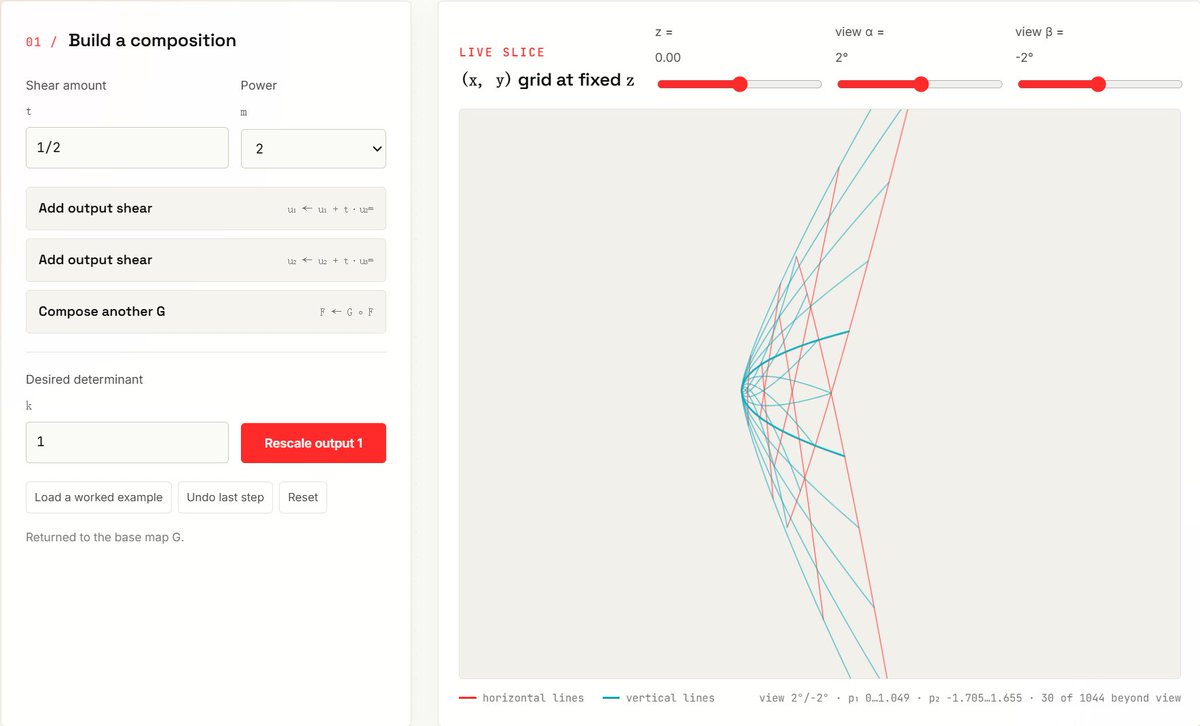
Inspired by the recent Jacobian-conjecture counterexample, I built an interactive playground where you can compose the polynomial map, rescale it to a chosen determinant, follow the exact chain-rule ledger, rotate a live slice, and watch its three-point collision survive.
Built with help from GPT‑5.6 Sol and Fable 5. Come play with it:
https://t.co/UpJph0qmF0
🚨 Banger from IQuest Research:
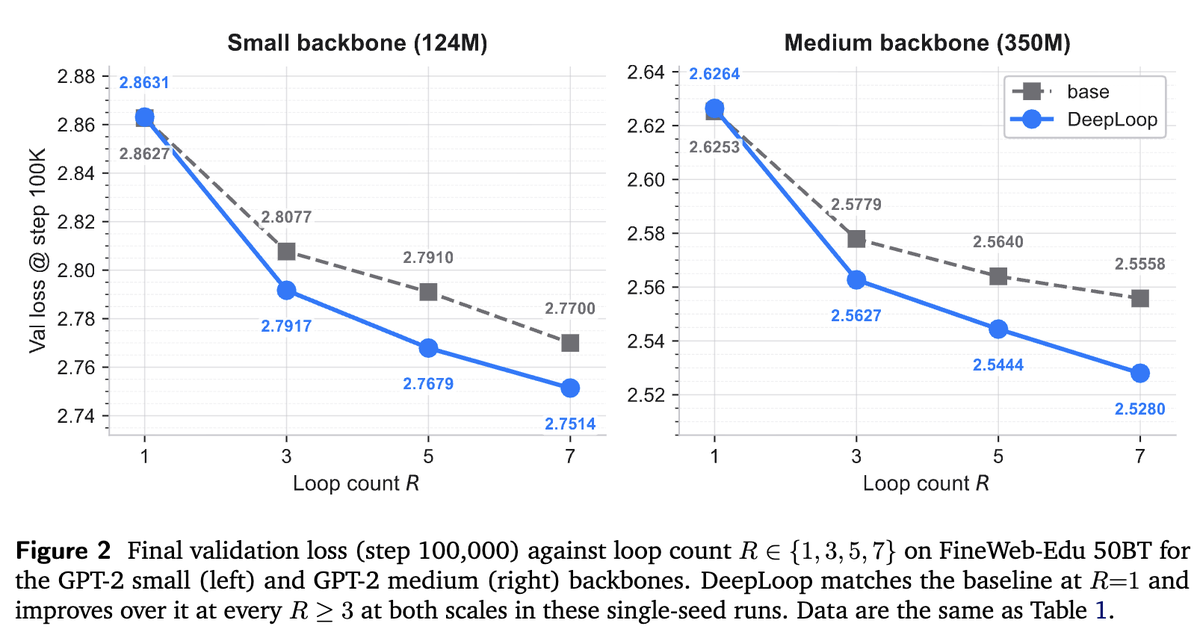
A loop model that beats its non-loop counterpart under the same wall-clock training budget and a matched inference compute budget, while using ~1/3 fewer parameters and optimizer states.
A meaningful step toward making loop models more practical and valuable for real-world deployment. Insightful one!
hello there the jacobian conjecture is false thanx to my close friend akhil for asking about it and my other close friend fable for working during the world cup final
((1+xy)^3 z + y^2 (1+xy) (4+3xy), y + 3 x (1+xy)^2 z + 3 x y^2 (4+3xy), 2 x - 3 x^2 y - x^3 z): \C^3\to \C^3, has jacobian determinant -2, and sends (0, 0, -1/4), (1, -3/2, 13/2), and (-1, 3/2, 13/2) to (-1/4, 0, 0)
Automatic harness evolution appears to be a promising path toward AI self-improvement, but we find that its gains still largely come from repeated sampling and show limited generalization.
Blog post: https://t.co/RgL1lLnetC
Code: https://t.co/Pv9DZ9IHnL
Heard that some frontier models are basically a 48-layer transformer looped twice (48L x 2).
Now we are introducing DeepLoop: Depth Scaling for Looped Transformers (https://t.co/jtxllo9aFF),
making the loop transformer stable and scalable!
What comes after harness engineering? 🤔
Reasoning models already internalized what CoT prompting was used to elicit. Interleaved reasoning + tool use is basically a stronger, learned ReAct. The natural next step: internalize the agent loop itself. Planning, tool use, error recovery, verification, memory, stopping. Maybe even tool design and skill composition.
Given only a repo, a goal, and basic tools, could a model behave like Codex or Claude Code without a detailed prompt or external controller?
But should we want full internalization? My tentative view: cognition moves in, enforcement stays out. The model should own planning, verification, recovery. The harness keeps sandboxing, permissions, budgets, and auditing: an enforcement layer that deliberately doesn't trust the learned policy.
Where should we draw the boundary? And how would we tell genuine internalization from tool-format memorization? For example, would the behavior survive being dropped into a completely different agent loop?
Curious about related work and counterarguments.