New issue is out👉https://t.co/7FRErzTs9T
Introducing DANDELION, a method to identify core genes of complex traits, the cover depicts a lung adorned with dandelions and background patterned with ATCG sequences representing application of the framework to reveal new asthma genes
Our paper is out today in Cell, "Trans-regulatory gene mapping prioritizes disease drivers in asthma", https://t.co/EcuxU2XIO3 🎉 GWAS hands us thousands of disease-linked variants, but the genes that actually drive the disease often aren't the ones sitting at those variants.
Mendelian Randomization Methods for Causal Inference: Estimands, Identification and Inference - Yao - 2026 - Statistics in Medicine - Wiley Online Library https://t.co/LuNVROTRrg
Last spring, the U.S. Food and Drug Administration (FDA) approved the first blood test to help diagnose Alzheimer’s. @ColumbiaMSPH's Dr. Zhonghua Liu explains how the new FDA-approved test works and the ways it can benefit patients. https://t.co/kAVtWjzuOQ
We're thrilled to share our latest publication, A statistical framework for multi-trait rare variant analysis in large-scale whole-genome sequencing studies, in @NatComputSci. Sincerely thanks to @XihongLin for incredible mentorship, @muzizimumu1, @ZHLiu13, @pnatarajanmd, Dr. Gina Peloso, Dr. Jerome Rotter, @AlisaManningPhD, Dr. Laura Raffield, Dr. Ken Rice, @ProfJoseeDupuis, all collaborators and study participants from the @nih_nhlbi TOPMed Program and the @uk_biobank.
Large-scale whole-genome sequencing (WGS) studies have opened new avenues for studying the genetic underpinnings of complex diseases through the analysis of rare coding and noncoding variants. However, it remains challenging to identify the pleiotropic effects that rare variants in genes and regions may have on multiple traits.
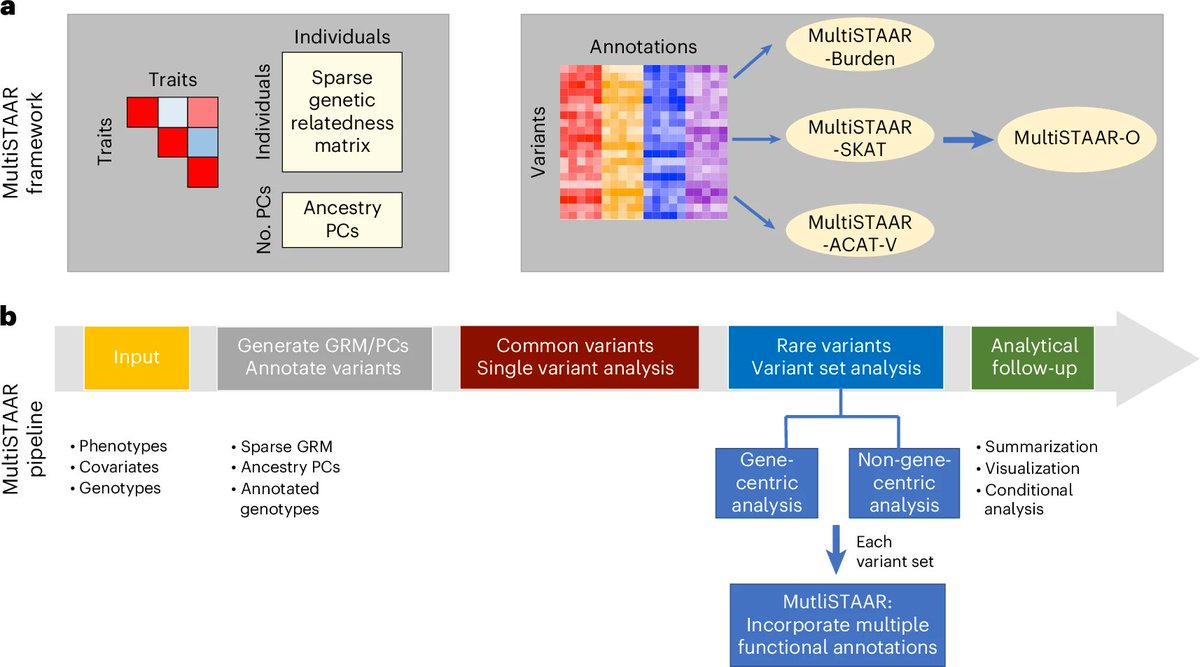
That’s why we developed MultiSTAAR, a scalable and functionally informed multi-trait rare variant analysis framework for detecting pleiotropic effects, with the following features:
• Accounts for relatedness & population structure
• Leverages cross-phenotype correlation structure
• Incorporates multiple functional annotations
• Integrates into the all-in-one rare variant analysis tool STAARpipeline
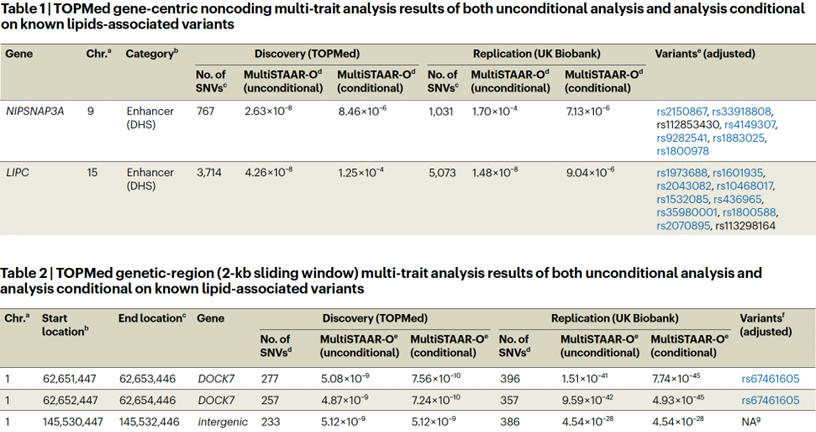
We applied MultiSTAAR to jointly analyze three lipid traits (LDL-C, HDL-C and triglycerides) in 61,838 ancestrally diverse samples from the NHLBI TOPMed Program. MultiSTAAR detected five putatively novel associations in multi-trait analysis but missed by single-trait analysis, including the associations of enhancer rare variants overlaid with DNase hypersensitivity (DHS) sites in NIPSNAP3A and LIPC, and the associations of two sliding windows in DOCK7 (chromosome 1, 62,651,447–62,653,446 bp; chromosome 1, 62,652,447–62,654,446 bp) and an intergenic sliding window (chromosome 1, 145,530,447–145,532,446 bp). These five associations could all be replicated using the UK Biobank 200K WGS data.
We further applied MultiSTAAR to analyze a broader spectrum of phenotypes in the TOPMed WGS data, including (1) multi-trait analysis of fasting glucose and fasting insulin (n = 21,731) and (2) multi-trait analysis of four inflammation biomarkers (C-reactive protein, interleukin-6, lipoprotein-associated phospholipase A2 activity and lipoprotein-associated phospholipase A2 mass (n = 9,380), demonstrating the applicability of the method.
In summary, MultiSTAAR provides a powerful statistical framework and a computationally scalable analytical pipeline for large-scale WGS multi-trait analyses in complex study samples. As biobank-scale sequencing studies continue to grow in both sample size and phenotype diversity, our method holds the promise of improving the understanding of the complex trait genetic architecture by elucidating the role of rare variants with pleiotropic effects.
MultiSTAAR is open source. The R package MultiSTAAR can be downloaded from https://t.co/v6O96pmOcK, which is integrated as part of STAARpipeline (https://t.co/occB9MbYG5).
Excited to share our latest work in Cell Genomics!
Using a novel MR method integrated with AlphaFold3, we identify Alzheimer’s-associated proteins with 3D structural changes.
https://t.co/Q5lnLo7zqn
@BaccarelliAA@GaryWMiller3@ColumbiaMSPH@CellGenomics
Innovation meets discovery! Columbia Mailman researchers unveil a cutting-edge pipeline that links protein biomarkers to Alzheimer's and predicts 3D changes, paving the way for early detection & breakthrough treatments. @ZHLiu13@GaryWMiller3 https://t.co/LANobOk8Ia
Novel all-in-one computational pipeline offers insights into Alzheimer's mechanisms and potential drug targets https://t.co/4DkuDHOzce via @medical_xpress
Deciphering causal proteins in Alzheimer’s disease: A novel Mendelian randomization method integrated with AlphaFold3 for 3D structure prediction
• This study introduces MR-SPI, a novel Mendelian randomization method, to address biases in identifying causal protein biomarkers for Alzheimer’s disease (AD) using protein quantitative trait loci (pQTLs).
• MR-SPI leverages the “Anna Karenina Principle” to select valid pQTL instruments, ensuring robust inference despite potential confounding factors.
• The framework integrates AlphaFold3 to predict 3D structural alterations in proteins caused by missense mutations, providing insights into the mechanistic underpinnings of AD.
• Applied to genome-wide proteomics data from 54,306 UK Biobank participants, MR-SPI identified seven proteins (CD33, CD55, EPHA1, PILRA, PILRB, RET, and TREM2) linked to AD risk, with structural mutations further validated through 3D predictions.
• The results highlight distinct associations: proteins like TREM2 and CD55 are negatively associated with AD risk, while CD33 and RET show positive associations.
• MR-SPI also reveals existing FDA-approved drugs targeting these proteins, suggesting potential avenues for drug repurposing in AD therapy (e.g., CD33-targeting gemtuzumab for leukemia).
• This study offers a comprehensive pipeline to explore causal proteins and predict their structural effects, paving the way for new therapeutic interventions and drug repurposing strategies in AD.
@ZHLiu13@BaccarelliAA@HarvardChanSPH@GaryWMiller3 @ColumbiaMPSH
💻Code: https://t.co/QI27ypKcPB
📜Paper: https://t.co/g9NQloyB7O
We aim to characterize the association between multiple co-occurring climate threats and neurodegeneration. Many statistical and data science challenges are waiting to be resolved!
https://t.co/fjaTkoRpn8
Gave a talk at STATGEN 2024 on Recent Developments in Mendelian Randomization Methods for Causal Inference. Thanks for the great turnout! #TrialSampleTwitter - via #Whova event app
Gave a talk at STATGEN 2024 on Recent Developments in Mendelian Randomization Methods for Causal Inference. Thanks for the great turnout! #TrialSampleTwitter - via #Whova event app