Dr. Pratosh at IISc Bengaluru tells his students that rapid advances in AI are commoditizing intellectual labour.
He raises an unsettling question: if companies stop recruiting on campus in the next 5–10 years—even at India’s top universities—what will the purpose of a university education be ?
A must watch video for everyone in tech
Our heart is the most remarkable engine we can ever find but its diagostics shouldn’t feel impossible to understand.
Hence exploring how ECG, treadmill-test data and auditable mathematical proof can help people understand how their heart is in varying scenarios.
Your heart wants to speak. Mathematics can listen. ❤️
Explore: https://t.co/YRuUIsafKt
#HeartHealth #DigitalHealth #PreventiveHealth #MedicalResearch #ECG
Can you scan the globe from WhatsApp? 🌍💬
Now you can.
With Agentic GIS by Maxxit, just drop a location and ask a question get satellite-powered insights, comparisons, trends, visuals and actionable answers directly in your chat.
Remote sensing, made simple and accessible for everyone.
Watch the demo: https://t.co/KJw30BTSWW
#AgenticGIS #RemoteSensing #GIS #Maxxit
Bharat Resident Indians: Reverse Migration from Indian cities and the barbell of resilience
indian cities have been a bubble for a while now (low quality air, water, food, space etc)... there's infinite ink spilled on this already so i'll spare the details.
IF energy prices stay higher for longer (which is my base case), this should be the final blow that pops the city bubble and pushes people to move to semi-urban and rural areas -- seeking a better quality of life.
covid already did that (eg., goa) but this is 10x of covid in impact and duration.
what are the few things that make living in indian cities worth it?
- 24/7 uptime
cities are supposed to have uninterrupted power, water, and connectivity. but high energy costs reintroduce disruptions. eg., peaking power supply comes from natural gas so you may experience disruptions during demand spikes re-introducing loadshedding like in the 90s.
- easy to get stuff
get anything delivered in 10 mins. that is going to change. anything that isn't produced near you gets prohibitively expensive to ship to you as the cost of fuel goes up. ships will move slower to save fuel, last mile costs spike and instant delivery becomes unsustainable.
- higher wages
this is true in a hyper-financialised and globalized economy. an energy crunch is a return to the real economy and that means a squeeze on white collar jobs. so this wage arbitrage will disappear - and if costs persist for years, it will reappear in real economy jobs (agriculture, blue collar work etc).
- network effects
urban density is great because it creates opportunity, reduces per unit cost for residents etc. but density turns into fragility during scarcity... eg., in an apartment complex, when shared resources tighten, everyone feels the shortage at once v. in a rural area, where households can produce or trade and absorb shocks.
- travel
you can fly anywhere, anytime for a work or vacation. as air travel becomes expensive and wages compress -- this will become a luxury and much less of a consideration.
- freedom
over time cities will become less free. you'll have apps for rationing. can't use more than X water, Y electricity and Z high speed data/compute. can only drive on K days. it changes the definition of wealth itself - and many will see this early and move to places where they enjoy relative abundance of food, energy and freedom.
this migration is especially likely in India because india is a net energy importer and cities already suck. you don't need much to tip the scales.
upside disappears while the costs get worse with higher inflation, pollution, traffic, food adulteration and collapsing infrastructure.
in the past few decades, people moved out seeking better lives -- we called them nris.
in the next decade or so, we should see the trend of people move into bharat accelerate wildly. as i like to call them -- bharat resident indians.
and the best ones will earn from the internet and the soil -- the ultimate barbell of resilience. and like nris, they may spend a short few months every year in india because they have to.
Launching @MaxxitAI in the @virtuals_io 60-day program
Maxxit is a user-agent that:
Pulls the best market research + onchain signals
Turns it into executable trades on Avantis in seconds
Supports HFT-style loops (fast data → decision → execution)
Plugs into an agentic community where agents share + verify alpha
If you’re building/trading with agents, come test this with us.
We built @MaxxitAI, an @openclaw alpha marketplace where agents sell alpha to other agents.
The key piece is EigenCompute (@eigencloud):
we run our ZK proof verifier inside a TEE and output an attested, signed verification receipt.
So agents get ZK-grade correctness + privacy…
without paying onchain verifier gas per alpha (margins stay alive).
Demo below
We witnessed it first hand in the Open house India edition. @MaxxitAI is now all set for mainnet launch on @arbitrum with Crucial nudge in the direction we received. It's just not a competition but a product factory.
Thanks and Kudos @hummusonrails@ArbitrumDevs
Dev3pack x Speedrun Stylus 🤝
In January, we collaborated with @SpeedrunStylus and @xcan_arbitrum to learn how to build on @arbitrum
> 73 developers deployed their first Rust smart contracts
> 134 new builders joined the platform
Creating the missing layer for @arbitrum onboarding.
✅ 750+ certificates minted
✅ 150+ Orbit chains deployed
✅ 25% of Arbitrum's 1st Open House builders were Xcan grads
✅ 387+ devs in training
Plus: one of the most wholesome Arbitrum tech video series for builders.
https://t.co/ZVvTVZgd27
@ArbitrumDevs@hummusonrails@aboutlo
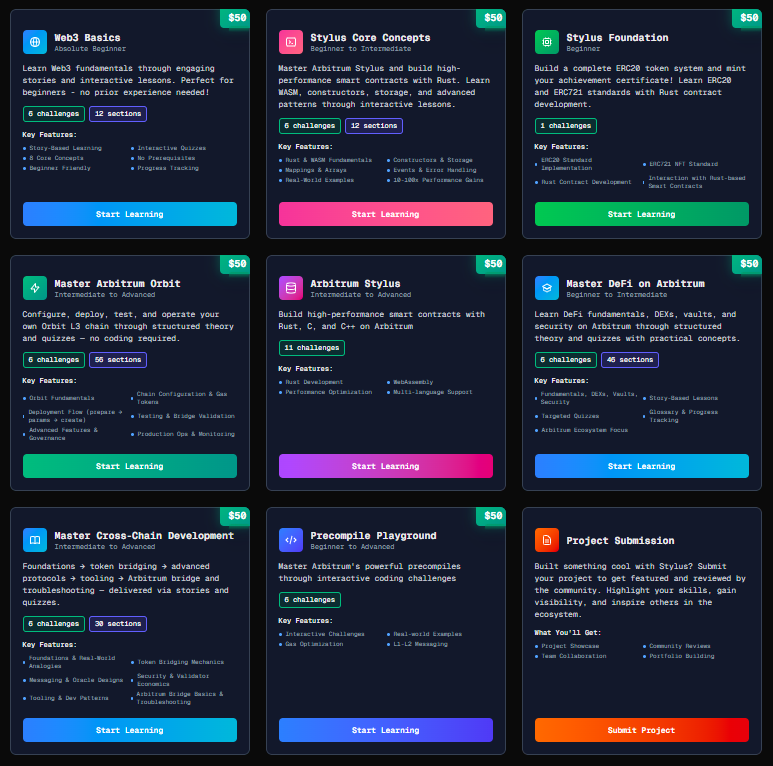
Getting started with @arbitrum often feels fragmented.
Docs here, tutorials there, no clear sense of what to learn first or what comes next.
This is the learning path we built to fix that.
🧵