This line from Atomic Habits isn't ready to leave my head:
"It doesn't make sense to continue wanting something if you're not willing to do what it takes to get it. If you don't want to live the lifestyle, then release yourself from the desire. To crave the result but not the process is to guarantee disappointment."
Be boring. Don't chase trends. Don't follow opinions. Do your own thing. Things that feels right in your heart. Wake up early. Go for walks without music. Read books that takes weeks to finish. Watch old films nobody talks about. Music that's rare. Build a private, unimpressive life that makes you deeply happy. A slow life that feels like your own. That's all that matters.
Btw aku baru tau kalo ternyata rasa putus asa itu datangnya dari setan, termasuk pikiran "ah dosaku banyak, nggak usah ibadah sekalian lah"
padahal Allah Maha Penyayang, Allah Maha Pengampun, dan Allah menerima taubat hamba-Nya. Allah itu dekat
the wealthiest people i know all had one thing in common. they seemed genuinely interested in life. they asked questions. they noticed little details. they got excited about books, recipes, travel, music, ideas. curiosity is such an underrated kind of wealth.
My one boring tip to anyone in their 20s is to resist the temptation to rot in your room every time you get a free moment. Dismiss any neuroses you have about going outside and "being perceived".
Genç kardeşlerim
Kitap okumayı sevmiyorsunuz biliyorum ama en azından 3-4 kült kitabı okuyun. hayatınızı ve olaylara bakış açınızı değiştirecek.
İnsanların ne kadar basit varlıklar olduğunu anlayacaksınız. Stratejik düşünceleriniz gelişecek. Bu hayatta sizi hiçbir güç, hiçbir alanda manipüle edemeyecek. Hayata herkesin gördüğü açıdan bakmayıp her alanda önde olacaksınız.
Nedir bu kült kitaplar
1)Machiavelli-Prens
2)Sun Tzu-Savaş sanatı
3)Mario Puzo-Aptallar erken ölür
4)Mario Puzo- Omerta
5)Beyaz zambaklar ülkesinde-Grigoriy
Petrov
6)G.Orwell/ 1984
Major cheat code for life: Stop dragging yesterday into today. The argument. The mistake. The missed chance. It’s already gone. Stop reliving it. Life happens in the direction you face.
A mentor once told me this: Reduce the amplitude of the wave. Never get too high on the wins. Never get too low on the losses. Emotional stability is the real cheat code for adapting to the inevitable uncertainty of life.
Uncommon advice:
If you don't know what to pursue in life right now, pursue yourself.
Pursue becoming the healthiest, happiest, most healed, most present, most confident version of yourself. Then the right path will reveal itself.
가난이 진짜 무서운 이유는,
단순히 돈만 없는 게 아니라 내 시간과
뇌 용량을 통째로 도둑질해 간다는 거임.
돈 몇 푼 아끼려고 버스 환승 기다리고,
최저가 검색하고, 마트 가격 일일이 비교하느라
사소한 데 뇌 용량을 다 써버리니까 에너지는
바닥나고 스트레스만 오지게 받음.
그래서 "가난은 아무도 월급을 주지 않는
무급 투잡과 같다"는 뼈 때리는 말이 있는 거임
반대로 부자는..음..
Carl Jung came to this same conclusion.
Avoiding work causes more pain, and ultimately neuroses, than any pain the work causes.
With enough avoidance, one comes to adopt and embrace the part of us avoiding the work until it becomes a personality of “I can’t”
We are seeing that a lot now.
A lot.
writing will genuinely change your life more than motivation ever will. not in some cringe “manifest your dream life” way. i mean in a very real, practical way. most people never actually stop long enough to understand what’s going on inside their own head. they just react to life all day. scroll when they feel uncomfortable. distract themselves when things get quiet. jump from one dopamine hit to the next. but writing forces you to slow down for a second and actually look at your thoughts instead of running from them. and the weird part is you usually don’t even realize what you truly think until you start writing it down.
writing doesn’t just record your thoughts it creates them. ideas start flowing that you didn’t even know were there. patterns start showing up. emotions start making sense. problems become easier to solve because they’re no longer this giant fog floating around in your head. writing organizes your mind. every high performer, every sharp thinker, every person who just gets it, they all write. It keeps showing up as the common thread. not the expensive stuff. not the complex stuff. Just pen and paper. they write because feelings are vague but words are precise. every time they sit down and search for the exact word to describe what’s inside them, they become a sharper, more powerful communicator.
“people follow the person who can say what they mean and mean what they say. writing every day is how you build that muscle until it becomes second nature.”
over time, all that accumulated writing becomes a resource you can draw from forever. the more you write, the more material you have to solve problems, connect dots and think bigger.
the better you get at putting thoughts into words, the better you get at communicating in general. and honestly, communication controls a huge part of your life. like relationships, opportunities, business, confidence, influence, all of it comes down to how clearly you can express yourself. and no, you don’t need to be some amazing writer either. your grammar doesn’t need to be perfect. nobody cares. half the benefit comes from simply getting thoughts out of your head and onto paper.
some of the best writing advice i’ve ever heard was:
“write badly. just write.”
because the moment you stop trying to sound smart or perfect, your real thoughts finally start coming out.
even 30 minutes a day changes something in you. you become calmer because your mind isn’t carrying around a thousand unprocessed thoughts anymore. you become more self aware because you start noticing your own habits and emotional patterns. you become more articulate because you’re practicing turning feelings into language every single day.
if you write every day, your future self gets to sit down and read exactly how far you’ve come. i think that’s more valuable than any photo album.
who knows maybe one day all that writing becomes a book, a course, something you give your children. at the very least, it becomes proof that you were here, that you grew, that you tried.
that’s one of the coolest parts about it. writing lets you watch yourself evolve with time.
seriously. start writing. doesn’t matter if it’s in a notebook, your notes app, twitter wherever. just sit, think about your thoughts and write.
just sit down for 30 minutes and let your mind speak for once. and watch yourself becoming unstoppable.
bir hayat hilesi vereyim:
iyi uyku.
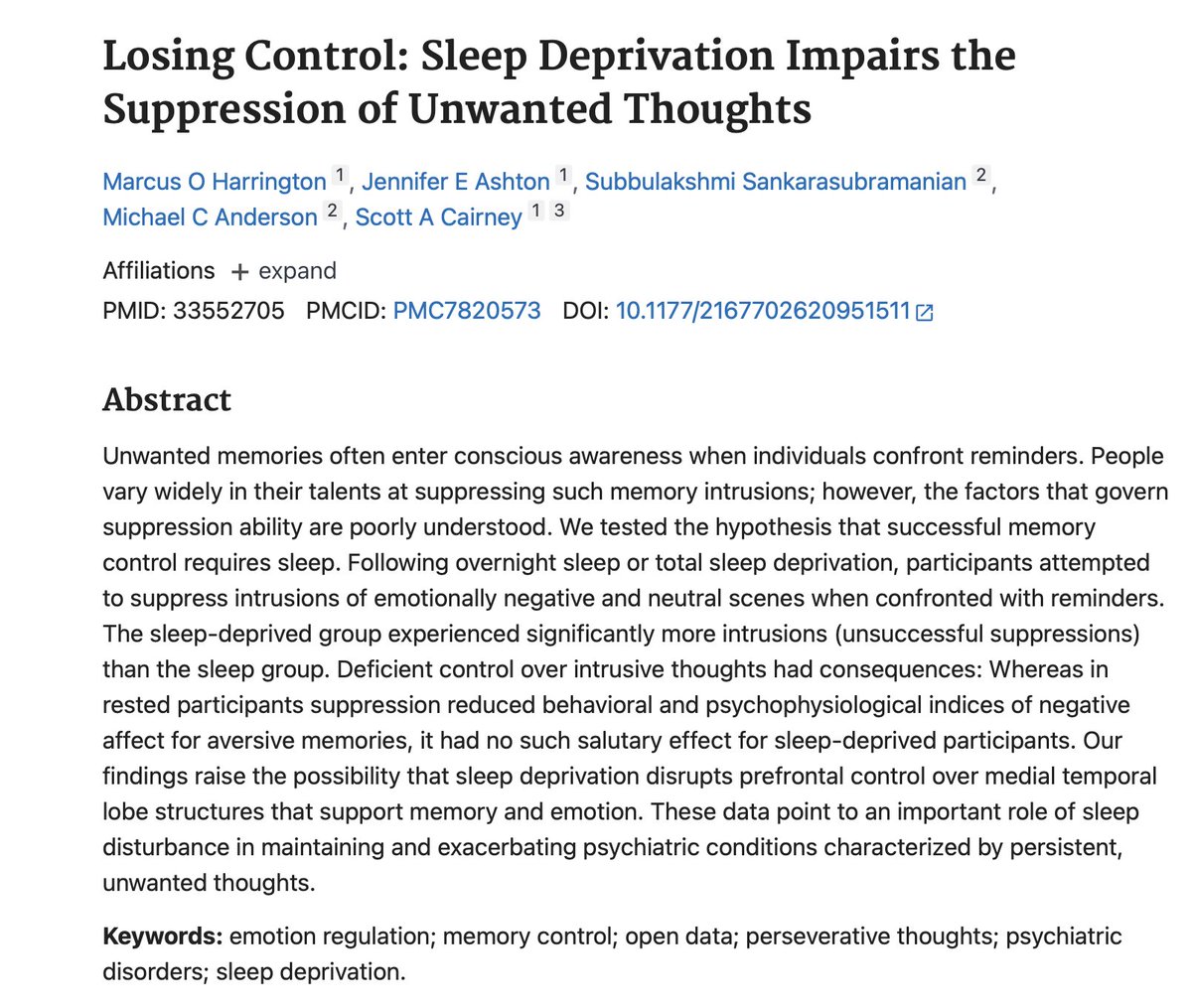
araştırmaya göre, az uyuduğunda istenmeyen düşünceler %50 oranında artıyormuş.
anlayacağın uykusunu az alan kişilerde geçmişten gelen bir anının aklına gelip canlanması daha mümkün...
ve bu anıyı bastırsan bile, geri gelme olasılığı uykusunu alan kişiden daha fazla.
az uyuma, uykuna dikkat et.
The faster technology moves, the more I think about Bezos' question
What won't change in the next 10 years?
Things I've been writing down over time:
- Humans will always need shelter, food, energy, and healthcare.
- The desire for ownership and the accumulation of wealth.
- The physical world will move more slowly than the digital one.
- Every increase in technological capability, especially AI, will require more energy.
- People and businesses will continue to need access to capital.
- Capital will continue to seek returns that exceed inflation.
- Underwriting methods evolve, but demand for credit (loans) is persistent.
- Trust remains scarce and becomes increasingly valuable as content, code, and fraud become cheaper.
- Verified identities and reputation becomes more important as information becomes abundant and synthetic.
- Long-term wealth creation and dynastic (multi-generational) thinking predate modern technology, and will persist.
- Coordination and transaction costs never fully disappear; market friction will continue to justify the existence of firms and intermediaries.
- People will continue to compete for status.
- Consumers will pay a premium for products and services that confer status.
- Time remains fixed at 24 hours per day.
- But attention is a finite resource and an enduring constraint.
- Products that credibly save time (or enable delegation) have a perpetual market.
- Inaccessible, proprietary data will be a persistent moat. The more inaccessible and difficult to aggregate, the deeper the moat.
- People want accountability, recourse, and clearly identifiable responsibility when things go wrong.
- Regulation consistently lags technological innovation.
- Compliance requirements, licensing, and regulatory moats persist even when machines can perform the underlying task.
- Local knowledge remains valuable and difficult to replicate.
- Heterogeneous markets (like real estate) continue to reward people with deep contextual understanding.
- Incumbent organizations tend to underinvest in disrupting their own businesses, which always creates opportunities for challengers.
Bezos' insight on what wouldn't change in 10 years was "Customers will always want lower prices and faster delivery."
It's boring/ true, but I think that's the point.
Everything we build today can and will be rebuilt more cheaply, faster by someone else.
Build on the invariants, not the trends.
What have I missed?
Your brain adapts to whatever scale you give it. If you spend your days scrolling simple feeds, your mind literally loses the capacity to handle deep books. You are shrinking your own intelligence by choice.
Life rarely changes in a positive way without an increase in responsibility.
That can mean taking ownership of your health or committing to a relationship or starting a business.
Whatever it is, if you want the trajectory to change, the amount of responsibility usually has to change.