Google finally made the AI Search reality clearer.
And the message is not what a lot of “GEO/AEO hack” posts are selling.
Google’s official guidance says AI Overviews and AI Mode still depend on core Search systems: ranking, indexing, quality, retrieval, and crawlable content.
So no, AI Search is not killing SEO. It's killing COMMODITY content.
- Build pages worth retrieving.
- Create content with unique POV, expert depth, first-hand insight, and original analysis.
- Make your site crawlable, indexable, fast, readable, and technically clean.
- Stop obsessing over llms.txt, artificial chunking, AI-only writing styles, fake mentions, and special AI schema.
So, the winners will not be the brands publishing the most articles but the brands building the most useful, trustworthy, and retrievable information systems in their niche.
Official Google guide:
https://t.co/7oIjViK99A
Before you write a single line of content, find the developer who stayed up till 3 a.m.
That’s where the story starts.
Authoritative content doesn’t come from keywords — it comes from people.
The ones who debugged the nightmare update, handled the midnight meltdown, or found the 40-hour shortcut.
Find them. Listen.
One real story can fuel a month of content.
I saw this firsthand while interviewing UX design experts for a @HubSpot piece.
@Saul_Sadka If you bomb another country, you should expect to be bombed.
That's a simple logic.
If you don't understand this logic, you probably shouldn't bomb anyone.
@OpenAI played me dirty today, and I'm incredibly disappointed to share a frustrating experience with their subscription policies.
I've been a ChatGPT Plus user for 25 months.
Recently, I ran out of my 10 Deep Research queries with 21 days left in my billing cycle.
So, I went to check the details of the Pro plan and clicked “Get Pro” just to view more info.
I wasn't quite sure about buying it.
So, I wanted to check the details first.
To my surprise,
it immediately upgraded my subscription—without a second confirmation!
OpenAI charged me $186.16 out of $200, mentioning that I already had $13.84 worth of bandwidth remaining in my Plus plan.
Fair enough!
I knew I could get a refund.
I did not use Pro at all. Not even once!
Just to ensure eligibility for a refund.
Then, the $186.16 refund was approved. Great!
But then I learned I couldn’t return to my previous Plus plan (no return policy) and suggested that I purchase a new Plus Package.
So I did.
I gave up my $13.84 and paid $20 expecting a fresh start.
Instead, I found that my Deep Research queries were still exhausted.
Why?
Turns out, their usage limits are tied to a 30-day rolling window, not your purchase date!!!!!
So I paid for a “NEW” plan… and got the leftovers of my old one!!!
WOW!
Imagine paying full price for a fresh pizza today and receiving leftovers from yesterday's order that I couldn't take away due to their no-takeaway policy!
That’s exactly what happened.
I reached out to support and I got robotic responses citing:
"Policy to prevent exploitation of limits by upgrading, downgrading, or resubscribing."
Dude, a con would simply use another email!
I have 10+ email accounts!
You wouldn't even know!
If usage resets follow a 30-day cycle, why does payment reset immediately?
Isn't that strange?!
I'm sharing this to notify others in the tech community, especially for the friends who use ChatGPT regularly.
Check OpenAI's fine print before subscribing, and be cautious of upgrades considering their policy.
We deserve transparent policies that prioritize user experience rather than exploit mistakes.
I’m not here for the $13 difference.
But it questions the fairness of a leading tech company with millions of users and how they are treated.
I hope #OpenAI takes a closer look at how subscription logic and refund mechanics align and ensure policies are user-first, not just policy-first.
#OpenAI #ChatGPT #AI #AIusers #TechCommunity #Tech #UserExperience #UserFriendly
Modals are one of the most misunderstood elements in content marketing.
Over the last decade, I’ve seen them work brilliantly.
And I’ve seen them drive users away in frustration.
So how do giants like @Google, @Reddit , and @Airbnb get it right?
That’s why I wrote a practical guide for @HubSpot covering:
- Modal vs. modeless vs. pop-up
- When to use modals for max impact
- Best practices for accessibility, mobile, and UX in 2025
- Examples from Google Docs, Reddit, Airbnb & more
Modals can be super powerful, if you respect your users’ attention.
🔗 Read the full guide on HubSpot 👇
https://t.co/2pBplBXa8m
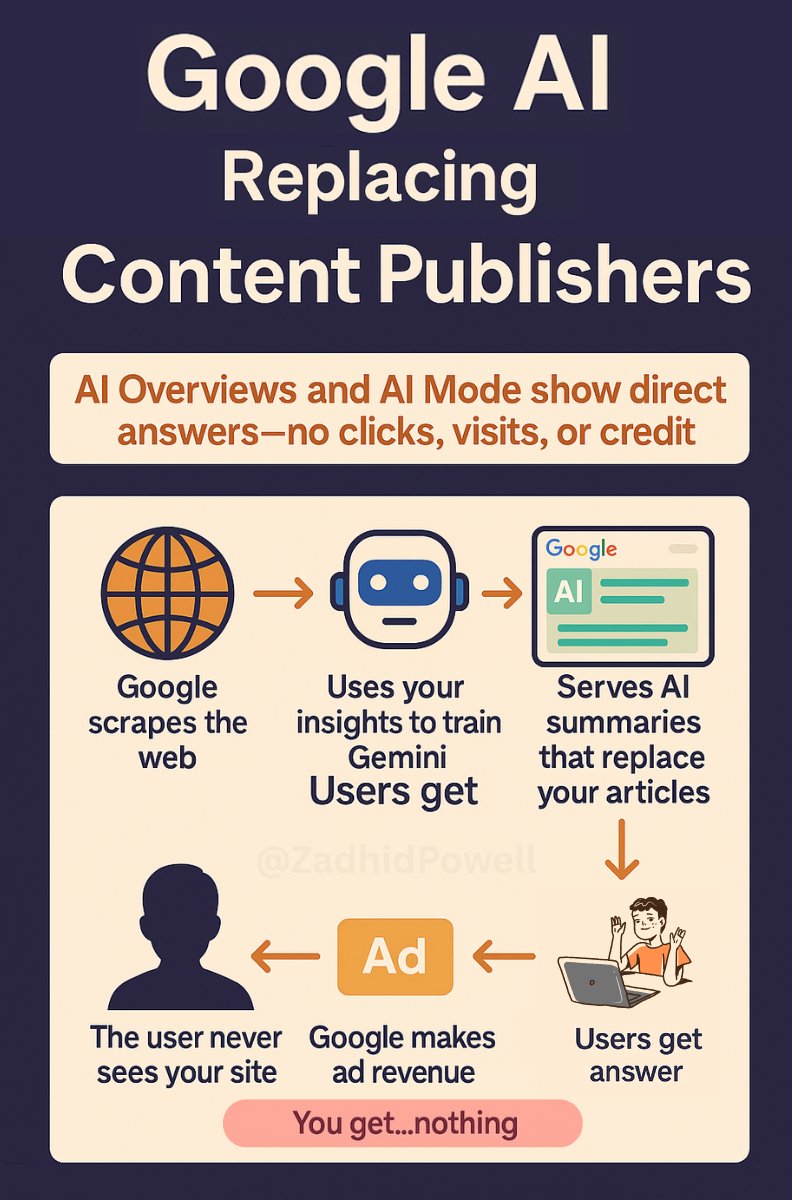
Google AI just made content publishers optional.
If you're writing content to be read, you might want to sit down.
Google used to be the bridge between publishers and readers.
Now, it’s cutting out the connection and becoming the seller itself.
Google isn’t just pointing to answers anymore, it’s taking over the delivery.
That means:
- No clicks.
- No visits.
- No credit (unless you squint for a tiny link).
But yes — ads inside the AI box for Google!
Google is about to,
- Scrape your content
- Train Gemini with your insights
- Serve AI summaries replacing articles
- Show ads in the AI box and make revenue
You get no traffic, no credit, no revenue.....nothing!
Sure, they say it’s for user experience.
But content publishers?
We're feeding the machine that’s bypassing us!
It’s already starting.
So, how do publishers, marketers, and businesses survive?
✅ Build un-Googleable content: real experience, case studies, data.
✅ Own your audience though blog, email, community, andnewsletters.
✅ Stop chasing SEO tricks, start offering value AI can't compress
Google changed the game. Now it’s on us to change how we play.
Create what can’t be copied, and build where Google can’t follow.