Highly recommended! 4+ stars! 'Journeys of Black Mathematicians' two-part documentary series "connects each subject with history, mathematics, and personal passion," writes J. Zimmerman. Now on public TV & streaming at https://t.co/0OPqkzpijU https://t.co/0QfkRDjDfm #jbmfilm
Here is a beautiful list! 125 free math textbooks, written by the mathematicians who teach the courses and shared on their own university pages. No sign-up, no paywall, no pirated copies. From high school algebra to graduate analysis. 👇
https://t.co/RHYaBMiKF1
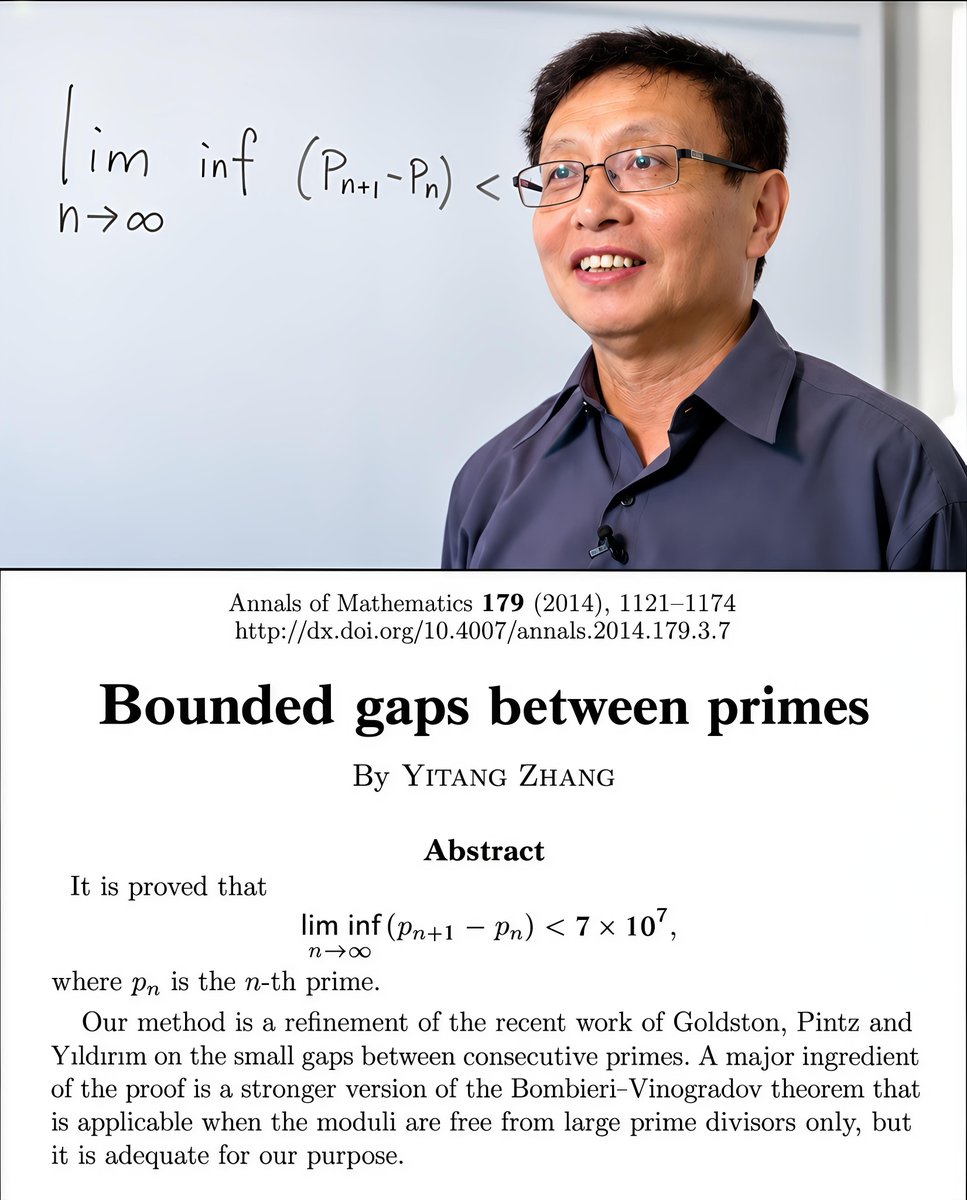
In April 2013, a 58-year-old mathematician named Yitang Zhang submitted a paper to the prestigious Annals of Mathematics.
At the time, he was virtually unknown in the mathematical community.
After earning his PhD from Purdue University in 1991, Zhang struggled to find a permanent academic position.
For years, he worked outside academia, including at a Subway sandwich shop, before eventually becoming a lecturer at the University of New Hampshire, where he taught undergraduate mathematics.
Yet throughout those difficult years, he continued pursuing his own mathematical research, particularly the mysteries of prime numbers.
In July 2012, while visiting a friend in Colorado, Zhang was sitting quietly in the backyard when an idea came to him. He had spent three years working on a problem involving the gaps between prime numbers, and suddenly he saw a way past an obstacle that had frustrated some of the world's leading number theorists.
Over the following months, he carefully developed that insight into a rigorous mathematical proof.
On April 17, 2013, he submitted his manuscript to the Annals of Mathematics.
The response was remarkable. Within just three weeks, the referees had delivered an unusually enthusiastic report, recognizing the work as a landmark achievement. The paper was formally accepted on May 21.
For centuries, mathematicians had wondered whether infinitely many pairs of prime numbers could occur within some fixed distance of one another.
The famous twin prime conjecture predicts that infinitely many pairs differ by exactly 2, such as 11 and 13 or 17 and 19.
Zhang did not prove the twin prime conjecture itself. Instead, he established something that had never been proved before: there are infinitely many pairs of consecutive primes whose difference is less than 70 million.
Seventy million might seem enormous when compared with 2. But the crucial breakthrough was that the gap was bounded by a fixed number, no matter how far along the number line one went.
It was the first proof that bounded gaps between consecutive primes occur infinitely often.
His discovery opened an entirely new chapter in number theory, inspiring mathematicians around the world to improve his bound. In 2014, Zhang received a MacArthur Fellowship in recognition of his extraordinary achievement.
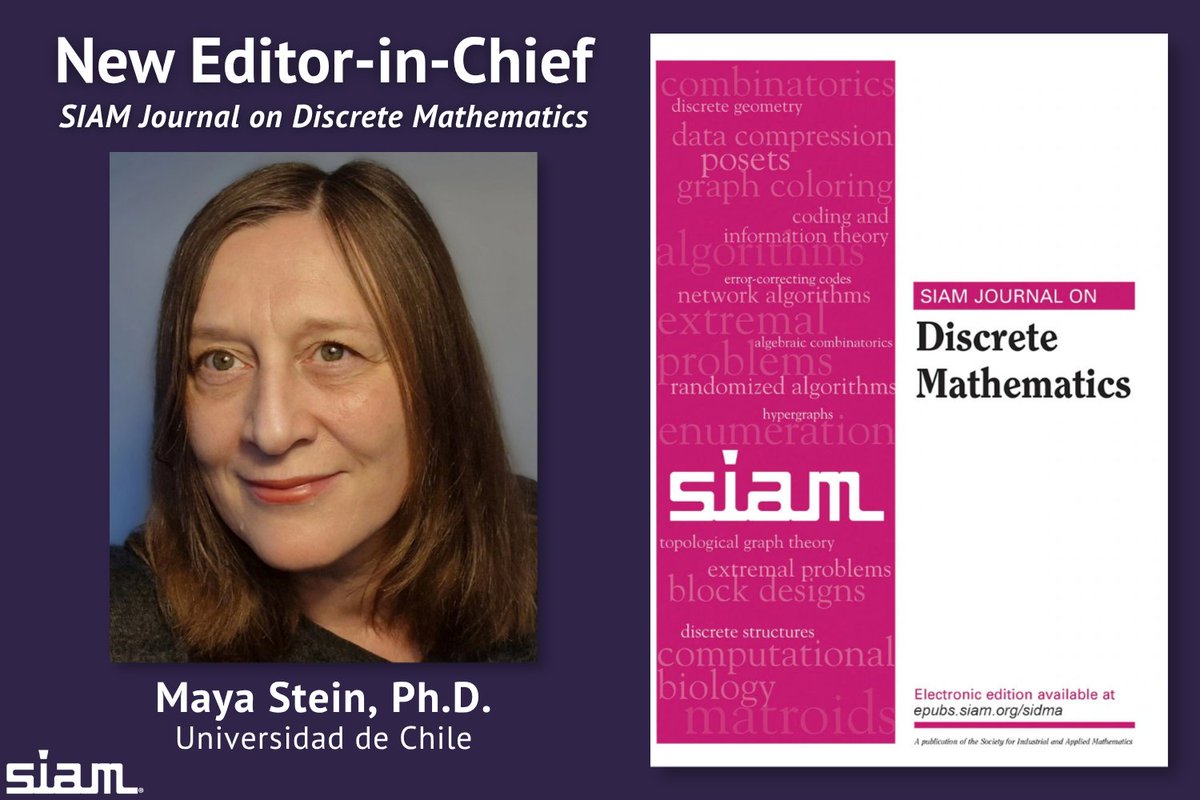
SIAM is pleased to announce the appointment of Dr. Maya Stein, @uchile, as Editor-in-Chief of SIAM Journal on Discrete Mathematics (SIDMA). Dr. Stein's tenure began in July of 2026.
Submit your best work in discrete mathematics to SIDMA: https://t.co/R6pyv2qHM0
Why are numbers beautiful? It’s like asking why is Beethoven’s Ninth Symphony beautiful. If you don’t see why, someone can’t tell you. I know numbers are beautiful. If they aren’t beautiful, nothing is.
-- Paul Erdős
Have you joined or renewed your AWM membership? Your membership helps us increase the presence and visibility of women in the mathematical sciences and support the careers of mathematicians like Anne Shiu.
Join or renew today!
🔗 https://t.co/KlenH44Ron.
#AWMMath#WomenInMath
Click on the screen below to hear a fun little snippet of my conversation with @AlexKontorovich in this week's "The Joy of x" podcast, as he recalls how inhibited he felt (at first) when working with the great mathematician Jean Bourgain.
For the second time, Mason Porter and Evelyn Sander have awarded Alternative Fields Medals (AFM)
The 2026 winners are Edray Goins, Jonathan Mattingly, and Joel David Hamkins.
https://t.co/yxAAqTGMgJ
Details in the thread 🧵 below
The Ruskai Research Fund supports the career and research advancement of women mathematical scientists. Join us in congratulating our 2026 award recipients: Dr. Sarah Chehade and Dr. Emily Heath!
On Saturday, OpenAI announced solutions to three Erdős problems (#146, 180, and 183). These solutions, along with May’s high-profile counterexample to the “unit distance” problem, are quickly and radically changing how mathematicians approach their work. @kkakaes reports: https://t.co/ejf2azRKnj
At a conference, Evelyn Boyd Granville was asked about her greatest accomplishments. Many people expected her to mention her work on Project Mercury, which helped send astronaut John Glenn into orbit in 1962.
Instead, she said, “First of all, I proved that women understand math.”
She also said, “As an African American, I showed people that we have the same ability to think and learn.”
We later learned that Evelyn Boyd Granville passed away on June 27 at the age of 99, at her home in Silver Spring, Maryland.
Our work is now on display at the #ICM2026. If you are there, please give it a look in the #MathArt gallery. There are more pictures here: https://t.co/UWSZn3nHpD, and you can find a gallery of all exhibited mathematical art here: https://t.co/O2UMvA68by.
Today at #ICM2026: SLMath Trustees Dr. Marilyn Simons, Dr. Dan Freed, and Dr. May Chu are among those pictured here awarding the 2026 Chern Medal, founded by Dr. Chu in honor of MSRI / SLMath co-founder Dr. Shiing-Shen Chern, her father.
Can't attend #ICM2026 next week but want to keep up with the action?
We'll be livestreaming the opening and closing ceremonies and the IMU prize winners press conference and reception on the Simons Foundation YouTube channel: https://t.co/Xq17NOEKlZ #math
Looking for new ways to explore mathematics? Enjoy 35% off 5 Fabulous Activities for Your Math Circle during the AMS Summer Reading Sale.
Featuring five engaging activities designed to encourage problem-solving, collaboration, and mathematical discovery, this book is perfect for educators, students, and math enthusiasts alike.
Sale ends July 4.
Link in comments.