If you have compute hungry AI ML tasks, you can spin up an Intel Gaudi2 instance and watch it just rip.
I wrote a quick Python script to use the facebook/detr-resnet-50 model (🙏🏻 @huggingface) to detect and label objects in a video.
It's interesting that no one is talking about Intel Gaudi vs NVIDIA A100 or H100.
Gaudi2 isn't cheap at $10.42/hour but it feels like a viable alternative to fighting someone for an A100 or H100.
Here's my code if you want to try it out:
https://t.co/Eq3xJIAMzb
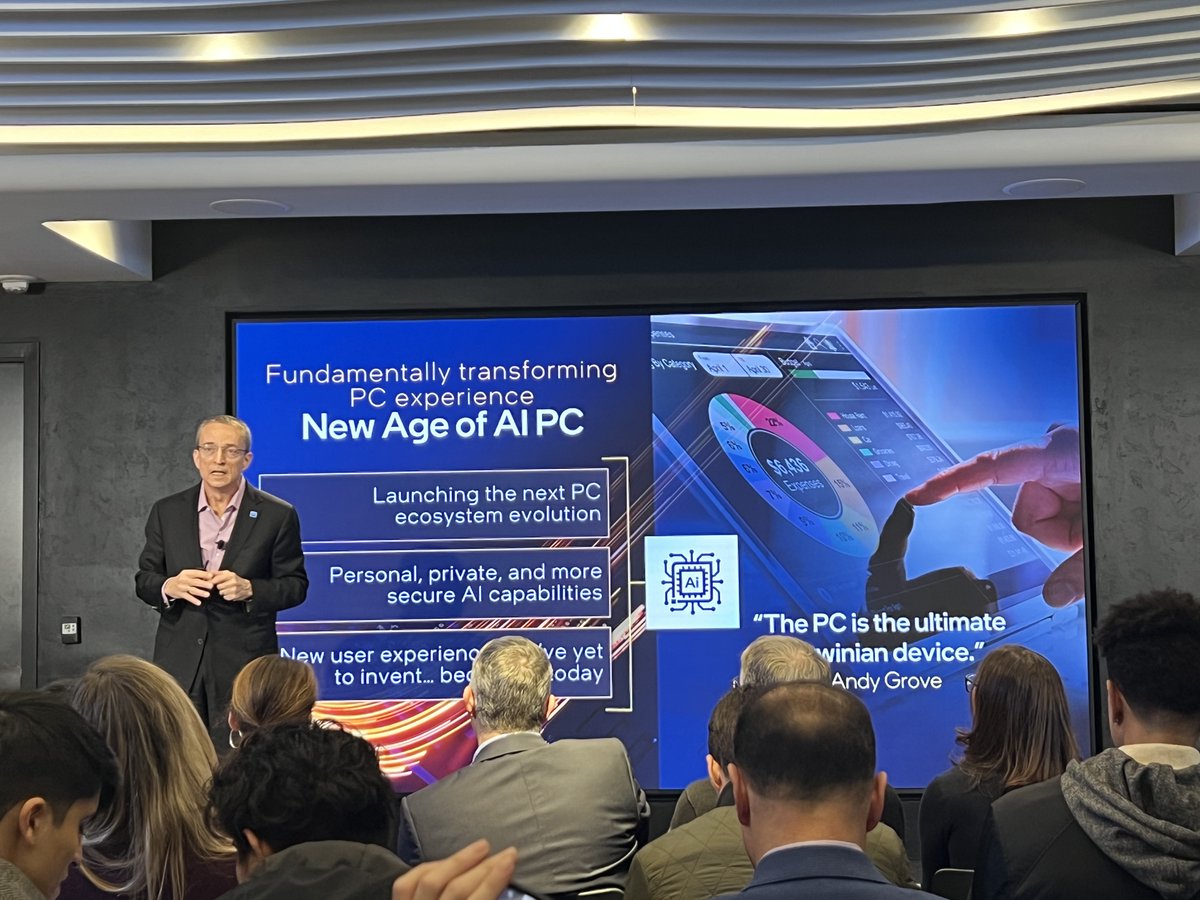
My @X "dissertation" on last week's @Intel event in NYC.
TLDR: Big positive changes for $INTC in past couple of years. But still work to be done. Directionally positive across the board with a sound AI PC story and progress in its CPU and ASIC designs for the datacenter.
Intel's AI Everywhere Event Unveils Strategic Moves in the Era of AI
Last week, Intel took center stage in New York City for its highly anticipated AI Everywhere event. Attendees at the Nasdaq MarketSite excitedly awaited insights from CEO Pat Gelsinger on how Intel plans to compete, grow, and innovate in the rapidly evolving landscape of AI, with generative AI emerging as the hottest topic of 2020.
The primary objective of the event was to communicate to the broader markets that Intel has a comprehensive plan to seize opportunities in both the PC space and the data center. One key focal point was the shift towards a new PC architecture, specifically the move from AI workloads being done on core CPUs to neural processing units (NPUs). This transition aims to enable large language models and other generative AI capabilities to be executed on devices with minimal latency, irrespective of available connectivity.
Over the course of an action-packed hour, we heard from CEO @PGelsinger and his top lieutenants including EVPs Michelle Johnson, Sandra Rivera, and Christoph Schell. The focus areas included client, datacenter, and go to market.
In the race for AI PC market consideration, major players such as AMD, Qualcomm, and Intel have each outlined their AI Processing Unit (AIPC) strategies. Pat Gelsinger, Intel's CEO, emphasized the company's commitment to Meteor Lake (Core Ultra), revealing that the first versions of an AI PC are already shipping and available today.
One of the distinct advantages that I see for Intel comes in its deeply rooted distribution networks and OEM relationships. Intel had the CEOs and top executives of essentially all of the world’s PC makers join the event (virtually) to discuss their commitments to Intel and its current and future client offerings. From Michael Dell to Satya Nadella, it was clear the company had the support and designs needed to drive adoption of its new AI PC offerings.
A pivotal aspect of the event was Intel's strategy to compete in the data center arena. Recent announcements from AMD, particularly its MI300X specifications, have positioned the company as a formidable competitor to NVIDIA A and H series in both inference and training. Intel, however, is dealing with delays with Ponte Vecchio and has had to lean in on its Habana products (Gaudi 2), emphasizing its performance in training, including the cost-effective training of OpenAI's GPT-3.
While acknowledging the importance of GPUs and ASICs in AI computing, Intel highlighted the significant computing horsepower offered by its fifth-generation Xeon (Emerald Rapids) CPUs for AI workloads. The event effectively addressed the question of whether Intel has what it takes to compete in AI, showcasing the company's progress and commitment to overcoming challenges from the past decade. While powerful GPUs are certainly the most flexible and in demand for the world’s small but meaningful subset of organizations developing LLMs, it is also well understood that a lot of acceleration can be done more efficiently on the core CPU, and this has long been a focal point for Intel.
Intel's IDM 2.0 strategy, aiming for five processes in four years, has been running close to on schedule, instilling confidence among investors and customers. CEO Pat Gelsinger's is also focused on geopolitical challenges, particularly those related to China and Taiwan, positions Intel uniquely, given its commitment to substantial capacity expansion in the United States. This matches our sentiment at @TheFuturumGroup, which sees the critical importance of more U.S. based capacity for leading nodes–Intel is well positioned to capitalize on this need.
The AI PC opportunity received positive reception, with Intel's early market entry providing a chance to leverage its robust distribution and partner ecosystem however many wanted to hear more about the datacenter opportunity...
In the data center space, Intel faces a more extended journey, but initiatives like Gaudi 3, OpenVino, and OneAPI signal progress in developer utilization and higher abstraction layers. Intel remains steadfast in its belief that it can provide genuine competition to both @NVIDIA and @AMD while serving as a valuable partner to hyperscale providers.
As the industry anticipates continued vertical integration by cloud providers, Intel's event underscores its dedication to remaining a key player in shaping the future of AI. The strategic moves unveiled at the AI Everywhere event position Intel as a resilient contender, ready to navigate the evolving landscape of AI with confidence and innovation. In the past 2 years under Pat Gelsinger’s leadership it is hard not to see meaningful improvement–even for the perma-bears, which may at some point need to look around to see this isn’t the same Intel that created the mess that Gelsinger and his team has been busy fixing.
$AMD $NVDA #GenAI #GPU
CXL: The Future Of Memory Interconnect?
An explosion in data is driving the need to be able to scale memory up and down in a way that roughly mirrors how processors are used today https://t.co/Nz0UiQFh5D
#CXL#MemoryPooling#DRAM#datacenters#FlashMemory#virtualization
Thanks to all that listened in to our spaces recap today with @melisevers. I’m very proud of our “sneaky Intel engineers” that were able to deliver a surprise at #IntelInnovation Intel Announces Sierra Forest Xeon CPU With 288 Cores https://t.co/FAVaokegaC
It will be amazing to see what the world does with this chip. Democratizing quantum computing indeed. and. just. wow. Congrats James Clarke and team!
#iamintel https://t.co/wxLP8PTH5C
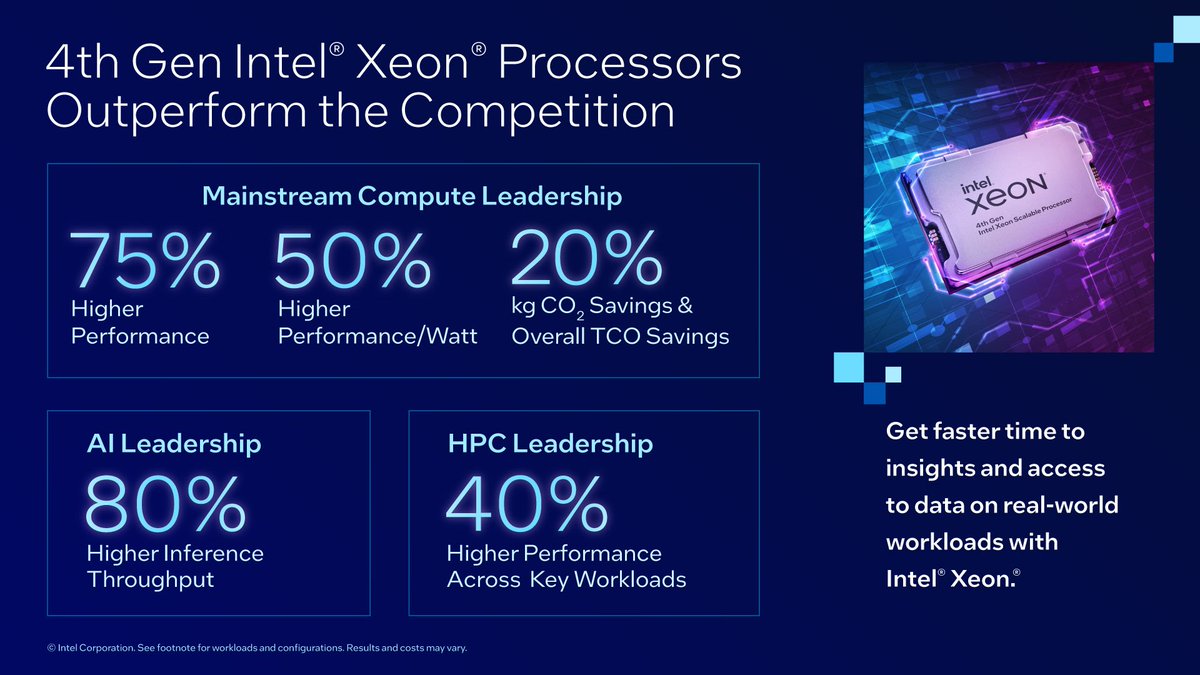
"4th Gen Xeon is leading the industry and powering the workloads that matter most to customers, and we have concrete data to prove it true,” says @LisaSpelman.
Read about 4th Gen Intel Xeon outperforming the competition on real-world workloads. https://t.co/fCAv5hVE97
Outstanding results from AWS on training LLMs with Intel Gaudi accelerator. Scaling efficiency results especially. Take a look...
#iamintel https://t.co/C5dM9eA6il
Delighted to see DOE investment in new cooling technologies supporting sustainable datacenters. Also proud to see the Intel team supported with one of the grants. Congrats Mark Macdonald, Ashish Gupta and Tim Gates. https://t.co/4BTYKlp45D
Check out this great overview of DC-MHS (Data Center Modular Hardware Specification) progress from OCP Prague regional event. Jabil shares their experience developing products to the new standard and the tremendous reuse opportunit…https://t.co/5w77bASPfN https://t.co/w7G3GGpkLW