Japan 🇯🇵 will probably beat Brazil 🇧🇷 today. And not by accident.
Japanese players became elite when they started benchmarking themselves with the elite. By playing in Europe.
That's why I keep saying, Bangladeshi founders need to integrate with the SF/Bay Area ecosystem.
SF/Bay Area is not just "where startups happen."
Just audit all the products you use in a day. Doesn’t matter where you live. An overwhelming % is built out of SF/Bay.
It’s where how the world lives, and will live, is crafted.
Harshita Arora was 17 when she cofounded AtoB and got into YC.
I was 27 when I cofounded Posterous and got into YC.
Nicolas Dessaigne was 37 when he cofounded Algolia and got into YC
It doesn’t matter what age you are. YC is the community to join to go fast when starting.
This is one of several reasons you shouldn't drop out of (or skip) college to start a startup at 18. Founders who do that tend to match the second paragraph rather than the first, because they haven't had time to have the "earned insight" he describes.
The companies I love working with in office hours are the ones where the founder has a specific, weird, earned insight that nobody else has. Not "AI for X." A genuine edge that came from living inside a problem.
The ones that are dying almost always have the same pattern: technically competent founders building something nobody asked for, moving metrics that don't matter, avoiding the conversation with the one user who'd tell them the truth.
The lucky thing is that 2nd type of founder can become the 1st kind if they don't stand still, they are willing to talk to people, try things, and always seek high rate of learning.
One of my favorite lessons I’ve learnt from working with smart people:
Action produces information. If you’re unsure of what to do, just do anything, even if it’s the wrong thing. This will give you information about what you should actually be doing.
Sounds simple on the surface - the hard part is making it part of your every day working process.
"I don't think many tech companies execute M&A well."
Palo Alto Networks CEO @nikesharora breaks down his strategy for successful M&A:
"Purchase price is an irrelevant artifact. If it's going to work, it's going to work phenomenally well, or you're going to screw it up. It's not what you paid, it's what you're able to do with it."
"You could say that Instagram was expensive, or YouTube was expensive, or DoubleClick was expensive. They all worked perfectly. AOL Time Warner is a different story. So it boils down to how you execute past the price you pay for it."
"In tech, when you buy a company, you buy a team, you buy an existing product, and you buy a roadmap for the future. The question is: can you deliver on that roadmap? Can you accelerate that roadmap? Does it work?"
"We sign a term sheet, and we ask the founders to sit with our team and redesign the product roadmap so we like it and they like it. And if they don't agree with our expectations and we don't agree with theirs, we don't buy the company."
"We make them in charge. My teams have to work for them, which makes them really unhappy. And not many of them like it. But I'm like, look, these guys went out there, raised money, kicked your ass in your category, and you want them to work for you? That makes no sense to me. You're going to work for them. Learn from them."
"So our job is to enable these people. We look at them and say, whatever your business plan was when you were a small private company, find me a business plan that's twice as assertive and bold as the one you had then."
"We've built a phenomenal system to take them to market. I have 3,000 people in the field... 3,000 people go out there and see 10,000 customers. So that's where the secret sauce kicks in."
"We've bought 34 companies so far. I think our hit rate on things that have worked is over 70%."
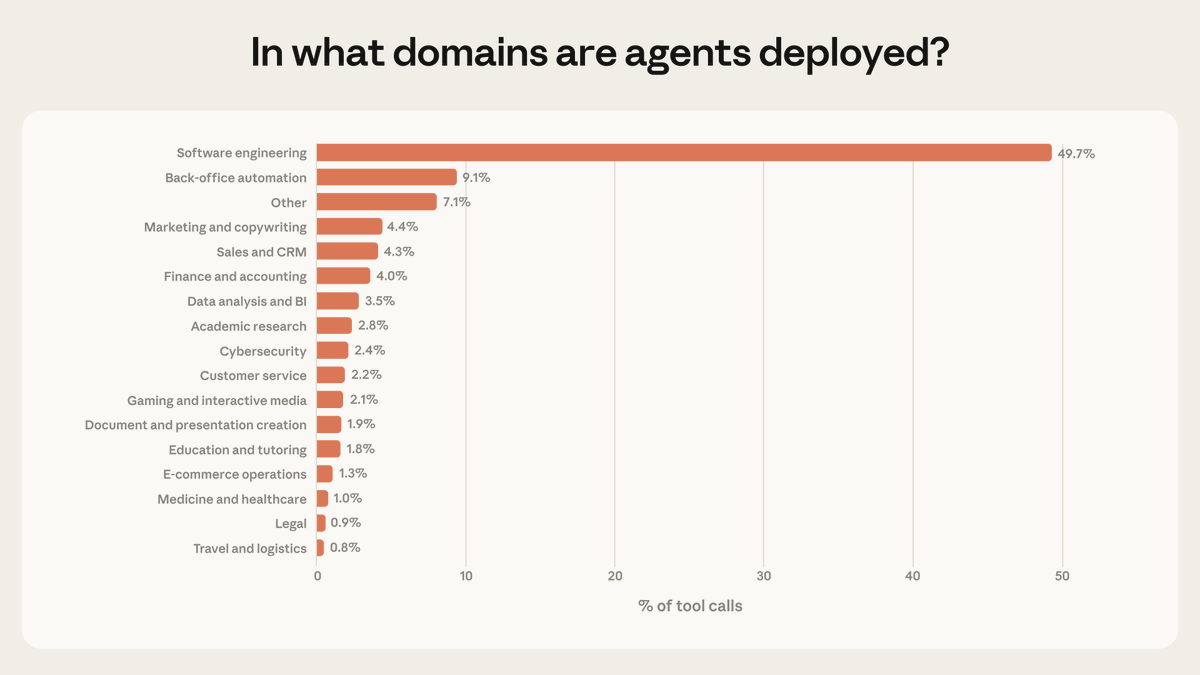
Software engineering makes up ~50% of agentic tool calls on our API, but we see emerging use in other industries.
As the frontier of risk and autonomy expands, post-deployment monitoring becomes essential. We encourage other model developers to extend this research.
I won't take credit for the idea, but I had a lightbulb moment today while talking with a longtime family friend in Dhaka. The way to think about the new student-led political party and Gen-Z more broadly is as a "political start-up."
Like any fledgling initiative, to grow and reach its potential it needs some "venture capital" and outside expertise. It may or not succeed, but those who can see the potential can be early "investors" who can help put it on the right track. The founders have the initial vision and they are the ones who convince others to buy-in to the vision and see the long term potential. Just as successful company start-ups have transformed the world, so too can this political version help those who have a vision for a Bangladesh 2.0 achieve their dreams.
I am sure @elonmusk, @JeffBezos and countless other successful founders would agree.
Every country of size will likely have its own AI model and approach, hyper-localized. Trump has made clear no country can rely on US models as it's only option.
The classic software startup writes code to solve users' problems. If AI makes writing code more of a commodity, understanding users' problems will become the most important component of starting a startup. But it already is.
In the aftermath of the fall of fascist Sheikh Hasina government, there has been a deliberate disinformation campaign propagated by certain media outlets regarding the July Uprising. We need to be cautious and stay aware to remain immune to this. Tech Global Institute presents a comprehensive analysis of the campaign.
Every year The Economist picks what we consider to be the most improved nation, for its “country of the year” award. This year the winner is Bangladesh. Our foreign editor, Patrick Foulis, congratulated its interim leader, Muhammad Yunus https://t.co/ACI7hA1vQi