Chinese astronomers have unveiled the mysterious origins of a young pulsar located in the Milky Way's halo, providing compelling observational evidence for the study of such objects' formation.
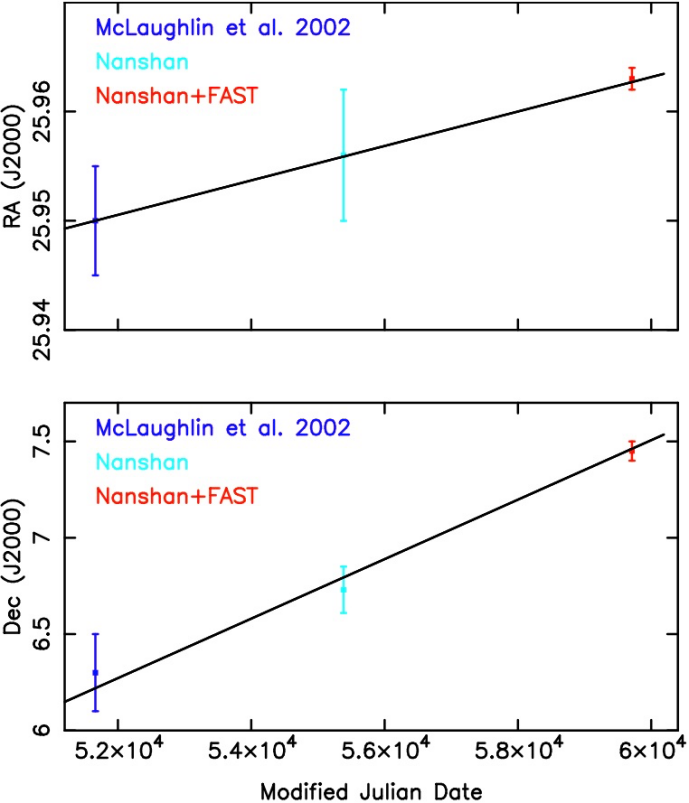
By utilizing long-term observational data from China's Five-hundred-meter Aperture Spherical Radio Telescope (FAST), also known as the "China Sky Eye," and the 26-meter Nanshan Radio Telescope, the team tracked minute changes in the position of the young pulsar, named PSR J1740+1000. Combining this with its distance, they calculated its spatial velocity to be 329±80 km/s. Based on this high velocity, researchers speculate that this young pulsar was born directly in the galactic halo. It is likely the offspring of a "runaway" OB star -- a massive star that was violently ejected from its native environment during a dramatic cosmic event.
Published in the Astrophysical Journal, the study not only provides key observational evidence for the origin of young pulsars in the galactic halo but also opens up new pathways for using pulsar signals to detect circumstellar and interstellar environments.