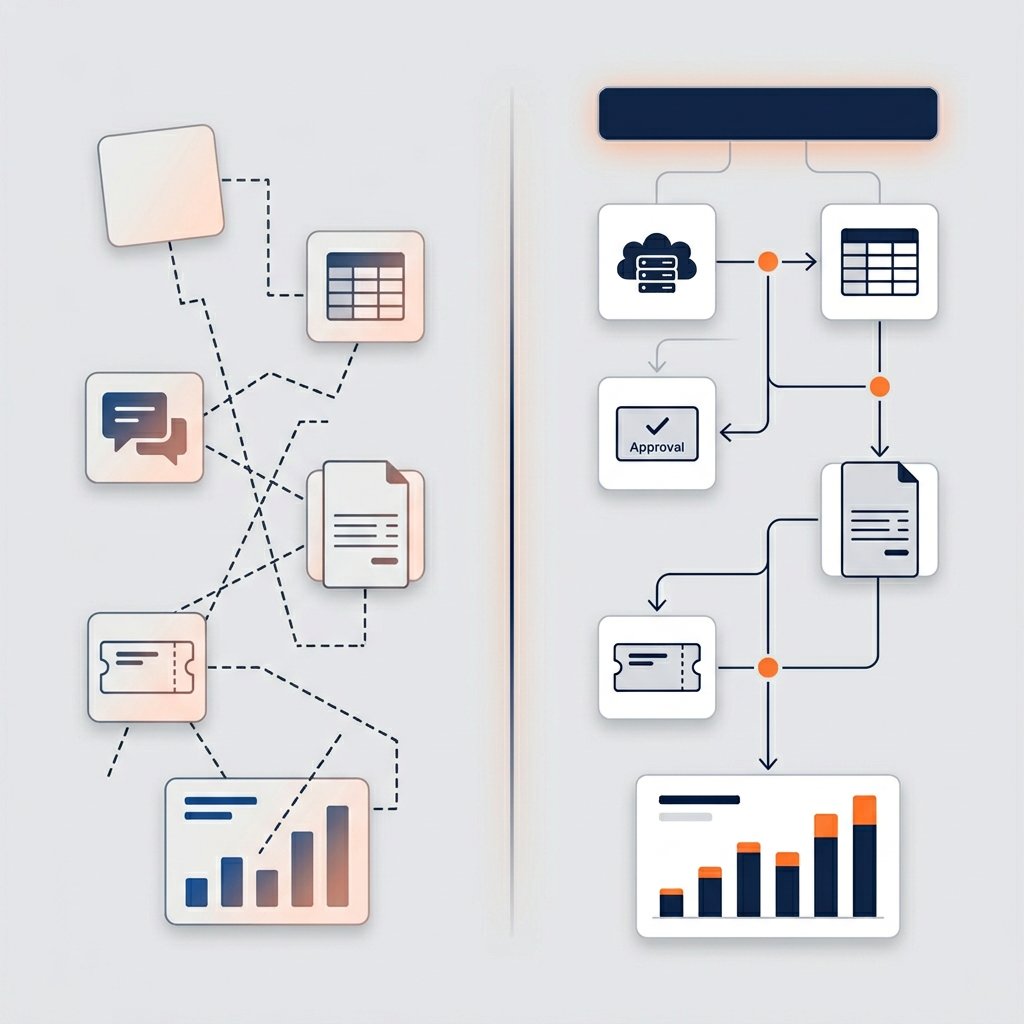
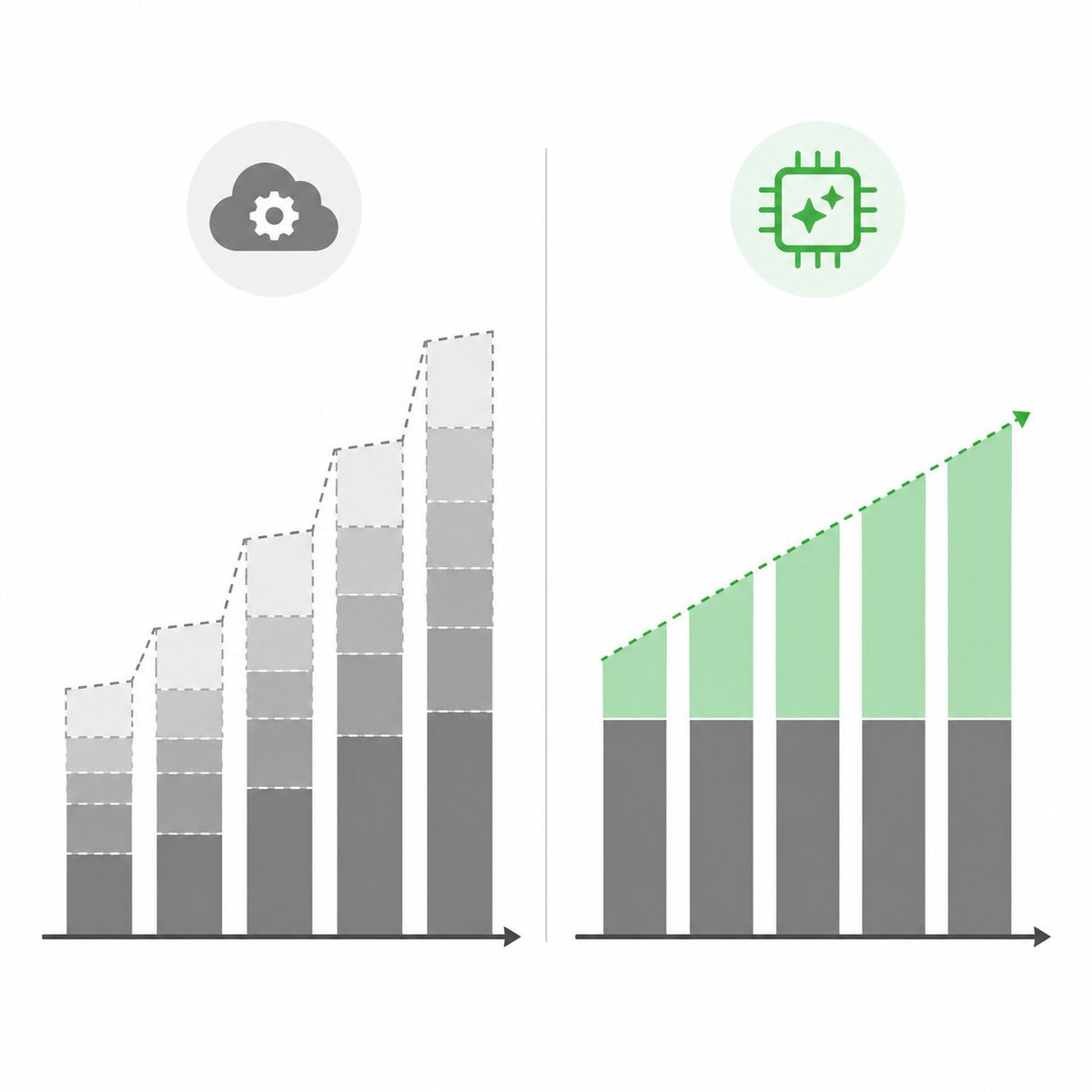
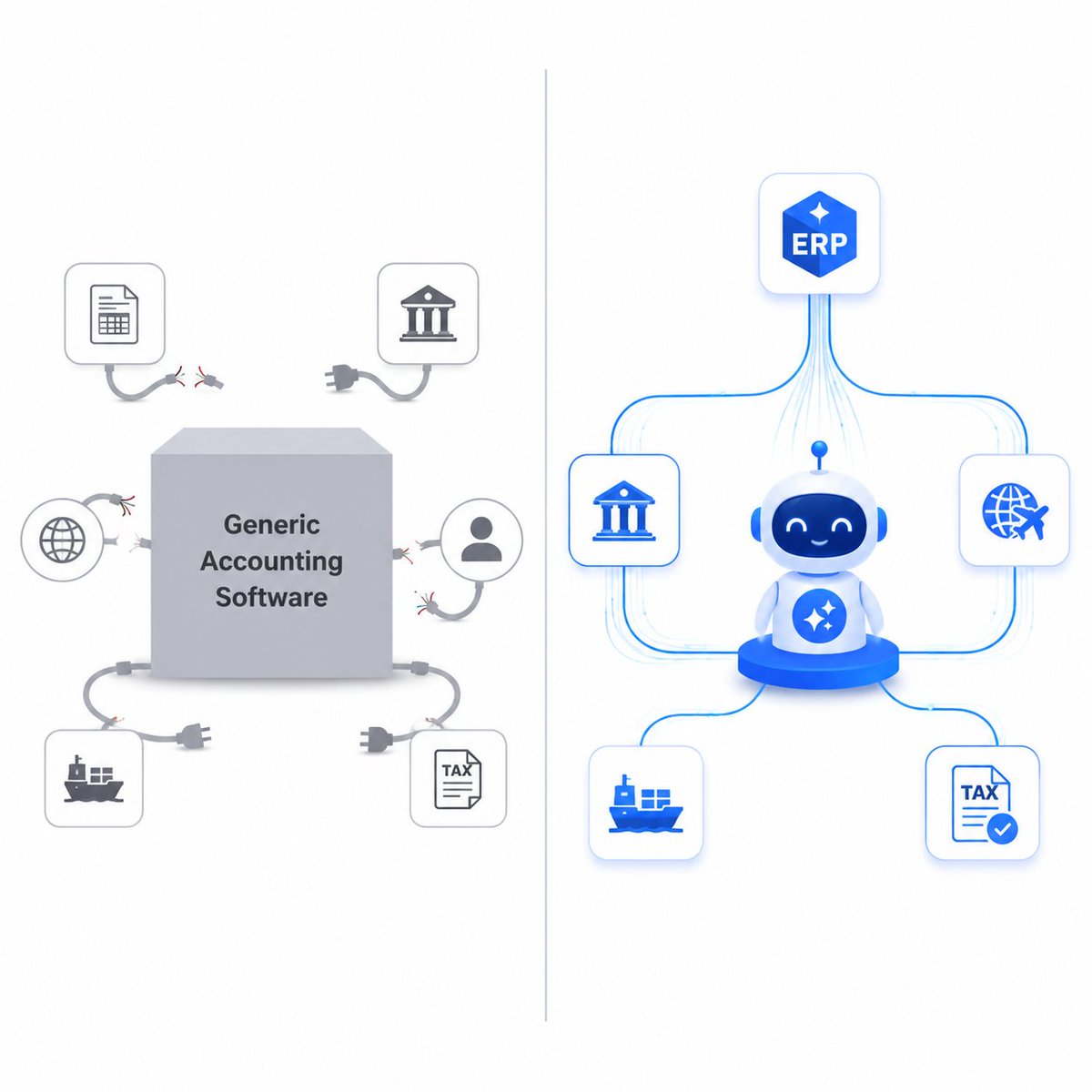
AI doesn’t replace workflows.
It exposes broken ones.
That’s what many companies miss.
They add AI on top of the business and expect transformation.
But the agent quickly runs into the real problems:
- customer data lives in 4 systems
- approvals still happen in Slack
- invoices are checked in Excel
- tickets don’t connect to CRM
- managers don’t trust the dashboard
- nobody knows who owns the final decision
At that point, the model is not the bottleneck.
The workflow is.
Good enterprise AI does not start with:
“Where can we add a chatbot?”
It starts with:
“Where does work actually break?”
Then you map the process.
Connect the systems.
Define the handoffs.
Add human review where it matters.
Measure the business outcome.
Only then does AI become useful.
Not as a shiny layer on top of the mess.
But as part of the operating system of the business.
Where do workflows break most often in your company: handoffs, data visibility, or approvals?
#EnterpriseAI #WorkflowAutomation #AgenticAI #BusinessOperations
AI agents are becoming the new access layer.
That changes enterprise security.
A human user logs in.
An AI agent acts.
It can read tickets.
Call APIs.
Update records.
Trigger workflows.
Move data between systems.
Sometimes faster than anyone can review.
That means the old question is no longer enough:
“Did the user have permission?”
The new question is:
“What exactly is this agent allowed to do, on behalf of whom, in which workflow, and with what audit trail?”
Enterprise AI needs more than model safety.
It needs operational boundaries:
✅ agent identity
✅ least-privilege access
✅ workflow-level permissions
✅ human approval for high-risk actions
✅ complete audit logs
✅ visibility into every system the agent touches
An AI agent without access control is not automation.
It is a privileged user you forgot to manage.
The next wave of enterprise AI will not be defined by who has the most agents.
It will be defined by who can trust them in production.
Where do you think companies will struggle most: agent identity, permissions, or auditability?
#EnterpriseAI #AgenticAI #AIGovernance #CyberSecurity
AI agents are moving into operations.
That changes the problem.
When an agent only drafts a message, the risk is manageable.
When an agent starts touching infrastructure, workflows, customer data, tickets, approvals, and business systems —
the question is no longer:
“Can it complete the task?”
The question becomes:
“Can we govern what it does while it is doing the task?”
That’s why the next phase of enterprise AI won’t be won by the company with the most agents.
It will be won by the company with the cleanest operating layer:
- agent registry
- clear system permissions
- approval paths
- human review loops
- audit trails
- rollback plans
- monitoring tied to real business workflows
An AI agent without governance is not automation.
It is operational debt with better UX.
The hard part of agentic AI is not making agents act.
It is making them act inside systems the business can actually trust.
Where do you think companies will struggle most: permissions, workflow integration, or monitoring?
#EnterpriseAI #AgenticAI #AIOps #WorkflowAutomation
Why generic finance software breaks in cross-border operations.
It’s usually not because the software is bad.
It’s because the workflow isn’t standard.
Three structural mismatches show up fast:
1. Money flow, order flow, and document flow live in different systems.
Your ERP sees part of the story.
Your payment platforms see another part.
Your invoices and customs docs live somewhere else.
2. The inputs are messy.
Cross-border teams deal with scanned invoices, mixed-language PDFs, supplier bills, reimbursement receipts, and documents that don’t fit neat templates.
3. The “difference” is where all the work is.
Fees, FX movement, split payouts, merged settlements, refunds, delays — this is exactly where finance teams lose time.
That’s why production AI in finance is not about replacing your current tools.
It’s about building the layer that connects them, interprets the messy inputs, and routes only the exceptions to people.
That’s the difference between software that stores records — and systems that help teams actually operate.
Most cross-border finance teams don’t have a finance problem.
They have a systems problem.
PayPal.
Stripe.
Bank wires.
ERP.
Invoices.
Customs documents.
Multiple currencies.
Different fee rules.
Different settlement cycles.
When all of that lives in separate systems, month-end becomes an Excel fire drill.
Generic accounting tools can help with the basic ledger.
They usually can’t handle the messy 80%:
- non-standard invoices and scanned documents
- payout matching across platforms
- FX differences, fees, refunds, and delayed settlements
- finance teams spending days checking exceptions manually
Production-grade AI workflow automation changes that:
✅ parse non-standard documents automatically
✅ match orders, payouts, fees, and currencies across systems
✅ surface only the exceptions that need human review
We’ve seen reconciliation workflows move from ~7 days to under 1 day when the system is built around the real process.
That’s the difference between adding AI to finance software — and redesigning the workflow around how the business actually operates.
What creates more pain in your finance workflow today: document handling, reconciliation, or visibility?
#AIforBusiness #FinanceAutomation #AgenticAI #WorkflowAutomation
@daniel_mac8 highlighted a Google DeepMind paper ‘From AGI to ASI’ that includes instructions written for an AI agent to read alongside humans, allowing tools like Codex to explain concepts in real time while going through the paper.
This points to an interesting shift where documents and knowledge work are increasingly designed with AI agents as part of the audience. It suggests a future where agentic systems don’t just execute tasks but actively participate in research, learning, and complex reasoning alongside people. The practical implication is that enterprises will need robust ways to integrate such agentic capabilities into knowledge workflows while maintaining control and accuracy.
ZenAI focuses on production-grade Agentic AI solutions. More at https://t.co/uo3Lk4KHen
How do you envision agentic systems changing how organizations handle research, documentation, and knowledge transfer?
#AgenticAI #AIFuture #EnterpriseAI
Okay, this is seriously cool.
A team from @GoogleDeepMind, including DeepMind Cofounder Shane Legg, published a paper "From AGI to ASI".
In the paper, they include instructions for an AI agent to read along with you.
You can open the paper in Codex's in-app browser and have GPT-5.5 read it with you and explain all the concepts.
This is the future. AI agents will be part of the target audience, and help us to understand anything we want.
@satyanadella shared a powerful perspective on the future of the firm in an AI-driven economy: organizations must build both human capital and ‘token capital’ — their own AI capabilities that compound institutional knowledge through learning loops.
He emphasizes that companies should create agentic systems they truly own, where human judgment and domain expertise are encoded into AI that improves over time, rather than ceding all value to a few general models. The key test is maintaining sovereignty over IP and the ability to switch underlying models without losing accumulated expertise. This framing moves the conversation from tools to durable competitive advantage through owned learning systems.
ZenAI focuses on production-grade Agentic AI solutions that help enterprises build and own these kinds of compounding systems. More at https://t.co/uo3Lk4KHen
How do you see companies balancing building their own token capital versus relying on frontier models? Welcome to discuss.
#AgenticAI #EnterpriseAI
3 agentic AI developments that actually matter for enterprises this week:
1. OpenAI is acquiring Ona, a secure runtime platform for AI agents. The real story isn't better code — it's giving agents a safe, contained environment to access tools and systems, which is the #1 barrier to production deployment right now.
2. Microsoft baked agent permission controls directly into the Windows kernel with MXC. When the OS enforces what an agent can and cannot access, governance stops being a prompt engineering problem and becomes a system-level guarantee.
3. OpenAI + Oracle made enterprise AI procurement much easier. Companies can now use existing Oracle cloud credits to deploy models and Codex, removing a huge budget and procurement friction point for large organizations.
The entire industry is quietly shifting from "can agents do cool things?" to "can we deploy them safely and legally at scale?"
We build production-grade Agentic AI solutions designed for real enterprise governance. More in bio.
Which of these shifts will impact your team first?
#AgenticAI #EnterpriseAI #AIGovernance #ProductionAI
The biggest lie in supply chain AI right now: "Just plug in our model and it will optimize your inventory."
A new industry report released this week confirms what we've seen firsthand: 78% of supply chain AI projects fail to deliver expected ROI. And it's almost never because the model is bad.
It fails because:
• Your ERP data doesn't match your warehouse data
• Supplier updates only come via email or PDF
• Inventory counts are still entered manually at the end of each shift
• Every channel has its own separate order management system
You can't train an AI on fragmented, stale, inconsistent data and expect it to give you good answers.
The first step to successful supply chain AI isn't buying another model. It's connecting all your existing systems so they speak the same language.
We build custom integration layers that turn your siloed data into a single source of truth. Then we add AI on top that actually works.
We build production-grade Agentic AI solutions. More in bio.
How many different systems does your supply chain team use every day?
#SupplyChainAI #RetailOperations #EnterpriseAI #AgenticAI
Gartner just dropped a brutal stat: 40% of enterprise AI agents will be decommissioned by 2027.
And it's almost never because the technology didn't work.
It fails because:
1. No one built audit trails or access controls before deployment
2. Teams tried to automate 10 workflows at once instead of nailing one
3. No clear owner was assigned to monitor and update the agent over time
AI agents aren't "set it and forget it" tools. They're production systems that need the same governance, security, and maintenance as any other critical business software.
The best AI projects don't start with the model. They start with the workflow, the guardrails, and the ownership.
We build production-grade Agentic AI solutions that actually stay in production. More in bio.
What's the #1 reason your AI projects got stuck or canceled?
#AgenticAI #EnterpriseAI #AIGovernance #AIforBusiness
@Beth_Kindig
highlighted how agentic AI is fundamentally rewriting the CPU vs GPU story in data centers — shifting the long-assumed CPU:GPU ratio toward 1:1 as agentic workloads change compute demands. This perspective stands out because it moves beyond model performance to the infrastructure realities enterprises face when scaling agentic systems. As agents move from training-heavy to inference-heavy and multi-step execution, hardware choices and budget allocation are being redefined in real time. The discussion underscores why production-grade integration is now as critical as the models themselves. ZenAI focuses on production-grade Agentic AI solutions. More at https://t.co/uo3Lk4Lf3V What do you think will have the bigger long-term impact on enterprise AI budgets — model advances or shifts in underlying infrastructure? #AgenticAI #EnterpriseAI #NVIDIA
3 months ago, the idea that CPUs could challenge GPUs on AI budget share was unfathomable – yet agentic AI has flipped the script.
Find out how agentic AI is rewriting the story for CPUs as the CPU:GPU ratio moves towards 1:1 and how $NVDA, $AMD, $INTC, and $ARM each aim to win in the server CPU market.
https://t.co/nU9IHtkW7a
@zodchiii
today shared NVIDIA CEO Jensen Huang’s latest statement: every company in the world now needs an agentic system strategy — calling it ‘the new computer.’ This framing is particularly timely — Huang is pushing the industry conversation from general AI hype toward enterprise architecture decisions, clearly distinguishing chatbots that merely respond from agents that execute real work. The depth of his 2-hour breakdown on agent architecture shows why production readiness and system-level thinking are becoming non-negotiable for 2026. ZenAI focuses on production-grade Agentic AI solutions. More at https://t.co/uo3Lk4KHen How are companies in your network approaching their agentic system strategy right now? Welcome to discuss. #AgenticAI #NVIDIA #EnterpriseAI
NVIDIA CEO Jensen Huang:
"Every company in the world today needs to have an agentic system strategy. This is the new computer."
In 2 hours he breaks down the architecture under every working AI agent and the difference between chatbots that talk and agents that actually do the work.
Watch the full talk, then grab the exact setup below👇
Top 3 Agentic AI news that actually matters this week (no hype):
1. NVIDIA officially declared "The Agent AI Era is here" at GTC Taipei, launching RTX Spark superchips for local AI agents and open-sourcing Nemotron 3 Ultra, the most powerful production-ready agent model to date.
2. Gartner warned that 40% of enterprise AI agents will be decommissioned by 2027 due to governance gaps — not bad technology. One-size-fits-all policies don't work for autonomous systems.
3. Cloudflare + Stripe shipped the first fully autonomous AI agent that can open accounts, register domains, and deploy production apps without any human intervention.
The shift from AI that generates content to AI that executes work is happening faster than most people realize.
We build production-grade Agentic AI solutions. More in bio.
Which of these developments will have the biggest impact on your business?
#AgenticAI #EnterpriseAI #NVIDIA #AIGovernance
The #1 question we get: "Is custom automation more expensive than off-the-shelf SaaS?"
The short answer: It depends on how you calculate it.
Off-the-shelf SaaS has low upfront costs, but you end up paying for:
- Features you never use
- Workarounds to make it fit your business
- Employees acting as human connectors between systems
Custom automation has higher upfront costs, but:
- It solves exactly your problem, not someone else's
- It eliminates 100% of the manual work in that workflow
- It pays for itself in 2-3 years through labor savings and error reduction
The biggest mistake companies make is spending $50k+ on a generic ERP, then still doing 70% of the work in Excel.
We build custom AI workflows that pay for themselves. More in bio.
We've talked to hundreds of operations leaders this year.
Almost every single one is spending 20-40% of their team's time on work that could be automated.
What's the biggest manual workflow pain point in your organization right now?
🔘 Siloed systems that don't talk to each other
🔘 Manual data entry and spreadsheet reconciliation
🔘 Compliance and regulatory documentation
🔘 Inventory and supply chain tracking
Drop a comment if your biggest pain isn't on this list.
We build production-grade Agentic AI solutions. More in bio.
#AIforBusiness #WorkflowAutomation #EnterpriseAI #AgenticAI
@eliadeleo 100% agree. The highest-impact AI isn't the one that makes headlines — it's the one that quietly eliminates the repetitive, high-stakes work that no one wants to do.
Burnout and human error are the two biggest hidden costs in every business.
"We have 3 accountants, but every month during reconciliation week, they are completely burnt out."
This is what an 8-year international trade business owner told us. And it's not an exception.
Cross-border finance is fundamentally different from regular corporate finance:
- 5+ payment platforms (PayPal, Stripe, Payoneer, wire transfers)
- 10+ currencies with real-time exchange rate fluctuations
- Invoices and documents in 7+ languages and formats
- Complex VAT/GST compliance across 20+ markets
Generic accounting SaaS only solves 20% of these problems. The remaining 80% still gets done manually in Excel.
This is where custom AI workflow automation delivers real value:
✅ Intelligent document processing: Parse any invoice, bill or receipt in any language without templates
✅ Multi-platform auto-reconciliation: Match bank flows to orders with 99.8% accuracy
✅ Real-time compliance checks: Flag tax and regulatory issues before they become problems
We helped one metals trading company cut invoice processing time from 40 hours/month to 4 hours/month, and reduce error rates from 3% to 0.2%.
We build production-grade Agentic AI solutions. More in bio.
What's the most painful part of your cross-border finance workflow?
#AIforBusiness #FinanceAutomation #InternationalTrade #AgenticAI
Why generic accounting software will never work for cross-border businesses.
It's not about missing features. It's about three structural mismatches:
1. They are built for linear workflows. Cross-border finance is a web of interconnected systems: ERP, banks, marketplaces, freight forwarders, customs. No standard SaaS can pre-integrate all of them.
2. They assume standardized data. In reality, you get PDFs, scanned documents, handwritten notes, and Excel files in 10 different formats from suppliers around the world.
3. They treat compliance as an afterthought. VAT rules change every quarter in Europe. GST requirements are different in every Australian state. Generic tools can't keep up.
The result? You spend more time adapting your business to the software than the software adapting to your business.
Custom AI agents don't replace your existing systems. They connect them. They sit between all your tools, translate between different data formats, and automate the manual work that generic software will never do.
That's the difference between "software that works for most businesses" and "software that works for your business".
The biggest hidden cost of manual cross-border finance isn't the labor — it's the errors. A single wrong exchange rate calculation can cost you tens of thousands of dollars.