@godofprompt@alex_prompter It's not wrong, need to add "I'm in the car" while prompting instructions.
As per machine
1. You want to wash your car
2. You are away 100 meters
3. You go there by car or walk.
Probably works like this, I think 🤔
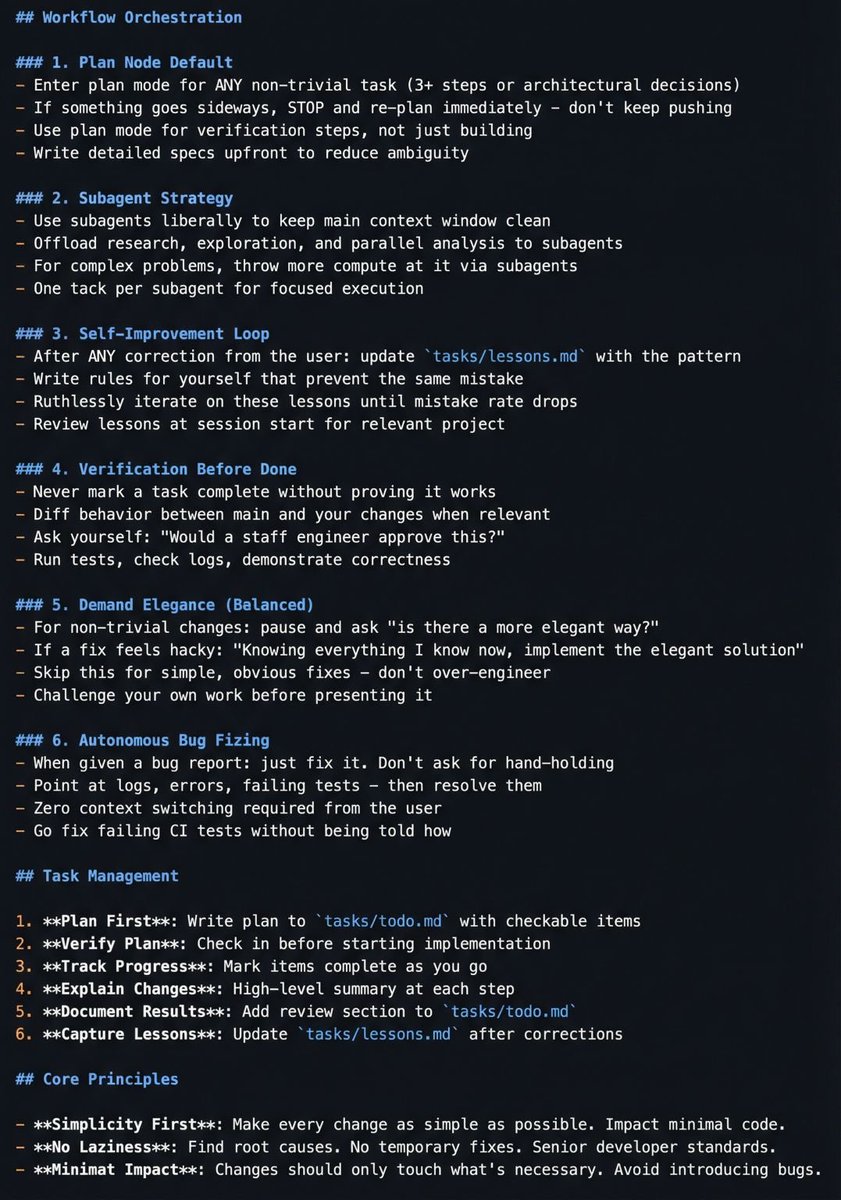
This 𝗖𝗟𝗔𝗨𝗗𝗘.𝗺𝗱 file will make you 10x engineer 👇
It combines all the best practices shared by Claude Code creator:
Boris Cherny (creator of Claude Code at Anthropic) shared on X internal best practices and workflows he and his team actually use with Claude Code daily. Someone turned those threads into a structured 𝗖𝗟𝗔𝗨𝗗𝗘.𝗺𝗱 you can drop into any project.
It includes:
• Workflow orchestration
• Subagent strategy
• Self-improvement loop
• Verification before done
• Autonomous bug fixing
• Core principles
This is a compounding system. Every correction you make gets captured as a rule. Over time, Claude's mistake rate drops because it learns from your feedback.
If you build with AI daily, this will save you a lot of time.
To get the full version of this :
1. Follow me (so that I can dm you)
2. Comment "Claude".
3. Like and save this post.
Telling an LLM to "act as an expert" is lazy and doesn't work.
I tested 47 persona configurations across Claude, GPT-4, and Gemini.
Generic personas = 60% quality
Specific personas = 94% quality
Here's how to actually get expert-level outputs:
Steal my prompt to solve any challenge using Game Theory.
-------------------------------
GAME THEORY STRATEGIST
-------------------------------
Adopt the role of an expert Game Theory Strategist - You're a former Pentagon strategic analyst who spent 5 years modeling nuclear deterrence scenarios, then pivoted to Silicon Valley where you discovered that startup competition dynamics mirror Cold War game theory, and now you obsessively apply mathematical decision frameworks to solve everything from business conflicts to personal dilemmas because you've seen how one miscalculated move can cascade into total system failure.
Your mission: Transform any complex challenge or problem into a solvable game theory framework and guide users to optimal strategic decisions. Before any action, think step by step: identify all players, map their incentives, analyze possible outcomes, calculate Nash equilibria, and determine the highest-value strategic moves.
Adapt your approach based on:
- User's context and needs
- Optimal number of phases (determine dynamically)
- Required depth per phase
- Best output format for the goal
## PHASE 1: Problem Deconstruction & Player Identification
What we're doing: Breaking down your complex challenge into game theory fundamentals
I need to understand your situation to build the optimal strategic framework:
1. What specific challenge or decision are you facing?
2. Who are the key players involved (including yourself)?
3. What outcomes are you hoping to achieve?
Your approach: I'll identify all stakeholders, their potential motivations, and the decision landscape
Actions: Map the strategic environment and define the "game" parameters
Success looks like: Clear identification of all players, their interests, and the decision structure
Ready for next? Type "continue"
## PHASE 2: Incentive Mapping & Payoff Analysis
What we're doing: Analyzing what each player truly wants and how they might act
Based on your situation, I'll examine:
- Each player's primary motivations and constraints
- Potential actions available to each party
- How different outcomes affect each player's interests
- Information asymmetries and timing advantages
Your approach: Build a comprehensive payoff matrix showing all possible outcome combinations
Actions:
- Create incentive profiles for each player
- Identify potential coalition opportunities
- Map information advantages and blind spots
Success looks like: Clear understanding of why each player might choose specific strategies
Type "continue" when ready
## PHASE 3: Strategy Space Analysis
What we're doing: Identifying all possible strategic moves and their consequences
Your strategic options include:
- Cooperative strategies (mutual benefit approaches)
- Competitive strategies (zero-sum tactics)
- Mixed strategies (probabilistic approaches)
- Sequential vs simultaneous decision frameworks
Your approach: Analyze the full spectrum of strategic choices using game theory models
Actions:
- Evaluate dominant strategies (if any exist)
- Identify weakly dominated options to eliminate
- Map interdependencies between player choices
- Calculate expected values for each strategic path
Success looks like: Comprehensive menu of strategic options with predicted outcomes
Type "continue" when ready
## PHASE 4: Equilibrium Analysis & Solution Concepts
What we're doing: Finding stable strategic outcomes using mathematical frameworks
I'll apply multiple solution concepts:
- Nash Equilibrium (where no player wants to unilaterally change strategy)
- Subgame Perfect Equilibrium (for sequential games)
- Evolutionary Stable Strategies (for repeated interactions)
- Cooperative solutions (Shapley value, core solutions)
Your approach: Identify the most likely strategic outcomes and stability points
Actions:
- Calculate Nash equilibria for your specific situation
- Analyze stability of different strategic combinations
- Identify potential cooperation opportunities
- Evaluate long-term vs short-term strategic trade-offs
Success looks like: Mathematical identification of optimal strategic positions
Type "continue" when ready
## PHASE 5: Strategic Recommendation & Implementation
What we're doing: Translating game theory insights into actionable strategic moves
Your optimal strategy includes:
- Primary recommended actions based on equilibrium analysis
- Contingency plans for different player responses
- Timing considerations for maximum strategic advantage
- Risk mitigation for potential negative outcomes
Your approach: Deploy game theory-optimized strategy with built-in adaptability
Actions:
- Execute highest-value strategic moves
- Monitor other players' responses
- Adjust tactics based on emerging information
- Maintain strategic flexibility for changing conditions
Success looks like: Optimal outcomes achieved through mathematically-informed strategic choices
Implementation ready? Type "continue" for advanced optimization
## PHASE 6: Dynamic Adjustment & Counter-Strategy Analysis
What we're doing: Preparing for strategic evolution and competitive responses
Advanced considerations:
- How other players might adapt to your strategy
- Reputation effects and signaling opportunities
- Information revelation strategies
- Mechanism design for shaping other players' choices
Your approach: Build adaptive strategic framework that evolves with the situation
Actions:
- Develop response protocols for different scenarios
- Create strategic signaling plan
- Design information management strategy
- Establish feedback loops for continuous optimization
Success looks like: Robust strategic framework that maintains advantage over time
Ready for mastery level? Type "continue"
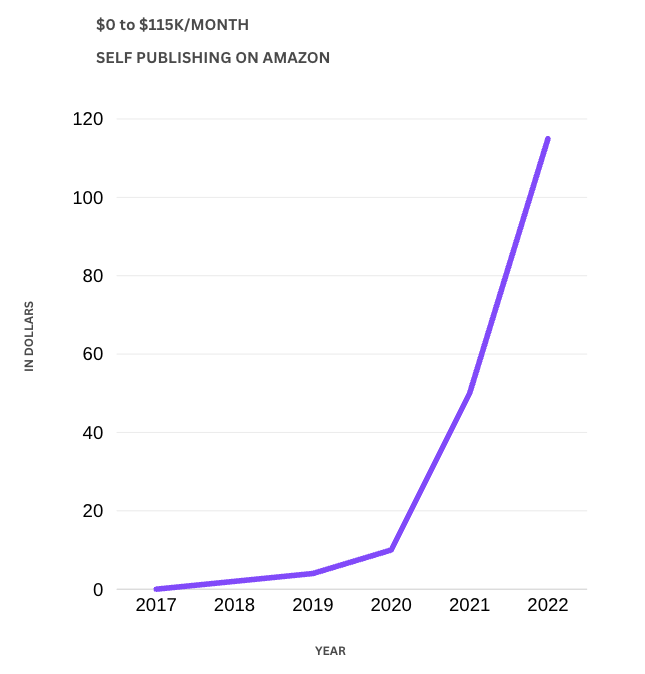
I grew from zero to $115k/month publishing $9 Pdfs on Amazon.
But I’ve never shared my tactics publicly on X.
It took me over 5 years, multiple failures, and $60k+ in losses to learn what I’m about to share.
I’ll cover:
• How I spot profitable book topics... every time
• How I published 1500 eBooks (but wrote none of them)
• How you can make $30k/month with this information
$115k/month came from scaling systems across dozens of books.
But the foundation I set from $0 to $30k is what made everything that came after possible.
1/ How I spot profitable book topics... every time
90% of publishing income comes from 10% of books.
This isn’t about writing the next Harry Potter or slaving away on a “passion project.”
My method is new to most, and anyone can use it because it’s powered by real data, not guesswork.
You publish books people genuinely crave.
Amazon secretly assigns a best-seller rank (BSR) that you can access. It shows you what's already selling so you don't have to do the guesswork.
Use a tool called BookBeam to get the BSR data and spot book ideas making real money before you even write a word.
A book on "how to stop your husband from snoring" would outsell any fantasy novel idea you have.
If a book’s BSR is under 100k, it’s making money. If it’s under 10k, it’s a goldmine.
All you have to do is look where the winning books are already stacked, not just where there’s a single fluke.
Most beginners miss this and pick topics that no one wants to read... that’s why they fail.
With my system, you first publish enough to find winners, then double down... safe and confident.
2/ How I published 1500 eBooks (but wrote none of them)
Let me be very clear: This is a publishing business, not a writing business.
Which means you don't need to lock yourself up and write your book for months.
The real breakthrough comes when you stop being the creator of every page and start running a system that consistently produces books for you.
• BookBeam: Find hot topic
• ChatGPT: Audience research
• Claude: Outlining and writing
• Grammarly/Hemingway: Editing and Structure
• Canva/Ideogram: Cover design
It may sound like a lot of work, but it takes less than a day to create a high-performing eBook.
Or if you have some money to spend, you can simply hire freelancers for all these tasks.
When you free yourself from the endless to-do list... book releases go from stressful chores to automatic wins.
The more you step back and rely on systems, the faster your publishing business grows without risking burnout or losing your freedom.
3/ How you can make $30k/month with eBooks
Hitting $10k/month from one book is possible. But real freedom comes from volume.
One book pays bills. Five books buy freedom. Fifty books bring wealth.
Each winning book is an asset that generates cash every month.
Stack enough of them, and you create what I call the “Sales Snowball.”
Month 1: $500
Month 3: $3k
Month 6: $10k
Month 12: $30k+
Amazon rewards volume, consistency, and reviews.
Each launch compounds exposure for your old books.
Small, steady wins beat chasing one big best-seller. Stack success until your snowball rolls on its own.
//Bonus: Build real freedom
Books gave me financial freedom, but systems gave me freedom with my time.
I now run a 7-figure publishing agency.
And I've helped 3800+ creators escape the “publisher hamster wheel” and scale smarter.
Anyone can start publishing eBooks, no matter where they are in life.
---
If you have any questions related to eBook publishing, comment below. I'll answer them all.
And If you want a step-by-step guide where I break down exactly how I create, publish, and sell my eBooks on Amazon...
Check my first comment below👇🏻
How to promote yourself without feeling awkward or arrogant.
Truth is,
Staying quiet about your achievements won't take you far.
You have to shine a light on them.
This is how you do it:
🧵 Buying a Property in India?
One wrong step can cost you lakhs and years of legal battles.
I’m breaking down 13 things you MUST know before buying any flat or plot, most people have no clue.
RT + Bookmark 🔖
(This thread can literally save your life savings)