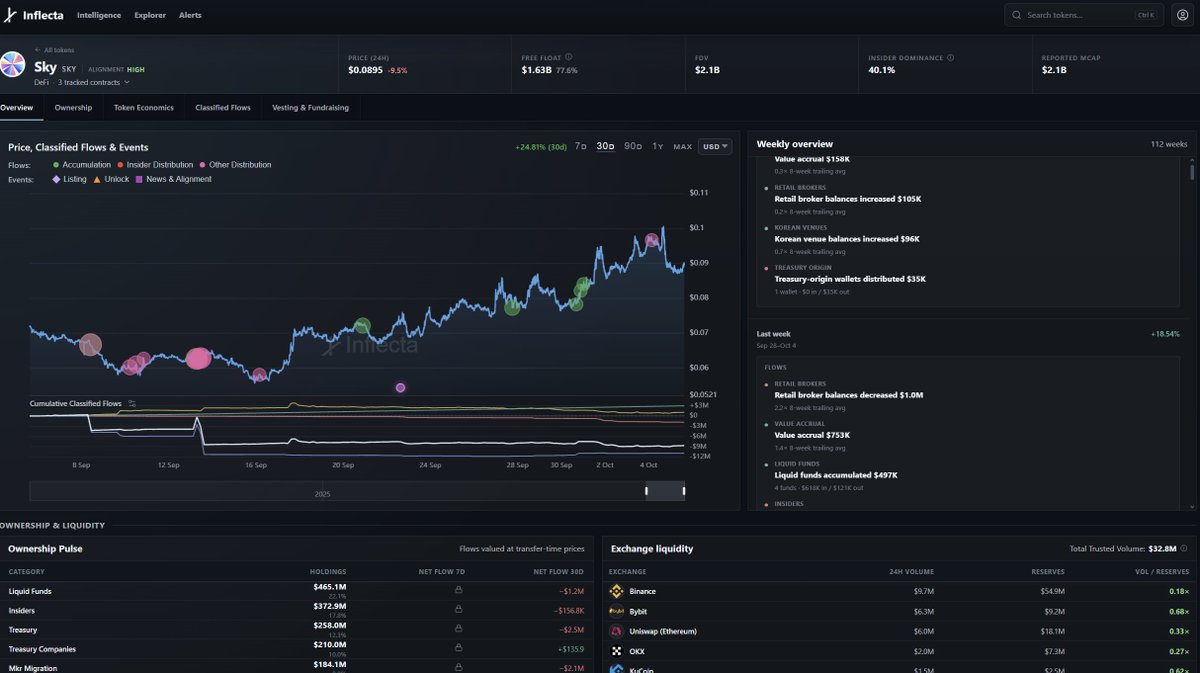
@inflecta_io is one of the best new crypto tools I've come across recently.
It shows whether VCs, insiders, and retail are buying or selling a certain token, while also giving you the most important recent news about it.
Highly recommend trying it out.
Here's a LlamaAI prompt to find protocols that have growing revenue and steady or declining P/S ratios.
Use it as one of your free 5 daily prompts:
Find token-backed protocols whose protocol revenue is growing faster than their market cap, so they are getting cheaper on P/S, and label each one as sustained or breaking out. Use protocol revenue (not gross fees). Rank the protocols and show P/S for each. P/S is mcap ÷ annualized revenue.
Universe: Protocols with a token and both mcap and revenue data. Exclude chains, stablecoin issuers, CEX-linked tokens, and protocols whose revenue is mainly incentive-driven. ⚙️ Floors: mcap ≥ $25M and 30-day revenue ≥ $250K.
Growth signals:
1.Revenue over the last 30 days vs the prior 30 days must be positive.
2.P/S is compressing: it is lower now than 30 days ago because revenue grew faster than mcap. Show the 30-day P/S change.
3.Classify each protocol as one of:
Sustained: revenue up in each of the last 3 completed months, and 90-day revenue up.
Breaking out: 30-day revenue growth well above its 90-day trend after a flat or declining stretch.
⚙️ Quality checks:
Show absolute revenue next to every % change, and flag base effects from small revenue.
Check whether one day makes up more than ~30% of the 30-day total. If it does, show growth with and without that day.
Separate organic revenue from one-offs and incentive-driven revenue, and say what evidence you used.
Output:
A top-15 table with these columns: protocol, mcap, 30d revenue, 30d revenue change, 90d revenue change, P/S, 30d P/S change, label (sustained or breaking out).
A scatter chart of revenue growth vs P/S.
For each name, one line on the thesis (what is driving revenue) and one line on the main risk.
State every filter you applied. Name notable protocols the screen dropped and why: below the floors, no token, missing mcap or revenue data, or incentive-driven
@NickSwardson Boating. Just floating around talking about nothing with friends.
BUT you can switch it up. Boating with a purpose, like going to explore something historical. If you have kids that's in and of itself rewarding. Doing the same exact thing without booze is a recipe for failure.
Dammit, I must have commented too much on parent Twitter.
What I learned today for parent Twitter:
Preschool is like so so hard. I have to do all this stuff. Me me me. I guess there is a kid in there somewhere.
@MuffinsNsuch How long is the bed? Can it fit a piece of plywood without any wonky modifications? Can it tow a small boat? I think these are things people want. I certainly do. I have no desire for the "truck" that's on the road now. Take my money of it can satisfy those 3 things.
@UziCryptoo 120K miles will get you down to the 10-12k range. And about 10 years older. Do the maintenance yourself (oil, brakes, maybe a battery) and your good to go to 200k with not much money invested.
📋Withdrawing EIP-8363 from consideration for Hegotá.
EIP-8363 rapidly became one of the most commented-on EIPs in the history of the Ethereum-Magicians forum, with 200+ comments in a few weeks. As we progressed through the Hegotà CFI (Consideration For Inclusion) process, several parties in the industry as well as core protocol and client contributors voiced that a fork scoping exercise was not the right venue to settle an issuance policy change.
We agree and we'd rather acknowledge this now than carry on towards Hegotà in this context. The topic is too important and raised too many concerns that it deserves its own process. We commit to giving issuance its own process and we thank the entities such as @LidoFinance who offered to help steer such an initiative.
We stand by the motivation of this EIP, in particular: “a very high staking ratio is undesirable for two distinct reasons (...), preserving Ethereum’s security, neutrality and resistance to capture, and protecting ETH’s role as money.” Not everybody immediately relates to both reasons and for others recognizing just one of these reasons is enough to justify a change. Nevertheless, we will all benefit from improving our understanding of the issue and what is at stake. The questions we have faced since we published EIP-8363 can be boiled down to 5 categories:
➡️Security: What does a lower ratio actually secure versus a higher ratio?
➡️Industry impact: What else is built on the yield and what will be the impact ?
➡️Curve specs and alternate tools: Is this curve even the right instrument?
➡️Composition: Who is left staking (the effect on the composition of the validator set) ?
➡️Decentralization: How will solo stakers be impacted by the reduction?
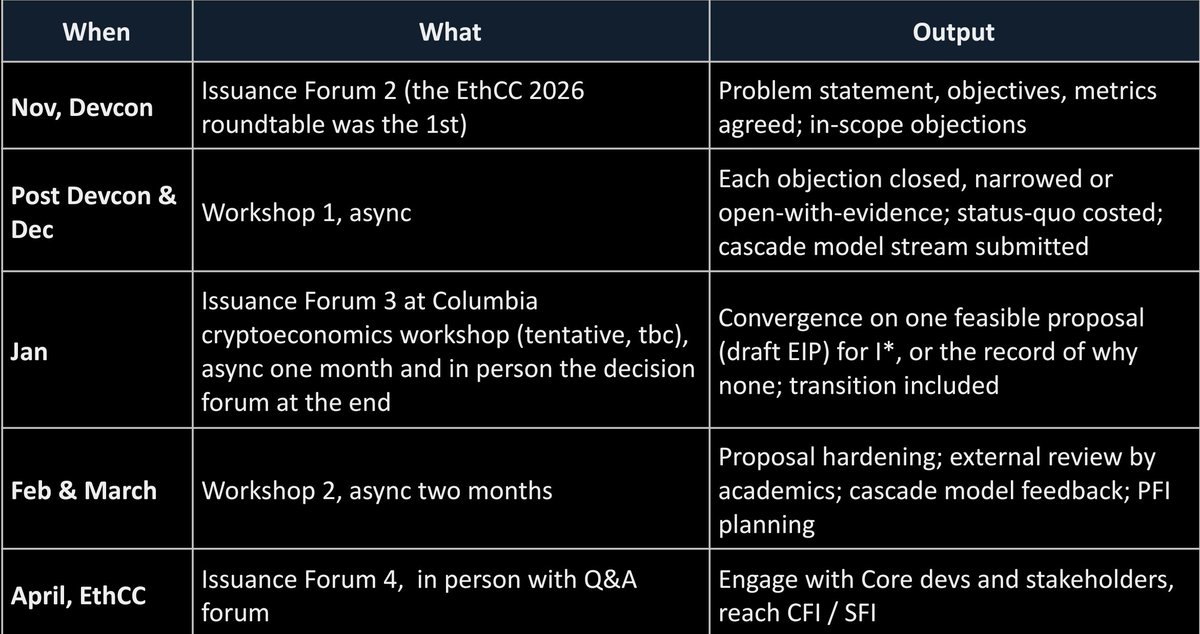
We already argued a lot, conceded some and adjusted a few points in the very long Ethereum-Magicians thread mentioned supra. For a broader consensus to emerge and a better issuance policy for Ethereum to be designed and adopted, we need a dedicated process. We call for all willing hands to help and contribute to this, please do reach out. Here’s our start at what a multi-node process would look like (table attached).
Onward and forward, let’s improve Ethereum.