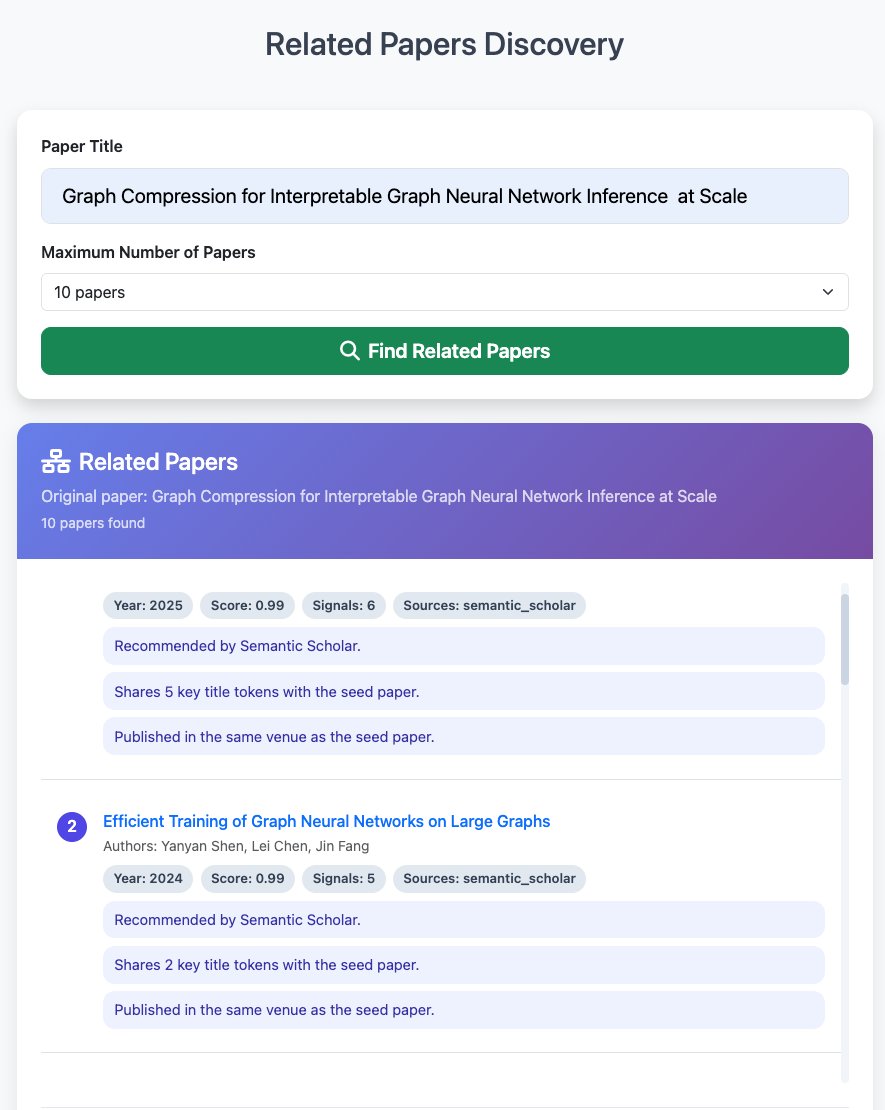
Excited to share CRUXpider (v0.1.0), an early open-source research asset discovery tool under the CRUX umbrella: https://t.co/ii5L89uMgW.
CRUXpider helps researchers go from just a paper title, topic, or research area to datasets, code, benchmarks, reading paths, and representative papers for AI4Science workflows.
It currently integrates arXiv, OpenAlex, Semantic Scholar, Crossref, DataCite, OpenAIRE, and the GitHub API, and can be launched with a simple one-command local setup.
This is an early release with much room for improvement, but we’re opening it early for feedback and collaboration.
If this direction resonates, we’d love your thoughts, issues, stars, and contributions.
Contact: [email protected]
CC: [email protected], Dr. Yinghui Wu (@yinghuiwu4)
@dbgroup_cwru@cwru
GitHub: https://t.co/VTxYMnNEPr
#OpenSource #AI4Science #ResearchTools #MaterialsScience #MachineLearning
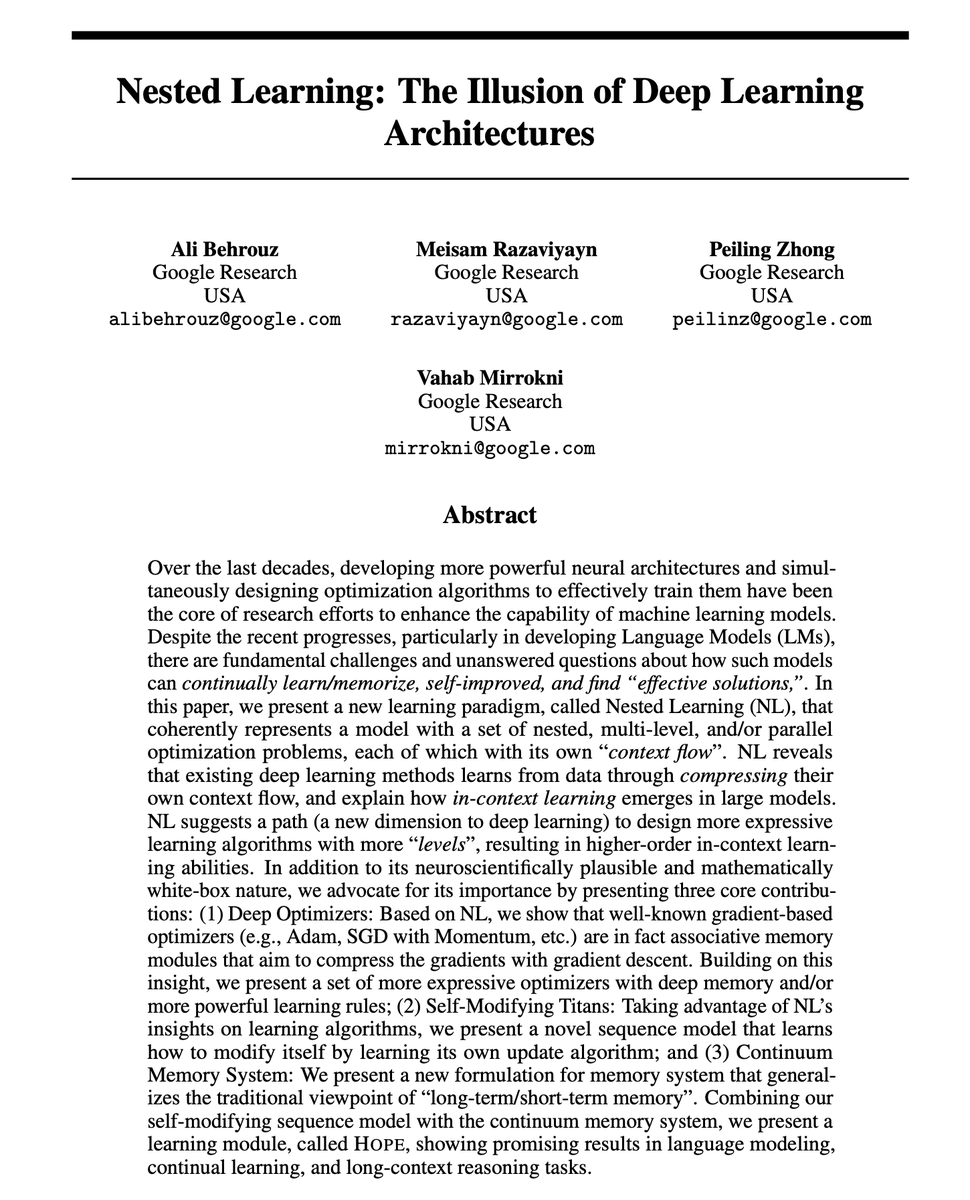
Google just dropped "Attention is all you need (V2)"
This paper could solve AI's biggest problem:
Catastrophic forgetting.
When AI models learn something new, they tend to forget what they previously learned. Humans don't work this way, and now Google Research has a solution.
Nested Learning.
This is a new machine learning paradigm that treats models as a system of interconnected optimization problems running at different speeds - just like how our brain processes information.
Here's why this matters:
LLMs don't learn from experiences; they remain limited to what they learned during training. They can't learn or improve over time without losing previous knowledge.
Nested Learning changes this by viewing the model's architecture and training algorithm as the same thing - just different "levels" of optimization.
The paper introduces Hope, a proof-of-concept architecture that demonstrates this approach:
↳ Hope outperforms modern recurrent models on language modeling tasks
↳ It handles long-context memory better than state-of-the-art models
↳ It achieves this through "continuum memory systems" that update at different frequencies
This is similar to how our brain manages short-term and long-term memory simultaneously.
We might finally be closing the gap between AI and the human brain's ability to continually learn.
I've shared link to the paper in the next tweet!
This paper from Tsinghua University and Shanghai Jiao Tong University received perfect scores (6, 6, 6, 6) at NeurIPS 2025!
It aims to answer a key question: Does reinforcement learning really make large language models better reasoners?
The authors study Reinforcement Learning with Verifiable Rewards (RLVR) and find that while it improves accuracy for small k, it doesn’t create new reasoning patterns—meaning the base model still determines the upper limit of reasoning ability.
Across six RLVR variants, performance gains plateau, suggesting that current RL setups mainly refine reasoning rather than reinvent it.
Interestingly, it’s distillation, not RL, that shows genuine signs of emergent reasoning.
This research points to the next frontier for truly self-improving large language models.
Does Reinforcement Learning Really Incentivize Reasoning Capacity in LLMs Beyond the Base Model?
Paper: https://t.co/jOvAn6eGIZ
Page: https://t.co/o951L62oR6
Our report: https://t.co/nnMLg0FC5p
📬 #PapersAccepted by Jiqizhixin
Read this paper to know how to 'actually' read a paper!
I've highlighted the key points -> now this 10 min read of 3-pass apprach will change your paper reading technique for good!
𝗞𝗲𝘆 𝘁𝗮𝗸𝗲𝗮𝘄𝗮𝘆𝘀:
— First Pass (5-10 minutes)
Quick scan for bird's-eye view
— Second Pass (up to 1 hour)
Read with greater care
—>> Third Pass below ⬇️
💬 𝗛𝗼𝘄 𝗱𝗼 𝘆𝗼𝘂 𝗮𝗽𝗽𝗿𝗼𝗮𝗰𝗵 𝗿𝗲𝗮𝗱𝗶𝗻𝗴 𝗽𝗮𝗽𝗲𝗿𝘀?
1/2
Vibe coding is a wild experience. You enter a state of pure flow and emerge hours later with a masterpiece... that you don't fully understand, almost like a blackbox.