You know 1+2+3+...+n = n(n+1)/2.
Now generalize:
What's 1+3+5+...+(2n-1)? (sum of first n odd numbers)
Drop your formula below
#MathTwitter#Mathematics#Mathchat
3/8
The theorem's answer: if you can't already win almost always, no cleverer strategy exists.
Not "we haven't found it yet." PROVABLY doesn't exist.
If the game is hard, it's hard. Permanently.
#MathTwitter#Computer#GameTheory
1/8
There's a game where every answer has exactly 2 correct responses.
If you can't win it almost every time, math proves NO strategy ever will.
This is the 2-to-2 Games Theorem — and it just won the 2026 Held Prize.
Let me break it down.
2/8
Real-life version: 100 locks.
Each of your keys opens exactly 2 locks. Each of your friend's keys does too.
No communication. You both try to open the same lock.
Can you find a strategy that works almost every time?
Quick one for you:
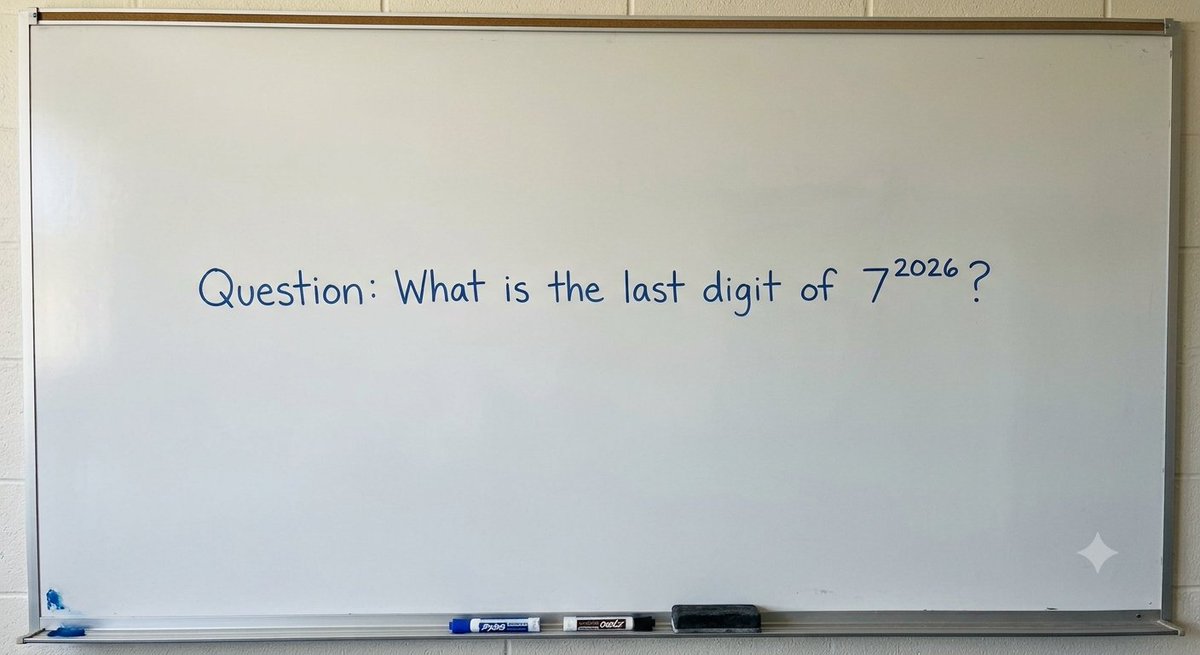
What's the last digit of 7^2026?
No calculator. Just pattern recognition.
(Hint: powers of 7 cycle in a pattern — find it, and this takes 10 seconds instead of 10 minutes)
#Maths#MathTwitter
The Unique Games Conjecture has puzzled computer science for 20+ years.
2026 Held Prize just went to 5 mathematicians for proving the 2-to-2 Games Theorem — the strongest evidence yet that UGC is true.
Massive win for approximation algorithms.
#MathTwitter#Computer
Graph theory's 50-year-old Cycle Double Cover Conjecture just got proved.
By OpenAI's GPT-5.6 Sol Ultra.
Noga Alon: "surprisingly, the proof is short."
Still under peer review. But that's 2 major open conjectures AI has cracked in months.
Wild times to be doing math.
#MathTwitter
When a mathematician stares at a blank page, their motivation isn't to write something brilliant immediately; their motivation is to translate the abstract problem into concrete, workable pieces. The first step is usually an act of setting up the board before playing the game.
Euler's constant isn't e.
It's this: take the harmonic series, subtract the natural log that's chasing it forever, and watch what's left.
1 + 1/2 + 1/3 + ... + 1/n - ln(n)
As n → ∞, this doesn't blow up. It doesn't hit 0.
It settles at γ ≈ 0.5772...
#Mathtwitter
1/6
Sum of 1/n² has a closed form. So does 1/n⁴. So does every even power.
But sum of 1/n³?
Nobody has ever found a closed form. Not Euler. Not anyone since.
Welcome to one of math's weirdest asymmetries.
OpenAI's chief research officer just said it out loud:
AI could make a Nobel-worthy discovery within 2 years.
Not "assist with." Make.
We already have AI that cracked a 1946 Erdős problem so cleanly that a Fields Medalist said no AI proof has come close before.
Reports say OpenAI's new model just solved a math problem that stumped humans for 50 years.
In under an hour.
No peer review yet. No public proof. Just a claim.
But if true? We're watching the line between "AI helps mathematicians" and "AI does math" disappear in real time.
Everyone knows the Fibonacci sequence.
Almost nobody knows what happens when you sum the reciprocals.
1/1 + 1/1 + 1/2 + 1/3 + 1/5 + 1/8 + 1/13 + ...
You'd think it explodes. It doesn't.
It converges to a number even weirder than π: the Reciprocal Fibonacci Constant ≈ 3.359885...
The harmonic series diverges. Everyone knows that.
But remove every term with a "9" in the denominator... and it suddenly converges.
1 + 1/2 + 1/3 + ... but skip 9, 19, 29, 90-99, 190...
Sum caps out around 22.9. Forever.
One digit changes everything. Wild, right?