Researcher | Agentic AI | Building exciting agent products now... | Exploring agent design, products, and the future of autonomous agents. AI news & insights.
Highly recommended! 🚀 Stanford's CS329Z: Engineering AI Agents (Fall 2026), now open and led by Diyi Yang (@Diyi_Yang), is a great resource for anyone interested in AI agents.
One of the most interesting takeaways is the history and challenges of AI agents, as well as the emerging topic of proactive agents.
https://t.co/XTPNvsAxov
We have raised a $720M Series C, led by @ThriveCapital, @lightspeedvp, @Redpoint and @foundersfund, to allow us to run faster in shipping the world's fastest chips for AI.
We've seen over the past year that many of the hardest problems that humanity faces - in science, medicine, physics - may be solved in our lifetimes by AI.
One hallmark of AI applied to the toughest problems is that extreme scaling of inference compute becomes vital. In tackling a Millenium Prize problem, for instance, @OpenAI ran 10,000 parallel agents for 80 hours. Costing over $10M, this level of capability is far from democratised today.
When we study agentic scaling, there are two paths: parallel, and sequential. In just the same way that most hard problems solved by humans don't parallelise efficiently, we see the same with agents: fewer agents, thinking for longer, scales better in every way except for the time that you wait for a response.
Building radically faster inference hardware, which doesn't force a trade-off on throughput, model sizes or context lengths, is a key step in bringing down the cost and time we incur in solving our hardest problems.
We're thrilled to be backed to bring this to the world!
Our strongest frontier model, Gemini 4 Carbon, is now available.
Built for deeply complex, long-horizon workflows that push a frontier model’s intelligence, Carbon delivers frontier performance in agentic workflows across complex knowledge work, software engineering and web development, cybersecurity, and scientific reasoning.
While Gemini 4 Argon remains the ideal model for the majority of software engineering and knowledge work, Carbon steps in for your hardest tasks that push a model to its limits — from complex, multi-step debugging to open-ended scientific research.
Available starting today:
— Consumers: use it in the @GeminiApp and AI Mode in Search for Google AI Ultra subscribers
— Developers and Enterprises: build via the API in @GoogleAIStudio and @AndroidStudio, Google @Antigravity for Google AI Ultra subscribers, and Gemini for business
— Scientists and Researchers: apply for a chance to get 6 months free via @Antigravity
— Cybersecurity Defenders: apply to join the Fairwind Program for access to Carbon for cyber
Watch how Carbon brings reasoning and coding together, turning avian research into an interactive 3D simulation of a songbird’s vocal organ that synthesizes the sounds of six bird species live.
These are promising directions for agent research to explore!
OpenAI and other leading AI labs have already made significant progress in mathematics and coding, as these two domains have become natural playgrounds for AI agents. The next frontier will be tackling similarly complex, high-value real-world tasks that can be carried out and verified entirely locally, enabling end-to-end support for compilation, execution, simulation, and rigorous verification through unlimited trial and error.
Proactive agents and goal-driven multi-agent systems will be core technologies in these areas.
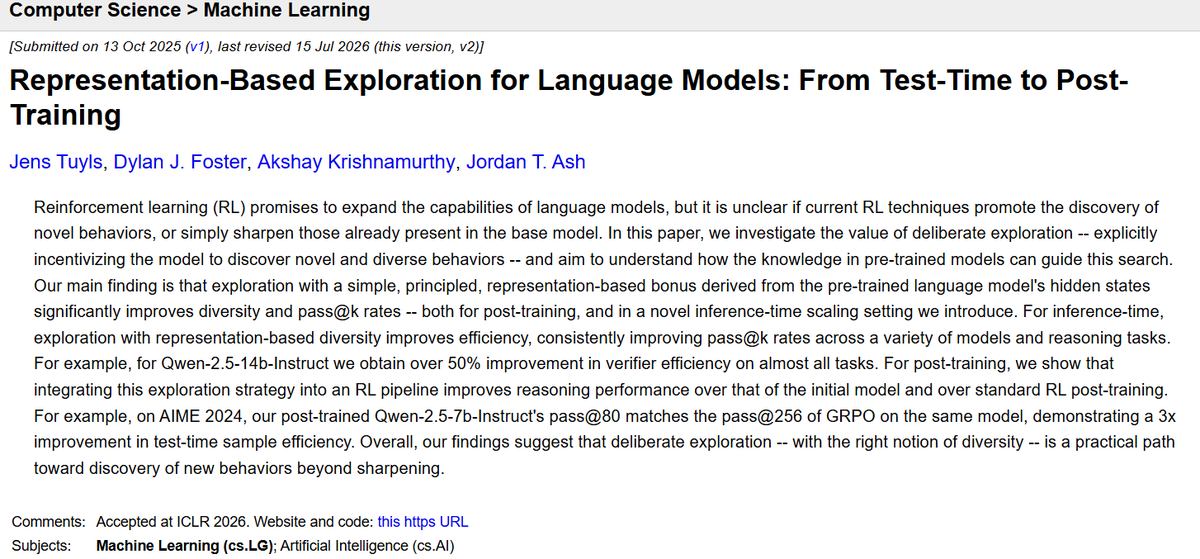
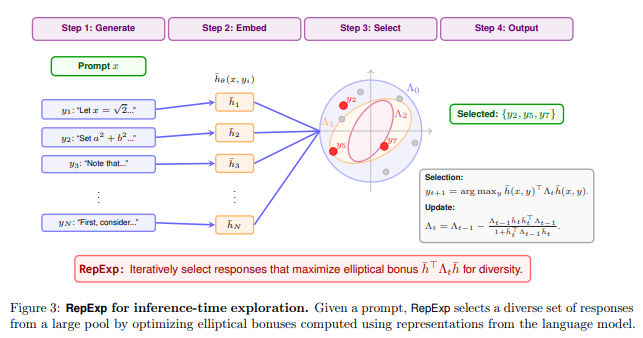
Representation-Based Exploration for Language Models: From Test-Time to Post-Training
"Our main finding is that exploration with a simple, principled, representation-based bonus derived from the pre-trained language model's hidden states significantly improves diversity and pass@k rates -- both for post-training, and in a novel inference-time scaling setting we introduce."
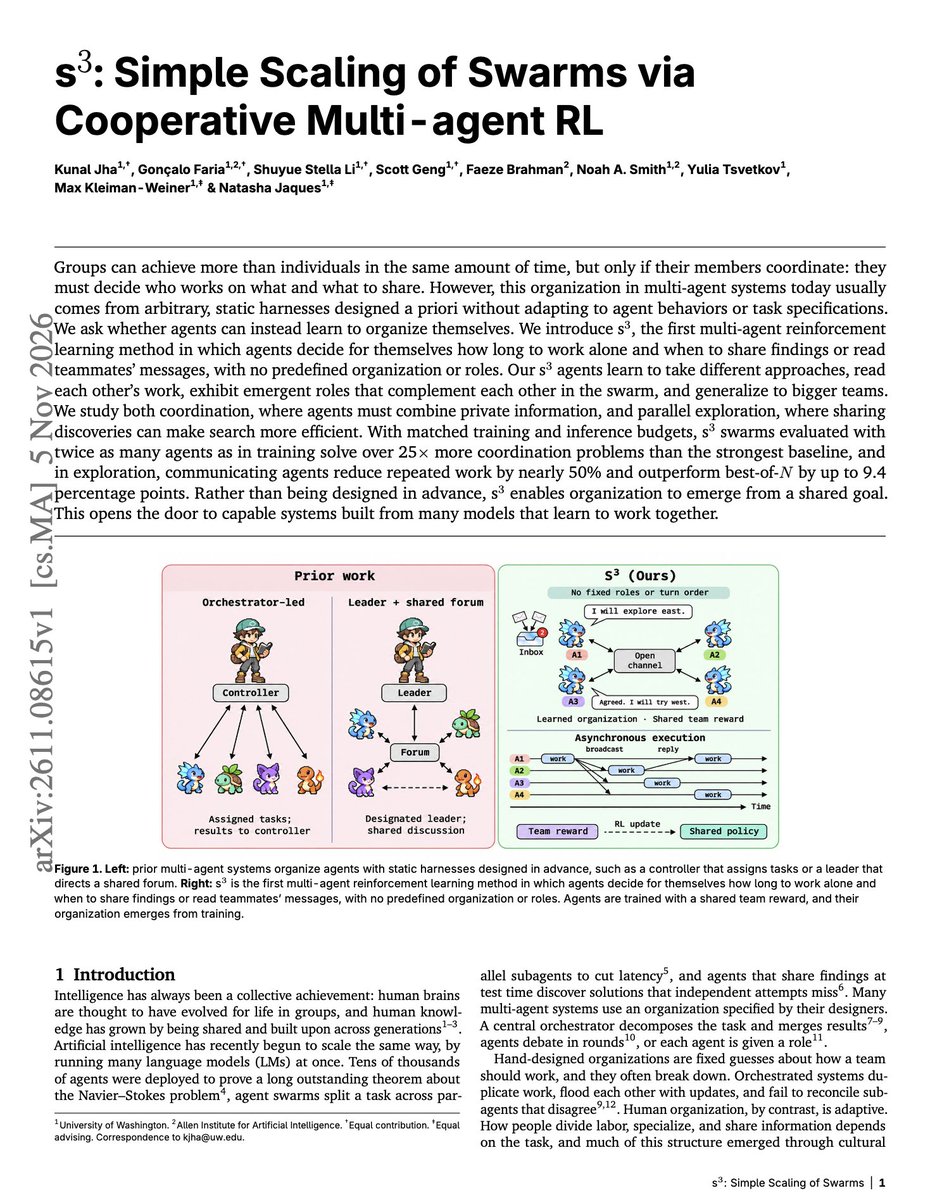
Must-read paper on scaling multi-agent swarms.
The main focus right now is training agent swarms to coordinate and cooperate better. Here is a promising new work on this.
The problem:
Multi-agent systems usually follow a plan that a developer writes ahead of time.
The plan decides which agent does what and when agents message each other, and it usually stays the same across tasks.
What they propose:
s3 has the agents learn that plan instead. Agents learn through cooperative RL when to work alone, when to share findings, and when to read teammates' work. There are no predefined roles.
With matched training and inference budgets, s3 swarms tested at twice their training size solve over 25x more coordination problems than the strongest baseline. In parallel exploration, communicating agents repeat nearly 50% less work and beat best-of-N by up to 9.4 points.
The agents develop complementary roles on their own, and those roles carry over to bigger teams.
https://t.co/uqGIs6ZACo
Chat with Paper: https://t.co/WtMRctTYSe
Very excited by the bleeding edge modelling that went into this thanks to new learning methods produced by my team, in collab with Gemini Robotics.
Congrats Michelle Lo, @HolarisSun, @MartinKlissarov, @JonnyCoook, @silviasapora, @Aniket_d98, and Claudia Clopath on the launch!
Coming out tomorrow morning. This blog was quite a challenge (but also fun!). My recent blogs have focused on breadth, so I wanted to go deeply into a topic this time. Score centering is interesting and a great topic to focus on given its (alleged) popularity in the labs.
Hey @X and @XDevelopers , have you recently changed the recommendation algorithm?
I've noticed that liking just 1–2 posts outside my usual academic interests can dramatically shift my feed, sometimes flooding it with content from an entirely different topic.
The problem: The algorithm seems to mistake temporary curiosity for a change in my long-term interests.
What I'd love to see: Keep my core interests as the foundation of my feed, while still allowing room for occasional exploration and discovery.
@MicrosoftAI will be at NeurIPS in December both Sydney and Paris, I will personally be in Paris walking the floor! Fill my form pinned if interested in meeting us to discuss our models 👇
We are #hiring#ai - follow me for live updates!
https://t.co/8aS7TRc8Ku
In her Sept. 10, 2026 column “Pause AI for Humanity’s Sake,” Peggy Noonan argued, “When something speeds up and gets out of control, it isn’t alarmist to demand prudence and deliberation.”
https://t.co/S0ybnsRnXH
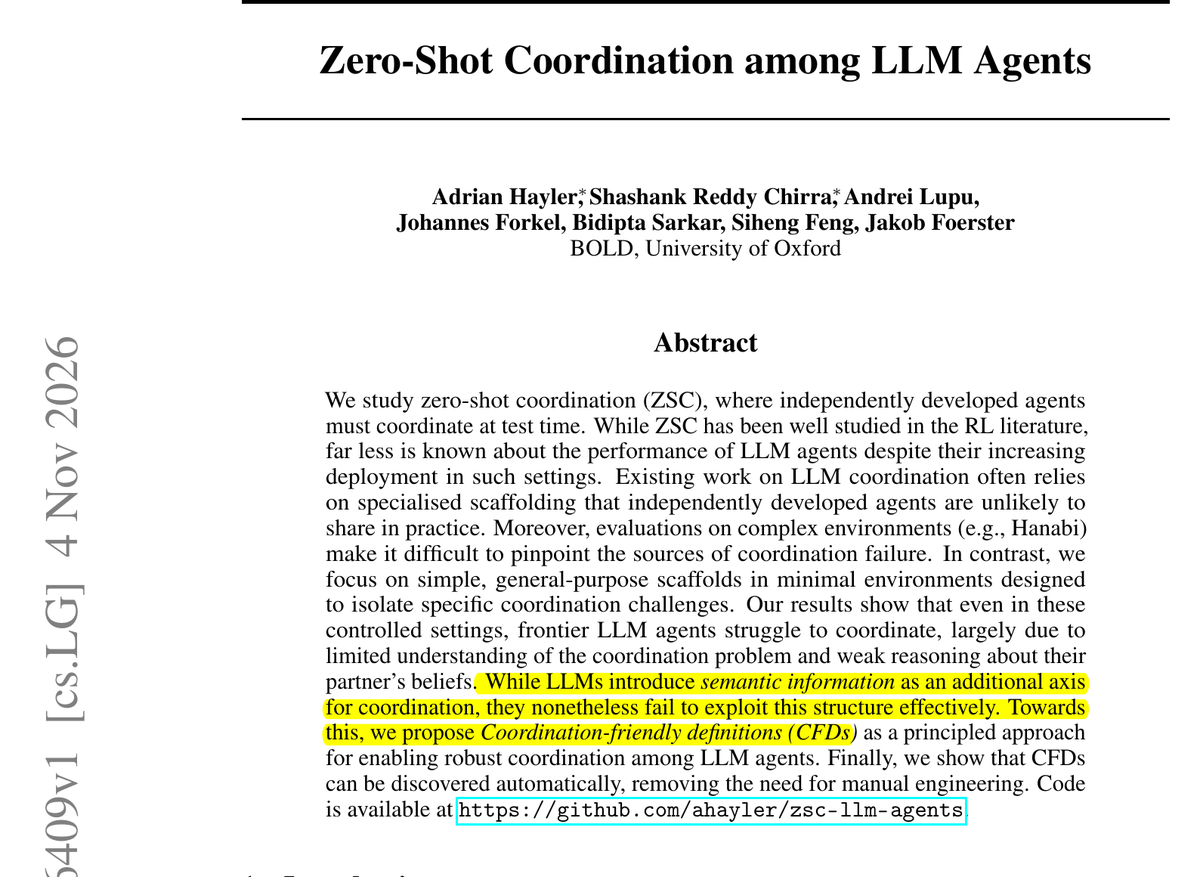
New Oxford paper finds that frontier LLM agents fail to coordinate with unfamiliar partners because each one treats its own made-up rules (arbitrary convention) as the obvious choice.
Agents from different companies increasingly must work together with no agreed rules. Past studies used shared scaffolding or complex games that hide why coordination fails.
They tested text and code agents built on models like GPT-5.2 and Gemini 3 Pro in 9 small cooperative games. In Cat & Dog, a safe move guarantees 5 points, while a signal convention pays 10 only if both agents pick the same one.
Paired with other models, text agents scored well below that safe 5, each calling its own arbitrary convention natural. A short shared statement of coordination principles, called a Coordination-friendly definition, led agents to reliably take the safe 5.
If your agent must work with agents you did not build, tell it to avoid unstated conventions and prefer actions any partner reads correctly.
Happy to announce that Vector Policy Optimization was accepted to NeurIPS 2026!
In case you missed it, we released the code and a shiny new website for the paper: https://t.co/n1LzXvvPpG
paper: https://t.co/XWFuQ2Scjt