We had a similar observation before and combined it with the Maglev idea, which becomes Gradlev https://t.co/00qLPwNakp.
In short, you could use one network to predict the costates in parallel, then use prefix scan to simulate token-wise test-time training.
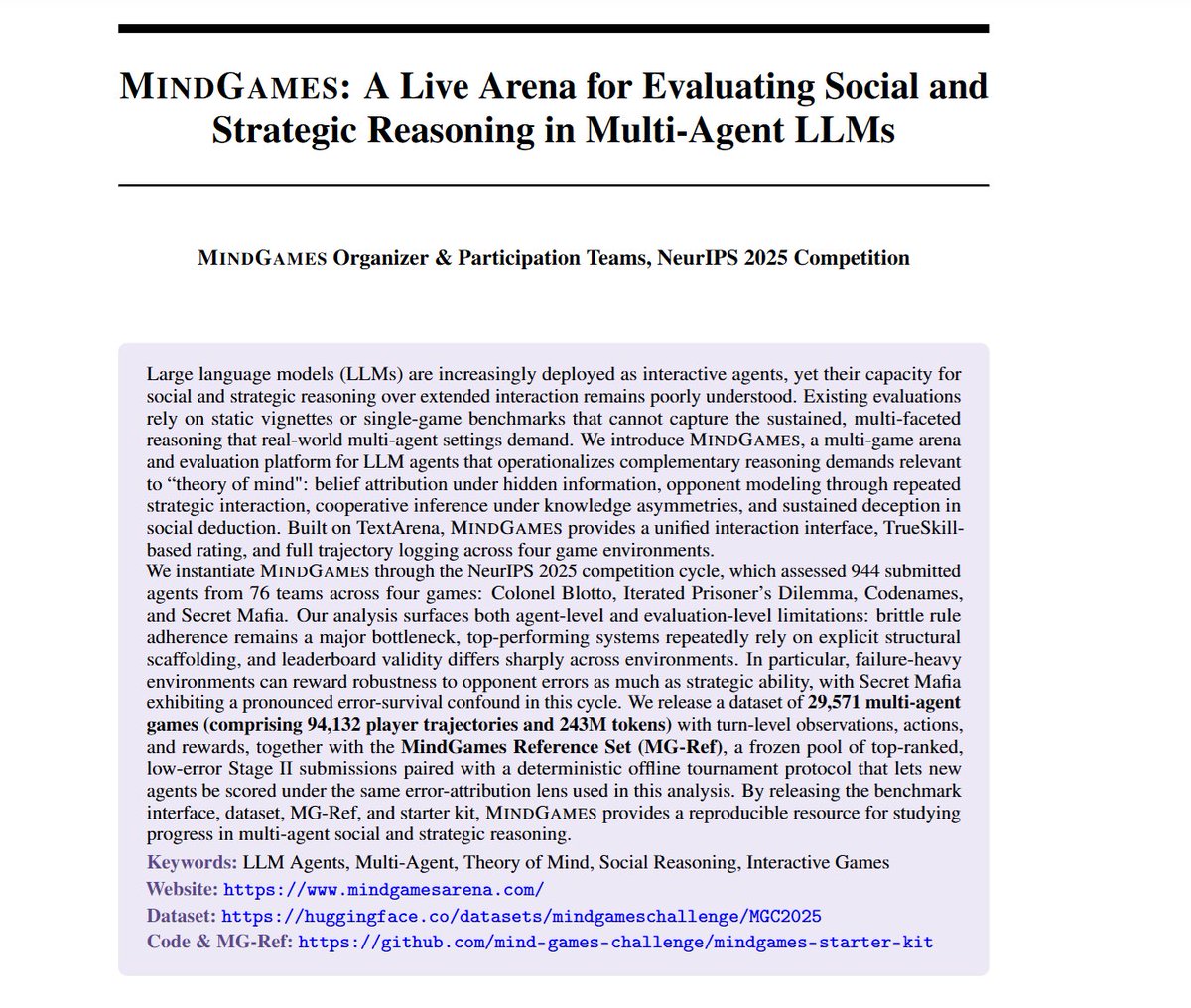
Can your AI agent tell when another agent is lying?
Our MindGames report is accepted at NeurIPS! 🎉
944 agent submissions. 76 teams. ~30K games.
Built on TextArena, with game data + top competition agents to test against. Paper and code link below ↓
RL with LLMs is very unstable when training and sampling policies differ. Standard fixes (matching numerics, importance sampling) work around the problem.
We find the root cause of this instability from first principles and propose a way to directly cancel it. Score Centering is competitive and compatible with existing approaches — while simple to implement!
🧵 [1/6]
Another way to get parallel training + sequential decoding:
Maglev: Sliding Recurrent Memory
https://t.co/knQhPs5yID
During training, a stronger (e.g., full-attention) teacher provides recurrent memory states, allowing the student (e.g., sliding window attention) to predict all tokens in parallel. The student learns to reproduce those states itself, closing the train–inference gap.
At inference, the teacher disappears: the student rolls its memory forward sequentially. Interestingly, one could have student and teacher share most of the parameters : )
Can you boost your AI review scores without changing any of the science?
Yes, no hidden text, no prompt injection. Just repackage how the paper reads(figures, equations, numbers all fixed). We call it adversarial repackaging.
→75.1% attack success, +1.21/10 mean score gain🧵👇
Open question: if presentation alone can move AI review scores, what's the right fix? Better reviewer prompts, ensembles, or keeping humans in the loop?
We'd love to hear how you'd make AI reviewers robust to this.








![m_ryabinin's tweet photo. RL with LLMs is very unstable when training and sampling policies differ. Standard fixes (matching numerics, importance sampling) work around the problem.
We find the root cause of this instability from first principles and propose a way to directly cancel it. Score Centering is competitive and compatible with existing approaches — while simple to implement!
🧵 [1/6]](https://pbs.twimg.com/media/HSg-MrPX0AAFL9E.jpg)


