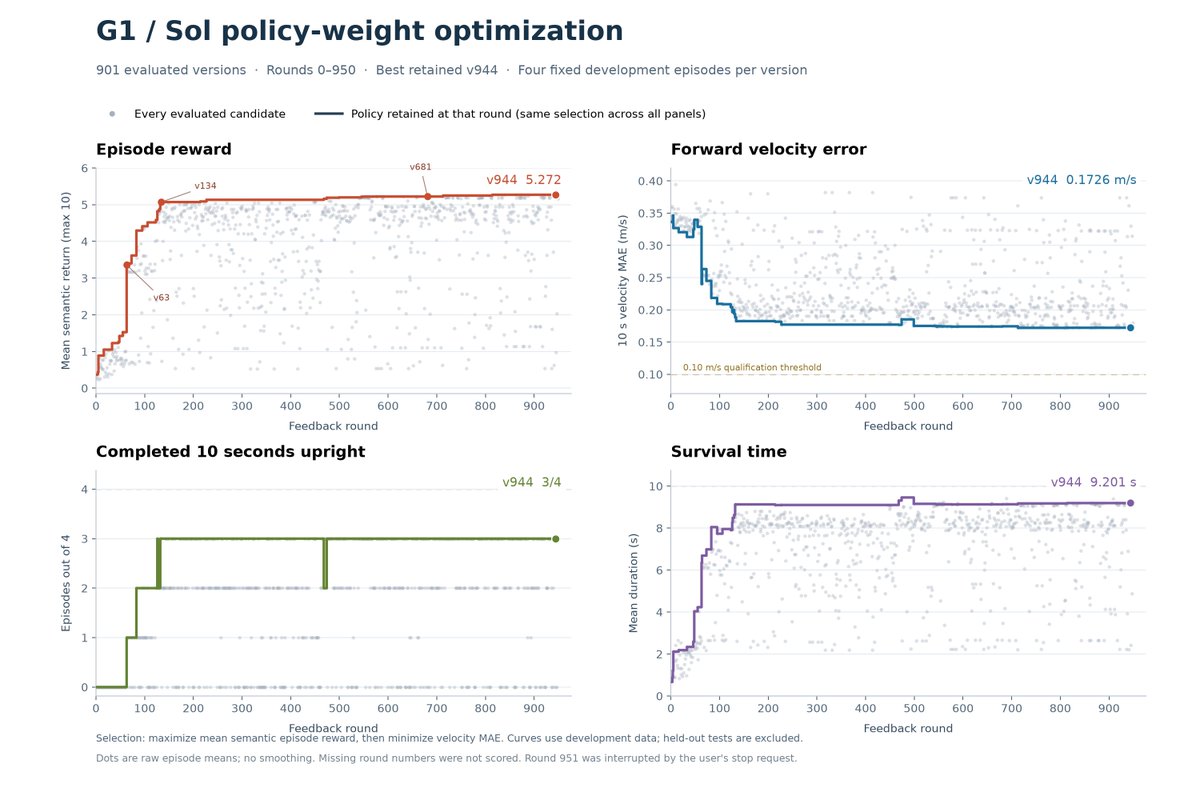
9/n Learning a policy from scratch this way is still very inefficient. Most of the gains came early, followed by hundreds of iterations with only small improvements.
8/n The results became feedback for subsequent iterations. Each attempt was recorded, and the best policy according to development-set reward was retained as the starting point for further edits.
7/n We applied those four numerical edits and reran the same four initial conditions. Average survival increased from 4.23 to 6.35 seconds, velocity MAE dropped from 0.329 to 0.240 m/s, and one episode completed the full 10 seconds upright.
6/n It then changed exactly four weights from 1.0 to 1.2. These connect the pelvis roll-rate input to four hidden units involved in contact-gated hip and ankle roll corrections. Its proposed fix was to strengthen that specific feedback pathway.
5/n Round 63 is a concrete example. The parent policy fell in all four episodes, surviving 4.23 seconds on average. In its logged reasoning summary, Sol hypothesized that stronger lateral damping could help counter the roll before the robot tipped too far.
4/n This includes per-step reward breakdowns, recorded body and joint states, foot-contact signals, and simulation frames. It can examine when the robot starts losing balance, how its speed deviates from the command, and how previous edits affected its behavior.
2/n Those parameters generate an internal rhythm, coordinate leg and arm movements, and turn body orientation, velocity, joint state, and foot contact into joint corrections. Some of the largest weights implement threshold-like switches between control branches.
Direct manipulation of π0.5 weights over fine tuning????
We ran a small experiment on the cloth-folding task on pi0.5. Results on robodojo:
1. Base: 50%
2. Fine tuned on Astra corrections: 68%
3. Direct weight manipulation: 75%
Will share the full breakdown soon
Round 16 of GPT-6.1 Sol editing a Unitree G1’s policy. I gave it per-step reward breakdowns and frames from the simulation.
The G1 still stumbles, but I’d bet we’ll soon be able to hand an LLM a goal and a simulator and get a working robot policy back by weight space programming.
We asked GPT-6 Astra to edit Qwen3.5-0.8B weights to improve math.
It directly changed only 0.016% of weights, fixing 0.8B's reasoning loops & improving math up to 6x and even instruction following 3x, without gradients or training.
We call this Weight-Space Programming: frontier LLMs can now natively read/write neural network weights! 🧵
Blog: https://t.co/bOWCcFhCVq
We asked GPT-6 Astra to edit Qwen3.5-0.8B weights to improve math.
It directly changed only 0.016% of weights, fixing 0.8B's reasoning loops & improving math up to 6x and even instruction following 3x, without gradients or training.
We call this Weight-Space Programming: frontier LLMs can now natively read/write neural network weights! 🧵
Blog: https://t.co/bOWCcFhCVq
Never let the word “language” in “large language model” fool you. At scale, autoregressive models can learn patterns beyond text. If a model can recognize an object from raw 3D voxels, why couldn’t it also find structure in neural network weights that look meaningless to us?
We asked GPT-6 Astra to edit Qwen3.5-0.8B weights to improve math.
It directly changed only 0.016% of weights, fixing 0.8B's reasoning loops & improving math up to 6x and even instruction following 3x, without gradients or training.
We call this Weight-Space Programming: frontier LLMs can now natively read/write neural network weights! 🧵
Blog: https://t.co/bOWCcFhCVq