If global GDP is $128 trillion, and China's GDP just under $22 trillion, China's $1.5 trillion trade surplus net of gold imports (just one-third of the gold purchased by Chinese is used for jewelry), is equal to 1.4% of the rest of the world's GDP.
If you think of this as the rough equivalent of a fiscal contraction of 1.4% of GDP, it may help explain why fiscal deficits must rise.
What's happening with US trade this month?
here is a flipbook that AI and I created: a simple structure, about a one minute read, nice visuals, and it auto updates with each new data release
also it works on mobile devices as well
https://t.co/iSZjGTQ6GK
Awesome new Fed data set with consistent estimates of US financial flows (valuation adjusted) based on measured holdings ...
Shows that equity flows are modest v valuation changes for example
1/
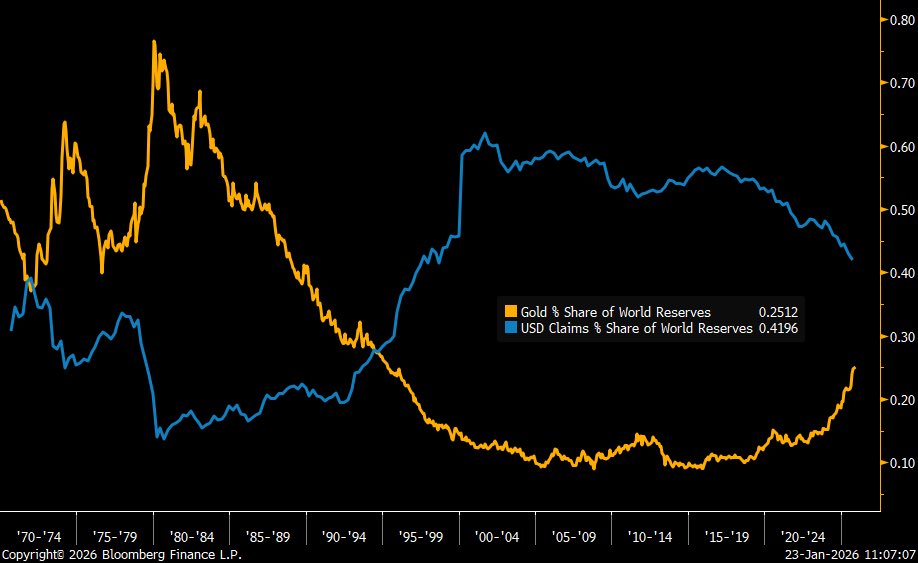
Gold now accounts for 25% of total world reserves. Still below the USD as a % share, and it remains far below its share in the 70s & 80s. In other words, if the recent reasons for buying gold persist, it can keep rising.
According to Danilo Pizzorno, Jannik used to ski from the roof of his parent’s house when he was 14-15 years old and his brother Mark used to film him doing somersaults.
😭😭
Let me explain why I believe modern economics is such a powerful tool for understanding the world. I’ll do this by discussing a great paper by Simone Cerreia-Vioglio, @UncertainLars, Fabio Maccheroni, and Massimo Marinacci, “Making Decisions Under Model Misspecification,” published in the Review of Economic Studies a few months ago.
Imagine I want to drive from UC San Diego to UCLA, but I’ve never driven that route before. I need to build a “model of the world” to guide me, which we usually call a map. Maps are simplified representations of reality. They can’t include every detail if they’re to be useful. Borges, in his short story On Exactitude in Science, makes this point beautifully. (In practice, I don’t draw the map myself—I use an app—but someone still had to make it.)
Because maps simplify, I can’t fully rely on them. Maybe last night’s storm knocked down a tree and closed a street, or there’s construction and the ramp off the highway in LA is shut down.
This uncertainty matters. Suppose I’m driving to UCLA for an important talk at 11 a.m. If the ramp is closed, I might need 15 extra minutes. When should I set my alarm to arrive on time, while still getting enough sleep to give a good talk?
The problem is that I can’t assign precise probabilities to all these contingencies. How likely is the fallen tree? Or new roadwork? Even the best traffic apps can’t capture every disruption, and some might happen after I’ve already left.
In economic terms, my “model of the world” (the map) is misspecified—and no matter how hard I try, I can’t fully fix that.
But sitting down and crying about misspecification doesn’t answer my basic question: when do I set the alarm? Too early, and I’m exhausted. Too late, and I’m late.
Simone and his co-authors offer a way to think about this. They start from the idea that we often hold several structured models of an economic phenomenon, grounded in theory. For example, a central bank might use a standard New Keynesian model and a search-and-matching model of money.
Yet, aware that each model is misspecified by design, the bank adds a protective belt of unstructured models—statistical constructs that help it gauge the consequences of misspecification.
The beauty of the paper is that it provides an axiomatic foundation for this protective belt (and even generalizes it to include a Bayesian approach). It shows that if a decision-maker’s preferences meet certain conditions —reflecting both rational and behavioral features— then those preferences can be represented by an augmented utility function that formally accounts for misspecification.
Crucially, we don’t assume that augmented utility function; we derive it. We start with general, plausible properties of preferences and prove that they imply such a representation.
That’s real progress. Instead of writing endless critiques of expected utility or rational expectations (as many have done for decades, with little to show), we now have a formal way to reason about misspecification—precise definitions, clear boundaries of validity, and awareness of what we still don’t know.
Take, for instance, a brilliant Penn graduate student on the market, Alfonso Maselli
https://t.co/rl2gu95V7t
His job-market paper pushes this frontier further. He studies cases where a decision-maker not only faces model misspecification but is also unsure which model best fits the data and can’t assign probabilities to them—what we call model ambiguity. In my example, the central bank is unsure whether the New Keynesian or the search-and-matching model fits better, and it worries that both might be incorrect.
If you read Simone et al. or Alfonso’s paper, you’ll see how misguided—and, frankly, cartoonish—many of the recent criticisms of economics on X have been.
First: the idea that economists don’t understand math or have “physics envy.” The math in these papers is subtle and advanced—utterly different from what physicists do (neither better nor worse, just distinct). An engineer transitioning into economics would find these tools unfamiliar.
Second: claims of ideological bias are unfounded. I have no idea about the political views of the authors, and I’d be surprised if anyone could infer them from the analysis—beyond vague guesses about typical academics.
Third: This has almost nothing to do with what one learns as an undergraduate, or even in first-year graduate school. If your knowledge of economics stops at an intro textbook, it’s best not to pontificate on the field’s frontiers.
Fourth: Is this science? Debating that word’s boundaries is pointless; every definition of “science” breaks down somewhere.
The Germans solved this long ago with the idea of Wissenschaft—the systematic pursuit of knowledge, whether of nature, society, or the humanities. By that measure, modern mainstream economics is clearly a Wissenschaft: a disciplined, cumulative, and highly useful effort to understand how the world works. Simone and his co-authors have demonstrated that beyond any reasonable doubt.
Here's a question I know many are wondering about: why did China wait until now to use rare earths as leverage against the US? Why not in the first Trump administration when the US started the trade hostilities? Or when the Biden administration unleashed the chips export controls 3 years ago?
I just watched a fascinating explanation by a Chinese analyst and, unexpectedly, a big part of the explanation is... helium.
I had no idea but as he explains (source here: https://t.co/eUbbU5QIHW), all the way until 2022 China imported 95% of its helium and most of it was controlled by the US. Of the world's ten largest helium producers, four were American companies, and the remaining six all used American technology.
Helium isn't just a party balloons gas: it has plenty of industrial applications for things such as quantum computing, rocket technology, MRI machines, as a coolant for chip lithography equipment, etc.
In a nutshell what he's explaining is that with helium the US had an even stronger card to play if China ever used the rare earths card.
This raised huge alarm bells inside China. In an article published in late 2022 in the journal Frontiers in Environmental Science (https://t.co/eZhyv438LK), several researchers from PetroChina’s Beijing-based Research Institute of Petroleum Exploration and Development stressed that China would be greatly affected if the US imposed a “stranglehold” blockade on helium exports.
So over the past few years there were gigantic efforts in China to break the "helium shackles," with seven helium extraction facilities going into production, and China also switching imports from the US in favor of imports from friendly countries like Russia.
China's research ecosystem also went into overdrive to find solutions to the helium dependency issues, with China's Academy of Sciences awarding its annual 2024 "Outstanding Science and Technology Achievement Prize" to a new helium extraction technology project (https://t.co/eWs163mfaO) because "these scientific and engineering achievements broke the long-standing monopoly of the US and ensured the security of China's helium resources" (https://t.co/d7YquWKFGS)
The result: by the end of 2024 China had cut its helium dependence on the US to less than 5% (https://t.co/wOxm8VRZJj). The "helium shackles" were broken.
That's what most people don't realize: power isn't about intentions or rhetoric - it's about what you can actually do. Many wonder why countries almost never retaliate when the US imposes sanctions or export controls. The answer is simple: they can't. They lack the alternatives, the technology, the supply chains.
China is the first country that systematically worked to eliminate every single pressure point, with humongous efforts. It's not just helium: it's chips, energy, telecommunication, pharmaceuticals, etc.
That's why the rare earth card can finally be played now. Not because China suddenly became aggressive, but because they have developed the capabilities to say "no."
Last word: as a European, this is both depressing and inspiring. Depressing because it highlights the immense magnitude of the task at hand to become genuinely sovereign and develop our own capabilities to say "no." Inspiring because China demonstrated that it can actually be done, and relatively fast if we execute competently. Although with the current crop of folks at the helm in Europe, that last part is admittedly a very, very big "if"...
The US tariff on China is back to 150%. When this last happened in April, China devalued the RMB, which put devaluation pressure on EM FX. EM central banks sold Treasuries, destabilizing the Treasury market. That caused the US to capitulate. Trump brought China tariffs back down.
The US is gradually losing its "exorbitant privilege," its ability to issue debt more cheaply than the rest of the G10 when foreign yields are swapped back into $. That loss is most pronounced for longer-term yields where risk premia are building. US deficits are taking a toll...
Forthcoming in the AER: "A Preferred-Habitat Model of Term Premia, Exchange Rates, and Monetary Policy Spillovers" by Pierre-Olivier Gourinchas, Walker Ray, and Dimitri Vayanos. https://t.co/NWtL1PSOea
📦 Can industrial policy work? Yes—the East Asian experience shows it can (at least partially).
But its success rests on a key condition: labor control.
🇯🇵🇰🇷🇹🇼 Japan, South Korea, and Taiwan industrialized rapidly under authoritarian or semi-authoritarian regimes. Wages and labor rights were systematically repressed to favor capital accumulation and export competitiveness.
This was especially stark in South Korea during the 1980s–1990s, when unions clashed with the state and business. (If you’ve watched Squid Game, it’s in the backstory of Seong Gi-hun.)
⚠️ Authoritarianism wasn’t incidental—it was functional.
Not all authoritarian regimes succeed with industrial policy, but successful cases relied on the ability to suppress real wages and labor rights.
🇦🇷 This is why Latin America’s Big Push programs failed: their political base—urban working-class voters (e.g., Peronistas)—couldn’t sustain the wage repression required. The strategy collapsed under its own contradiction.
💥 You can’t push industrialization with cheap labor and depend politically on those who demand higher wages. The internal logic breaks. Latin America’s populism was a road to nowhere.
As far as I can tell, there are no examples of country-wide industrial policy success where real wages (and consumption) were not kept relatively low.
🇨🇳 China is not so different today.
🧾 Consumption as a share of GDP remains exceptionally low—even compared to countries at similar stages of development.
That wouldn’t be the case if China were a democracy. High savings and low consumption are features, not bugs, of its growth model.
🤔 That’s why I’m puzzled when advocates defend industrial policy from a progressive position that favors high wages and democratic institutions. You can’t have your cake and eat it too.
📚 This point isn’t new: @pseudoerasmus has made it for years. And long before him, it was central to Marx, Gerschenkron, and Dobb—and deeply embedded in the logic of socialist Big Push programs, from Stalin to Mao.
Wow, highly relevant!
"Integrating balance sheet policy into monetary policy conditions" by Benoit Mojon, Phurichai Rungcharoenkitkul, and Dora Xia.
"This paper introduces a new Monetary Policy Conditions Index (MCI) that integrates conventional and unconventional monetary policy tools into a unified measure. The MCI is a weighted average of short-term interest rate and central bank balance sheet size, improving upon the shadow rate by capturing balance sheet policy effects away from the effective lower bound."
https://t.co/PkUQ2OjPuX
Low fertility is the result of shifting adult priorities, likely driven by changing norms, evolving opportunities and constraints, and broader social forces, from @kearney_melissa and @phil_wellesley https://t.co/lVxDaP45pL
Why do governments wait until the fiscal crisis hits to act?
Alesina & Drazen (1991) argue that stabilization delays aren’t irrational. They’re a war of attrition as groups fight to avoid bearing the cost.
The Big Beautiful Bill is setting up the next round.