Oh dear. @bloomberg had been publishing some good fact-based invetigative journalism on Bitcoin mining recently.
They may think twice about handing the mic to @davidfickling again. Granted it's an opinion piece, but even an opinion should really be written by someone who has done at least cursory investigation of the domain they are writing on.
David Fickling by contrast clearly demonstrated that he has no understanding of how energy, hydro, grids or bitcoin mining works and his research on bitcoin mining in the countries he is writing about didn't even extend as far as reading the investigations of his peers in the media.
I won’t spend the energy debunking all the nonsense in the article but here's a few of the most glaring errors:
The "journalist" makes the claim that Bhutan has somehow been adversely impacted by Bitcoin mining because "that power could have been used by the poor".
101-level misinformation.
Bhutan uses surplus water that would have flowed over the side of the dam or sold very cheaply to India. No locals miss out. This has been widely covered by more thorough journalists including WSJ, Forbes, Aljazeera.
https://t.co/mPfaNxHoRj
He also conveniently leaves out the well documented fact that bitcoin mining spared Bhutan a foreign currency reserve crisis
source: https://t.co/ljJA3tzxnM
... which in turn meant they avoided an IMF debt burden, built a bitcoin treasury now worth almost 50% of their entire GDP and allowed them to put up salaries of govt workers by 50-65% (again, well documented facts from the media outlets that did their homework)
source:
https://t.co/lTpgyXTX9K
Ethiopia miners use surplus hydro. Surplus. As is often the case with large infrastructure projects like dams, they are overbuild for future capacity. Many of the transmission lines have not been built to supply the rural population so the surplus energy is used for bitcoin mining. The $55M additional profit for EEP is being used to build out transmission lines ahead of schedule, delivering power to rural Ethiopians earlier.
The Ethiopian Tribune called "Bitcoin mining's success: a Model for Energy-Rich Nations"
source: https://t.co/ATkmvEvfKK
The “that power could have been used for something better” is highly misinformed because most of that hydro power is wasted surplus energy. I know of no informed journalists are still persisting with this take, which was once common in 2021-22 before the independent reports and peer reviewed research (22 papers) started flooding in and showing that bitcoin was using vast swathes of wasted energy).
As for “straining grids” - again, this is old FUD debunked multiple times. 3 different peer reviewed studies have shown that bitcoin stabilizes grids because it is a non-rival and flexible user of power.
Grid operators in ERCOT and other regions have confirmed this.
source: https://t.co/QDf98L9CcP
Bitcoin mining has been shown to help reduce electricity prices, accelerate the green energy transition, accelerate renewable hydro microgrid development that brings Africans out of energy poverty, obviate gas peaker plants, delay expensive grid upgrade costs, and work synergistically with other users of energy because it has an in yoke economic incentive to power down when electricity prices spike (ie: demand from other users rises). This is not conjecture, or opinion, it's been widely documented in 20 peer reviewed journals.
source: https://t.co/Tdq6i0kBY3
While the writer tries to neuroassociate bitcoin with fossil fuel by reference to some ancient history in Kazakhstan (very few miners are still located there) this is again highly misleading as bitcoin is, unique to any global industry, predominantly powered by sustainable energy (52.4%, source : Cambridge April 2025,
https://t.co/kp3iOgqE7k
So what is the true picture? The real picture is that Bitcoin mining is doing the exact opposite of the claims in this opinion piece: ie - bringing 10s of 1000s of people in the most energy-poor regions of the world out of energy poverty.
Gridless is one of many examples, where as a result of green micro-hydro grids coupled with Bitcion mining, 28,000 rural Africans have already been brought out of energy poverty.
source:
Looking forward to more informed opinions from journalists who do their homework in future @Bloomberg.
@wsj, @bbc, @forbes and @AJEnglis have made the effort. So can you.
https://t.co/fPjggY08SL
@bcrypt Love it! It looks like he is trying to simplify the logic here and then realises he's made a mistake mid-sentence. You can almost see the cogs turning before he goes into it.
🚨 Bitcoin May Be Sounding The Alarm On Inflation
Bitcoin went vertical yesterday. The digital currency is up more than 11.5% in the last 24 hours. This type of performance is rare in financial markets, especially if there is no obvious catalyst such as an earnings announcement or M&A activity.
So why is bitcoin rapidly appreciating over the last few weeks?
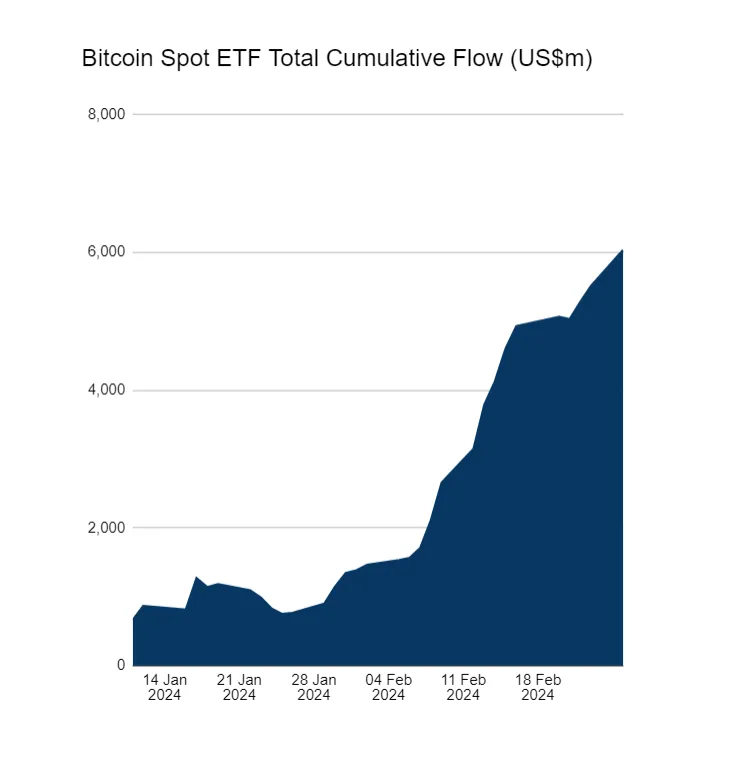
The common answer is that the bitcoin spot ETFs have led to significant demand for the asset. This answer is not wrong. Yesterday we saw $520 million in net inflows to the ETFs.
As the folks at @BitMEXResearch pointed out, that is 9,510 bitcoin of net inflows when you price the capital flow in bitcoin. To put it in perspective, the bitcoin network is producing 900 net new bitcoin per day. So there is more than 10x demand for bitcoin than what the network can produce daily.
That imbalance of supply and demand would not be shocking if we were evaluating it during the first few days of the ETF launch. But we are now 45 days after the ETF launch, so the 10x demand imbalance is mind-boggling.
The ETFs have also officially crossed over $6 billion in cumulative net inflows since launch. Blackrock’s fund has $7.2 billion in assets as the leader and there are 5 ETFs with at least $1 billion in AUM. The launch of the bitcoin spot ETFs have been the single greatest launch of any ETF in history by almost every measurement.
This brings us to the most important question — why are so many people buying bitcoin right now?
The easy answer would be some version of “the institutions want to make money and now that they can buy the best performing asset of the last 15 years, so they are going to buy as much as they can.” There is some truth in that statement, but I don’t think it is the full story.
In fact, there is a hidden detail that most people are missing, which may scare the hell out of you.
What if people are buying bitcoin because we are going to see a resurgence of inflation and investors are preparing for the inflation shock to their portfolio?
Let me explain.
First, let’s go back to 2020. The pandemic had a chokehold on the economy. Government officials and central bankers stepped in with unprecedented monetary and fiscal stimulus. Trillions of dollars in liquidity was sloshing around the economy.
The state talking point was to not worry about inflation, which was later followed by “inflation is transitory.” Sophisticated investors were not fooled though. Paul Tudor Jones and Stanley Druckenmiller went on CNBC to say “inflation is coming!” They each said they were buying bitcoin because the belief was that inflation would be the fastest horse in the inflation-hedge category.
That was a correct prediction.
Bitcoin’s price was around $8,000 during the summer of 2020 and inflation was under 2%. By March 2021, less than 1 year later, bitcoin was trading at $64,000. That 8x increase in price was attributable to a few things, but a major reason was that markets are forward-looking.
Investors saw that inflation was coming, so they began buying bitcoin hand-over-fist. They wanted to be protected when the inflation arrived. Remember, investors don’t wait for inflation to come before buying inflation-hedge assets. They buy them in anticipation.
And there is a strong argument that investors are doing it again now.
The Fed has worked tirelessly to get inflation down. The media has celebrated that year-over-year CPI continues to fall aggressively. But that is not an honest evaluation of the situation.
According to @WinfieldSmart, “Inflation resurfacing is a real risk today. ISM services prices has been an accurate leading indicator for inflation. And it has just moved up sharply.”
Most importantly @donnelly_brent points out, companies are still looking to raise their prices. This is the ultimate measure of future inflation — if companies continue to raise their prices then it won’t matter what the Fed is doing.
So the risk of inflation coming back is getting higher each day. Some investors are buying bitcoin in anticipation of that situation coming to fruition. The new investment vehicle presented via ETFs gives more capital the option to use this asset than at any other time in history.
As this capital flows in, the numerous investors who were short bitcoin are being liquidated. Bitcoin analyst Checkmate explained by saying, “You know what sets this rally apart from the last time bitcoin hit $57,000 in 2021? This time, short-sellers continue to bet against the prevailing uptrend, getting liquidated as a result. At true bull market peaks, it is the levered longs that get wiped out. Right now, its the shorts.”
This is reflexivity at it’s finest. The market begins to chase the asset that is running away from them. The smart investors kick off the trend, but the followers push everything further and faster than previously thought possible.
@wclemente wrote yesterday, “Anyone that’s bought a Bitcoin ETF is now up at least 15%, as it trades just 25% away from price discovery. Any suit waiting to see whether the ETFs would have impact will soon become momentum buyers. Then all time high breakout buyers will follow. Reflexivity.”
I couldn’t agree more.
The bitcoin ETFs are getting most of the attention because the capital inflows are quantifiable. They have exceeded all expectations. It is fun to watch Wall Street push the price of bitcoin up in order to get bitcoin holders to sell their coins.
But don’t buy the narrative that this rally is only tied to some speculative interest from large capital allocators. There is a big risk of inflation lurking in the dark corners of the economy. Many investors have seen this story before and they are not going to be fooled twice.
Inflation. ETFs. Media attention. Liquidated shorts. Reflexivity.
Satoshi couldn’t have drawn it up any better.