Disturbing reports from District Hangu, Khyber Pakhtunkhwa: There are multiple police deaths and injuries in today’s “hours long” clashes with Taliban in the Khazina Banda area of the district. A DSP has also lost his life. Police say 6 Taliban were also killed in the clashes.
History will remember how at one of the country's most critical junctures in recent memory, from Naushki to AJK, and in the presence of rising terrorism and collapsing regional orders, PML-N and PPP were enacting a pitiable theatre of the absurd trying to distract attention from the core issues. They really think they can insult national intelligence and nobody will notice.
At 5:45 p.m. ET today, Islamic Revolutionary Guard Corps forces launched multiple ballistic missiles from Iran in an attempted surprise attack on U.S. forces based in the Middle East. All Iranian missiles were successfully intercepted. U.S. forces remain vigilant and at a high state of readiness.
Ukraine attacked an Iranian vessel in the Caspian Sea. The Caspian Sea is one of the most direct and strategically valuable routes connecting Iran and Russia. It facilitates commercial trade, logistics and military cargoes.
Iran is facing a major dilemma because the Caspian Sea or Ukraine is not a theatre where it possesses strategic depth or an extensively tested escalation framework. It is the front in which military options, political constraints, and diplomatic relationships differ substantially from those of the Persian Gulf and West Asia.
It is the front where Iran can't resort to immediate retaliation. This demands a significantly different and comprehensive strategic assessment.
First, Iran needs to determine whether this was a one-off action or a prelude to a much wider campaign, particularly aimed at disrupting Iranian-Russian connectivity.
- Should Iran respond overtly and militarily, or should Iran consider a covert response?
- If retaliation is considered necessary, where should it occur? Caspian? Ukraine? Red Sea?
Every option carries different escalation risks.
A response in the Caspian would signal a determination to defend that specific theatre but could alter the security dynamics of a region that has been relatively calmer for Iran. It could lead to a wider disruption of Russia-Iran connectivity.
Similarly, a response directed toward mainland Ukraine would represent a much broader escalation with significant political and military consequences, not to mention the operational constraints due to NATO's layered air defence.
As for an indirect or covert response, would it be able to establish deterrence?
- What would be the objective of the response?
Since this would define the scope, scale and timing of the response. Iran seeking to establish deterrence, impose cost or restore credibility by communicating resolve?
Through a symbolic response, Iran might be able to communicate resolve, but it may fail to restore deterrence. A disproportionate response risks inviting further escalation, and a proportionate response in the Caspian Sea might expand the conflict into a new theatre of relative peace.
Two U.S. Congressmen, Mr. Ryan Keith Zinke, Member House of Representatives (State of Montana) and Mr. Michael James, Member House of Representatives (State of Washington) called on the Chief of Defence Forces and the Chief of Army Staff of the Pakistan Army, Field Marshal Asim Munir at General Headquarters (GHQ), Rawalpindi.
During the meeting, discussions focused on matters of mutual interest, regional security, bilateral defense cooperation and avenues for enhancing economic collaboration and prosperity.
The visiting delegation thanked the military leadership for the warm hospitality and expressed a shared commitment to promoting deeper economic, commercial and institutional linkages between the United States and Pakistan.
Iran informed Pakistan it suspended its participation in the talks rather than withdrawing, and is willing to resume in Doha, Geneva, or Islamabad.
Tehran told mediators it will not accept a new route in the Strait of Hormuz and wants the talks to proceed under the memorandum of understanding. It is demanding the Strait be addressed first, followed by the frozen funds, with the nuclear issue last. - Al Arabiya
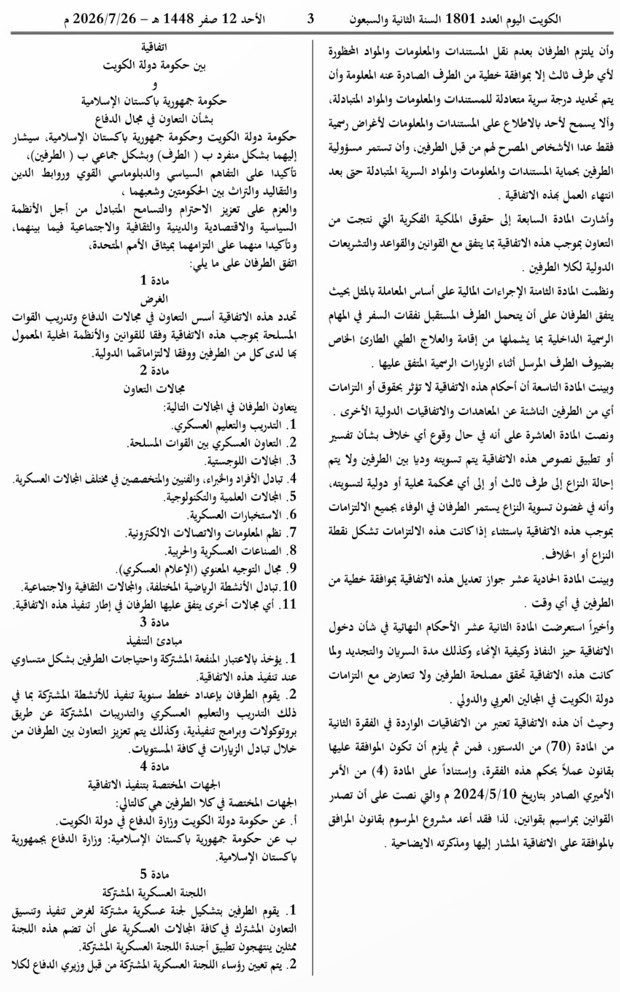
Also a much needed disclaimer; The Pakistan Kuwait joint defence cooperation agreement as ratified by Kuwaiti Cabinet on 19th July and made public today and published in the Kuwaiti Gazette under Decree 73 of 2026 is more to do with Capacity building of Kuwaiti forces by Pakistani side.
It in NO way has any resemblance to the Saudi Pak Strategic Mutual Defence Agreement.
The Nomenclature of both the agreements make it quite clear on what these agreements mean, entail and cover.
To my understanding, while the defence cooperation agreement between Pakistan and Kuwait was signed in June 2023, but it took over 03 years for the Kuwaiti cabinet to ratify the agreement for implementation.
It has now come into implementation since 19th July 2026 as per the Kuwaiti Decree.
The question is what prompted this ratification; geopolitical complexities or bureaucratic delays, that can be anyone’s guess.
The fact remains that the agreement signed in June 2023 has now been announced in July 2026, implemented, and made Public by Kuwait on their part.
Kuwait has formally approved the defense cooperation agreement with Pakistan.
Under the agreement, the two sides will cooperate in the following areas:
- Military training and education
- Military cooperation
- Logistical support
- Exchange of personnel, experts, technicians, and specialists across various military fields
- Scientific and technological cooperation
- Military intelligence
- Information and electronic communications systems
- Military and defense industries
Breaking : Kuwait Announces a joint defence cooperation agreement between Kuwait and Pakistan -- Pakistan now has a strategic mutual defence agreement with Saudi Arabia and a defence cooperation agreement with Kuwait effectively turning it into a net security stabiliser for the GCC
President Trump ordered the U.S. military to pause strikes on Iran on Friday, ending nearly two weeks of daily attacks.
The decision came as Omani officials held talks in Tehran, with reports indicating progress toward a possible agreement to reopen the Strait of Hormuz.
Source: Axios
Indian forces have launched one of their biggest crackdowns in recent years, detaining more than 3,000 people across India-administered Kashmir after the killing of a police officer in Anantnag.
Critics, including political leaders and human rights organisations, say the mass arrests, house raids and demolitions amount to collective punishment of civilians