The future of wellness is already being studied. 🧬
In a landmark trial involving 17,604 adults, semaglutide reduced the relative risk of major cardiovascular events by 20% in people with established heart disease and overweight or obesity.
This is why peptide-based medicine deserves serious attention.
The future isn’t about chasing perfection. It’s about using real science to help people live healthier lives and reach their potential.
Discover our vision for evidence-led wellness at Velvora. Link in bio.
Study: DOI 10.1056/NEJMoa2307563
The future of metabolic medicine is evolving. 🧬
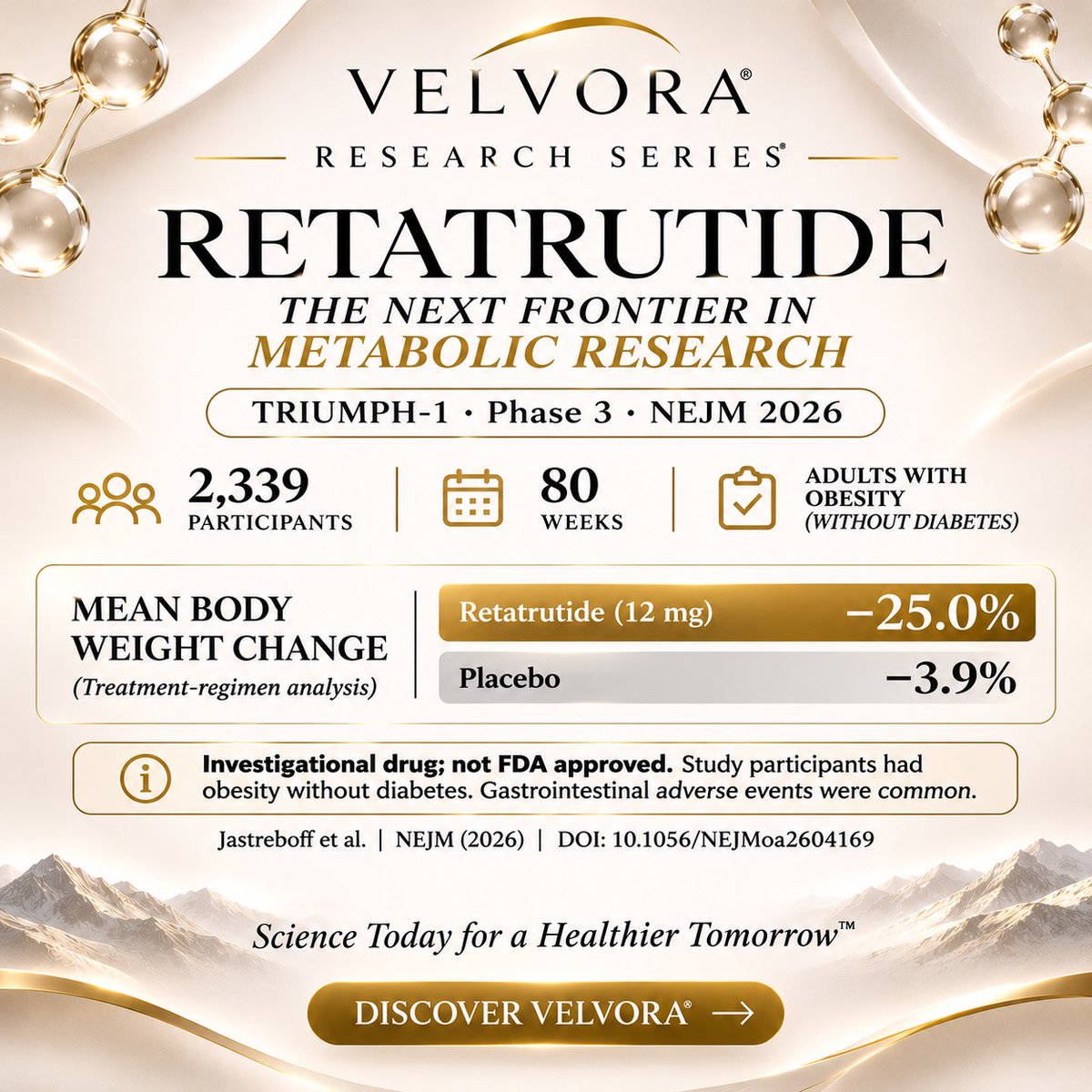
A Phase 3 clinical trial reported 25% average weight reduction with investigational retatrutide over 80 weeks in the 12 mg group.
This is what the next generation of biotechnology research looks like.
At VELVORA, we believe human potential begins with scientific progress, transparency, and better health.
Explore our vision for the future of wellness. Link in bio.
Study: NEJM (2026), TRIUMPH-1.
The next decade of biotechnology could change how we approach metabolic disease.
Peptide-based medicines are already demonstrating meaningful results in clinical trials.
But innovation means nothing without safety, rigorous testing, and evidence.
The future of wellness should be built on science, not shortcuts.
VELVORA | Research Without Compromise.
The future belongs to those who value precision.
At VELVORA, our vision is simple:
Elevate the standards of research compounds through quality, scientific integrity, and transparency.
Because exceptional research deserves exceptional standards.
VELVORA.
Research Compounds Without Compromise.
Discover our vision: https://t.co/LQCYgv8t0a
For research use only. Not for human consumption.
A premium label doesn’t prove purity.
A beautiful bottle doesn’t prove quality.
And a scientific-sounding description isn’t laboratory evidence.
Real research transparency starts with documentation, independent analysis, and traceability.
That’s the standard worth pursuing.
VELVORA | Premium Research Compounds.
https://t.co/LQCYgv8t0a
Two names shaping the future of metabolic research:
Tirzepatide: Dual GIP/GLP-1 receptor agonist.
Retatrutide: Triple GIP/GLP-1/glucagon receptor agonist.
Both have produced substantial weight-loss results in clinical studies.
But more receptors don’t automatically mean better outcomes for everyone.
Which research question interests you most?
Velvora, https://t.co/LQCYgv8t0a
Genuine question for the peptide research community:
What matters most when evaluating a research compound?
A. Verified purity
B. Independent laboratory testing
C. Batch-specific certificates of analysis
D. Supplier transparency
At VELVORA, we believe quality should never be a guessing game.
What’s your answer?
Research deserves more than ordinary standards.
Precision matters.
Purity matters.
Transparency matters.
At VELVORA, we believe premium research compounds should be defined by verifiable quality, not exaggerated promises.
Research Compounds Without Compromise.
Explore VELVORA: https://t.co/LQCYgv8t0a
For research use only. Not for human consumption.
Unpopular opinion:
The biggest problem in the peptide industry isn’t a lack of innovation.
It’s the gap between scientific evidence and marketing hype.
Some peptides are established medicines. Others remain experimental.
Should research companies be required to publish independent purity testing?
We think transparency matters.
The future of metabolic health is evolving.
Peptide-based medicine is opening new possibilities for managing obesity and improving metabolic health.
Retatrutide (RETA) is one of the most exciting examples.
In a Phase 3 trial, participants receiving 12 mg achieved 25% average weight loss over 80 weeks.
Imagine what the next decade of biotechnology could bring.
Better science. Greater potential. A new era of wellness.
Discover VELVORA’s vision for research-driven innovation.
🔬 https://t.co/LQCYgv8t0a
Retatrutide remains investigational and is not FDA-approved.
Everyone is talking about AI changing the future.
Meanwhile, biotechnology is quietly changing how we think about human health.
Peptides might be one of the most interesting parts of that conversation. 🧬
What if the future of metabolic health is already taking shape? 🧬
In the SURMOUNT-1 trial, tirzepatide achieved 20.9% average weight reduction over 72 weeks in the 15 mg group.
A milestone in peptide-based medicine.
At VELVORA, we’re inspired by innovations that help people pursue healthier lives and unlock new possibilities.
Discover our vision for science-led wellness. Link in bio.
Peptides are about to become one of the biggest conversations in health and longevity.
Most people still have no idea what they are.
Some are already used in medicine. Others are being studied for recovery, metabolism, skin health, and aging.
We’re only scratching the surface. 🧬
Picture a clipper whose edits are clean and whose clips still get skipped, and it usually comes down to three things that have nothing to do with the cut…
The first is the opening. If the first second doesn't give someone a reason to stay, the rest of the clip doesn't matter, because retention and rewatches are what get a clip pushed to more people (the fix is to open on the strongest moment and cut anything before it)
The second is the on-screen text. It reads as decoration to a lot of beginners, but it's really copywriting. A good line of text tells a viewer why to keep watching, and a weak one wastes the one place you get to speak to them directly
The third is copying the wrong format. Formats differ a lot between niches, so a style that works for one kind of page can flop on another. The fix is to study the top pages in your niche before you cut anything, and notice what they open on, how long the clips run and what the text looks like
What he should've done is fix those three before spending any more time on the edit, because they're quicker to change and they decide whether the clip is seen at all
Most clips that don't land weren't badly made, they were made for a viewer who'd already scrolled past
Most people use AI for fun. You can also use it to hand your most boring weekly task to a machine.
Not ten tasks. One.
Pick the thing you do every week and hate, then build around it. Everything else can wait until that one works.