Railroads were once 63% of the entire US stock market.
Not 63% of transport stocks. 63% of everything listed.
The history of concentration, in order:
– Tulips, 1637. A single bulb traded for the price of an Amsterdam canal house.
– South Sea Company, 1720. Shares went from about £128 in January to above £1,000 by summer, then back near £150 by December.
– US railroads, 1840s. 63% of US market cap.
– Utilities, telecom and industrials, 1929. 36%.
– Nifty Fifty, 1972. 40%.
– Japan, 1989. 44% of global equity.
– Dot com, 2000. 41%.
– AI Big 10, today. About 40%.
Every one of them was built on something real. Railroads did compress a continent. The internet did rewire commerce. Being right about the technology was never the thing that protected you.
The tulip story is also less clean than the legend. Modern research found the economic damage was modest and the ruin was mostly literary.
The bubble was never in the idea. It was in how many people decided to own the same idea at the same time.
If you're curious about the broader implications of today's U.S. Treasury announcement (see earlier posts):
Gold is back up to $4,500
The Dollar Index has weakened by ~1%
Bitcoin popped 6%
(CNBC charts below.)
#markets#gold#bitcoin#dollar#economy@cnbc
🚨 The Bond Market Just Broke: Japan Dumps $26 Billion in Treasuries While America Is Buying Back Its Own Bonds
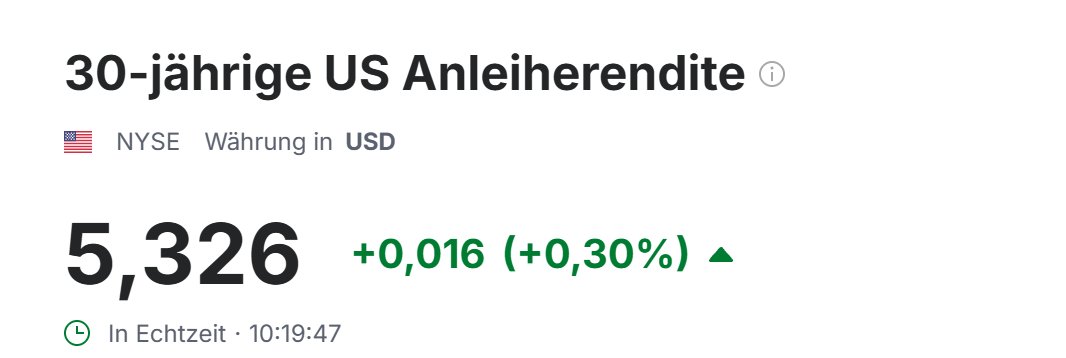
Today, the US Treasury admitted the long end of the bond market is broken. Nobody wanted the 10-year, 20-year, or 30-year debt. The 30-year yield just slammed into its highest level since 2007 (peaking near 5.33%).
So what did they do?
They announced they’re AT LEAST DOUBLING their liquidity buybacks of those exact long-term bonds, from a $2 billion max per operation to $4 billion+ starting September 9.
They’re literally borrowing short-term money to buy back their own long-term debt. Classic desperation move. Bond prices spiked, yields crashed 9-10 bps, and futures ripped higher the second the news dropped.
Meanwhile Japan, still the #1 foreign holder of US Treasuries is dumping them to fund currency interventions.
The BoJ and finance minister threatened of bold actions to save the yen. BoJ’s Yuto apologized for the measures being prepared.
June data just showed Japan cut holdings by another $26.4 billion (down to $1.117 trillion).
That follows the massive joint US-Japan yen-buying intervention in late July that burned tens of billions of dollars trying to stop the yen from hitting 40-year lows near 164. The yen has already given back more than half those gains and is back above 159.
When the biggest foreign buyer is selling Treasuries to defend its own currency… and the US government is forced to step in and buy its own unwanted long bonds… this isn’t “market support.” This is the system flashing red.
The famous City Of London banker @LordBelgrave had already warned about the planned debt, oil + currency financial crisis at the start of the year. It is now being executed.
Yields are the gravity of everything, your mortgage, stocks, crypto, gold. The can just got kicked harder and farther. Don’t look away.
Makro-Update: US-Renditen bei > 5,3 % – Ein fundamentaler Regimewechsel
Im Mai hatte ich in einem Beitrag skizziert, dass die US-Staatsanleihen am langen Ende bedrohlich nahe an die 5%-Marke rücken (damals notierte die 30-jährige bei 4,96%).
Heute Morgen sehen wir, dass sich dieser Trend verfestigt hat: Mittlerweile notieren sowohl die
20-jährige als auch die 30-jährige US-Staatsanleihe bei über 5,3 %. (Siehe Screenshots)
Warum diese strukturelle Zinsverschiebung für Aktien Investoren jetzt zur echten Belastungsprobe werden könnte:
Das Ende von T.I.N.A.:
("There Is No Alternative"): Der Markt wird von institutionellem Großkapital wie Pensionskassen bewegt.
Deren Modelle verlangen oft 4 bis 5 % garantierte Jahresrendite. Bietet der US-Staat für die nächsten Jahrzehnte risikofreie 5,3 %, haben diese Giganten keinen zwingenden Grund mehr, hohe Volatilität auszuhalten.
Das "Equity Risk Premium" wird zu dünn.
Liquidität fließt aus dem Aktienmarkt ab.
Die Anatomie der Bewertung (DCF):
Der faire Wert einer Aktie basiert in der Theorie immer auf abgezinsten zukünftigen Cashflows. Steigt der risikofreie Diskontierungszins auf über 5,3 %, fällt der heutige Barwert dieser zukünftigen Gewinne. Besonders unprofitable Tech Werte und Hypergrowth Storys können durch diese Multiple Kompression schwer unter die Räder geraten.
Fazit:
Wir stehen nicht zwingend vor einem Crash, da die absolute Liquidität noch hoch und die US Wirtschaft erstaunlich robust ist.
Aber dieses Zinsniveau ist ein guter Nährboden für eine spürbare Sektor Rotation.
In solchen Phasen trennt sich die Spreu vom Weizen. Während das breit gestreute Basis-Portfolio solche Makro-Wellen langfristig aussitzt, ändert sich der Filter für den aktiven Teil des Portfolios jetzt massiv. Der Fokus liegt hier zwingend auf Quality Compoundern.
Ein entscheidender Blick gilt dabei der Bilanzstruktur: Zwar sind viele Unternehmenskredite noch langfristig festgeschrieben (die Auswirkungen kommen erst mit Verzögerung), aber wer einen hohen Anteil an variabel verzinsten Verbindlichkeiten in den Büchern hat oder kurzfristig refinanzieren muss, dem fressen die Zinskosten demnächst die operativen Margen auf.
Wer hingegen enorme Preissetzungsmacht besitzt und gigantische freie Cashflows generiert, finanziert sich aus eigener Kraft.
Aber und das ist in der aktuellen Lage entscheidend, selbst die höchste Qualität schützt nicht vor makroökonomischem Gegenwind.
Deshalb ist "Buy and Hold" blindes Hoffen (bei Einzelwerten), wenn sich das Zinsregime dreht.
Genau jetzt ist der Zeitpunkt, an dem striktes, systematisches Risikomanagement und das Absichern von Gewinnen absolute Priorität haben. Überprüft eure Allokation.
#Zinsen #Makro #Aktienmarkt #US30Y #Anleihen #Risikomanagement #QualityCompounder #PortfolioManagement #Börse #DCF
All the comments below on Nike stock being down 75% are about the product, competitors, politics, macro.
None of them are about the stock's P/E ratio, which went from about 10 in 2009 to 70(!) in 2020, back down to about 20 today.
Multiple expansion and contraction can be major drivers of stock returns.
Maybe consider that as you review your current portfolio of high multiple names and what happens if they rerate.
Worth thinking about my favorite Vonnegut quote:
"All that had changed was people’s opinion of the place"
Berkshire Hathaway's current stock portfolio (barring any changes so far in the third quarter that are not yet public.)
If you combine the two classes of Alphabet shares, that edges out Coca-Cola as the third-largest position.
(h/t CNBC's Berkshire Portfolio Tracker)
I går i Folketinget sagde Danmarks statsminister:
"Problemet er jo, at en stor fjende er begyndt at vokse op indefra, og det er udlændinge, der er kommet til Europa.
Det er Hamastilhængere, det er folk, der begår terror mod europæiske samfund, det er folk, der ikke anerkender vores grundlæggende europæiske værdier, det er folk, der sympatiserer med nogle af de allermørkeste kræfter i den her verden.
Så Europa er truet. Problemet er, at vi både er truet udefra og nu indefra, men det er ikke på grund af en uenighed mellem den danske og spanske regering. Det er på grund af folk med en islamisk baggrund, som ikke vil det åbne, frie europæiske samfund, desværre."
@sparbuchfeinde@kat_invest Gerade einen schönen Bericht über Microsoft Lizenzen bei heise gelesen. Der Freistaat Bayern gibt mehr für Microsoft aus als für die Infrastruktur von Feuerwehr, Rettungsdienst etc. Ein echtes Armutszeugnis
Der Aktienmarkt ist die beste Anlageklasse der Geschichte. Die durchschnittliche Aktie ist ein Verlustgeschäft.
Beides stimmt gleichzeitig, und genau darin liegt die ganze Pointe.
Hendrik Bessembinder hat jede US-Aktie seit 1926 durchgerechnet - rund 25’300 Stück.
Ergebnis:
4 von 7 Aktien haben über ihre gesamte Lebensdauer weniger abgeworfen als ein simples Sparbuch beim Staat.
Die 4 Prozent besten Titel?
Die stehen für den kompletten Vermögenszuwachs des amerikanischen Aktienmarkts. Die restlichen 96 Prozent haben sich gegenseitig neutralisiert.
Weltweit sieht es noch krasser aus:
Bei 64’000 Aktien aus 30 Jahren waren es 2,4 Prozent.
Warum?
Ganz simpel: Nach unten ist bei minus 100 Prozent Feierabend. Nach oben gibt es keine Bremse. Über Jahrzehnte gerechnet zieht eine Handvoll Amazons den ganzen Markt - während der Durchschnittstitel still vor sich hin dümpelt oder verschwindet.
Wer zehn Aktien im Depot hat, trifft eine Auswahl - statistisch aber eine sehr enge Wette. Nicht wegen mangelnder Sorgfalt, sondern weil die grossen Gewinner so selten sind, dass sie in einem kleinen Depot mit hoher Wahrscheinlichkeit fehlen.
Das ist der eigentliche Grund, warum Indexfonds so hartnäckig gut abschneiden.
Nicht in erster Linie die Gebühren. Vor allem die Mathematik.
Und trotzdem:
Genau diese Zahlen sind auch das beste Argument fürs Stock Picking.
Wenn 4 Prozent der Titel alles erklären, dann heisst das im Umkehrschluss, dass die Belohnung für einen einzigen Treffer absurd hoch ist – und dass man ihn nicht einmal früh erwischen muss, sondern nur lange genug halten.
Übrigens: Deine Chance, blind eine der 4 Prozent Gewinneraktien zu ziehen, liegt bei 1:23. Beim Swiss Lotto Jackpot sind es 1:31 Millionen.
Ich versuche über mein Leben 2-3 Big-Winners zu erwischen. Damit schlage ich den Index.
Und bin mir gleichzeitig im Klaren, dass die meisten Picks nie aufgehen werden. Es kann gar nicht anders sein.
Hinweis zum Schluss:
Bessembinder misst Einzelaktien über ihre ganze Lebensdauer - ein Index tauscht seine Mitglieder laufend aus. Die Studie sagt also nicht, dass Stockpicking unmöglich ist. Nur, dass die Trefferquote, die man dafür bräuchte, ziemlich brutal ist.
A billionaire trader has spent 40 years trying to delete a one-hour documentary. It shows him making $100 million in a single afternoon. He predicted the crash that made it possible three months in advance. He has never explained why he wants the film gone. His name is Paul Tudor Jones. The film is on YouTube.
The documentary is called "Trader." PBS filmed it in 1987, three months before Black Monday. Jones was 32 years old, working from a small New York office, wearing shorts and a t-shirt, yelling at his phones, throwing paper across the room, and sleeping under his desk. The film captures him and his research partner Peter Borish overlaying a chart of the 1929 market on 1987, month by month. The two charts tracked within one percent. Borish said this is exactly what happened in 1929. Jones said if the analog holds, October is when it breaks.
On October 19, 1987, the Dow fell 22.6 percent in a single day. It remains the largest one-day percentage loss in stock market history. That afternoon, Tudor Jones covered his shorts and made roughly $100 million. He was 33 years old. He was one of the very few traders on the street who came out ahead.
He tried to bury the tape because it made him look reckless in a professional world that punished swagger. Twenty years of legal effort did not delete it. Someone kept a copy. It is on YouTube. It has fewer views than most makeup tutorials.
The film is not really about a crash. It is about a specific philosophy of trading. Jones is shown building conviction slowly, sizing carefully, then striking hard when the setup arrives. He is never once shown making a random bet. He is shown doing the same thing five times a day, every day, for three months.
His signature line, repeated across a 45-year career:
"The most important rule of trading is to play great defense, not great offense."
He does not try to be right. He tries not to lose. He sets stops tight, cuts positions fast, and never averages down on a loser. Every trade in the film follows this template.
Tudor Investment Corp, the fund he founded in 1980, has compounded at roughly 19 percent a year for 45 years. He is 71 years old and still trading. His method has not changed since the film.
The lesson: greatness in markets is a refusal, not a talent. Refusal to be reckless. Refusal to be certain. Refusal to average down. Refusal to trust yourself in a drawdown. Tudor Jones has refused those refusals for 45 years.
The tape is free. The philosophy is repeated in every trade. Most traders will never watch it.
@bundeskanzler Wann sorgen sie sich denn um den Mittelstand (Die Mitte!!!), um die Kleinunternehmer, Soloselbstständigen? Oder Profitieren wieder nur die Großkonzerne und die Ränder?
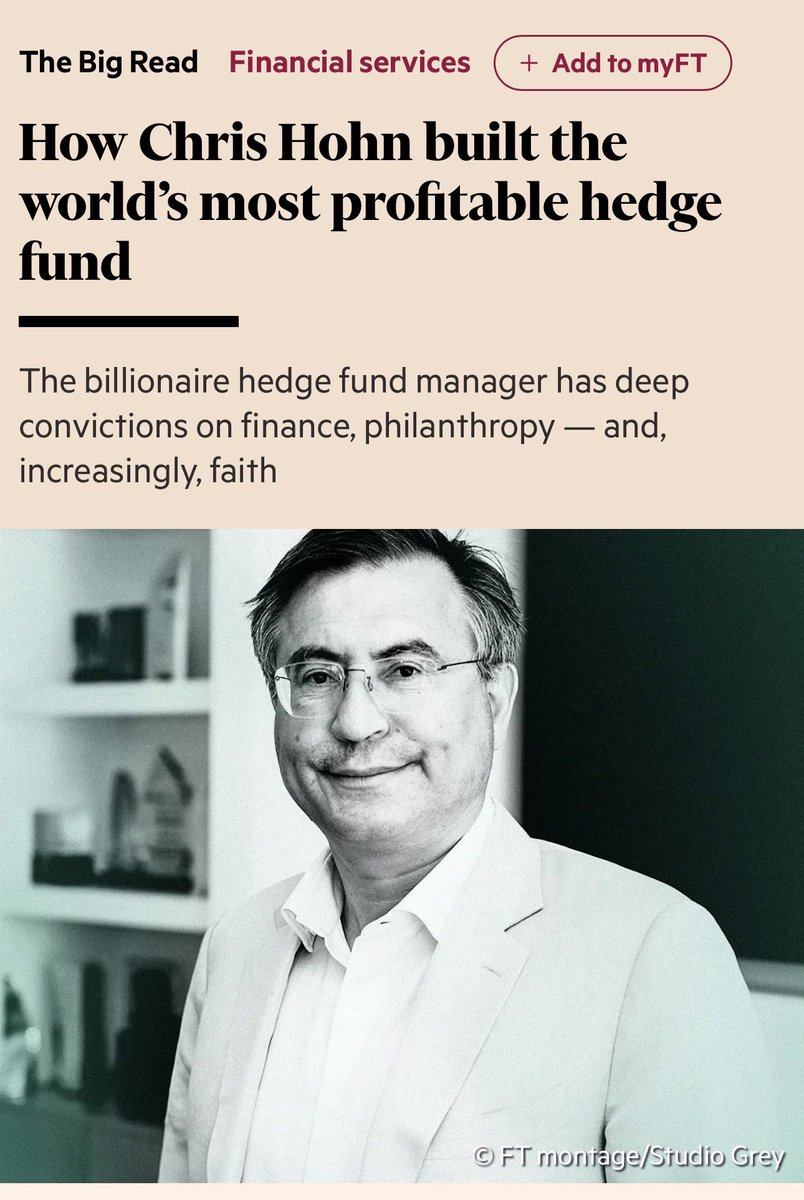
Chris Hohn did a 90-minute sit-down with Nicolai Tangen and then dropped an investor letter the FT got hold of last week.
You’d think the guy who printed a record $18.9B last year would be doing victory laps. Instead he’s quietly rewiring his whole portfolio.
My favorite takes from both:
1.The most important thing in investing isn’t growth. It’s barriers to entry. Growth without a moat is the airline industry: 5% volume growth for 100 years and basically zero cumulative profit.
2.There are only about 200 companies on earth he considers high-quality and investable. His fund holds 15.
3.Average holding period: 8 years. Some positions 13. “You have to hold the company forever, because the stock market may be at very bad prices when you want to sell.”
4.His real test for a moat: can the company price above inflation? A 20% margin business that prices 1% above inflation grows profits 5% faster than revenue. Forever. Almost no companies can do this.
5. Industries he won’t touch: banks, autos, retail, insurance, tobacco, asset managers, fossil fuel utilities, airlines, wireless telecom, media, advertising. On banks: “sooner or later someone without a lot of intelligence comes to run them, and then it can be toxic.”
6.On AI generally: call centers go bankrupt. Indian outsourcing coders are next. But for everyone else, AI lowers costs and raises productivity. Companies with real moats become MORE valuable.
7. Here’s the punchline. The FT got hold of his investor letter. He cut his Microsoft stake from 10% of the fund to 1%. Roughly $8B sold. He’d held it since 2017 through a 400% rally. His reason: AI could disrupt Office and Azure faster than the market thinks.
8.He moved that capital into Alphabet. Doubled it from 3% to 5%. Now his largest tech position. The world’s best quality investor sold Microsoft and bought Google because he thinks Google’s moat is more durable in an AI world. Not the consensus trade.
9.The underlying thesis: “AI eats software.” If AI agents do the work humans used to pay per-seat SaaS licenses for, the whole SaaS model gets re-rated. Oracle, Adobe, Salesforce all ~40% off highs. Microsoft 25% off. Market is starting to agree.
10.When to sell? Not when something gets expensive. When conviction drops. Valuation is one variable, conviction is the other. What kills you isn’t being wrong, it’s permanent loss of capital.
11.He admits hardcore activism doesn’t work anymore. Too much of the shareholder base is passive index funds. And even when activism wins, you usually win in a bad business. “The business always wins.”
12.Counterintuitive take: there are more good companies in public markets than in private equity. The best businesses are too big for PE to buy. And when public companies sell something to PE, they’re selling the assets they want to get rid of.
13.On intuition: “thinking without thinking.” Pattern recognition from 20 years of reps. It’s how he sniffed out Wirecard while the German establishment was defending it. “Most investors trust authority too much.”
14.He basically stopped shorting. “You’re going to be eventually right but not be able to fund the losses.” The first guy to short Wirecard had to cover 19 years before it hit zero. Buffett told him he and Charlie studied shorting and concluded it was too hard.
15.He gives almost everything away. ~$500M a year. $10 prevents an unwanted pregnancy in Africa. $40 saves a child from severe malnutrition. $50 prevents permanent blindness.
16.Tangen asks: advice to young people? Hohn, who runs the world’s most profitable hedge fund: “Go on a spiritual path.” The guy who made $18.9B last year ends the interview saying only purpose and meaning matter.
The headline: the world’s best quality investor just sold his biggest tech compounder because he thinks AI is breaking the moat. Quietly, with conviction, on an 8-year horizon, while everyone else is still buying the AI winners of 2023.
The U.S. 30-Year Yield is now 5.03%.
It has only been higher for a handful of days in the last 19 years. And it is now just 8 basis points from a new 19-year high.
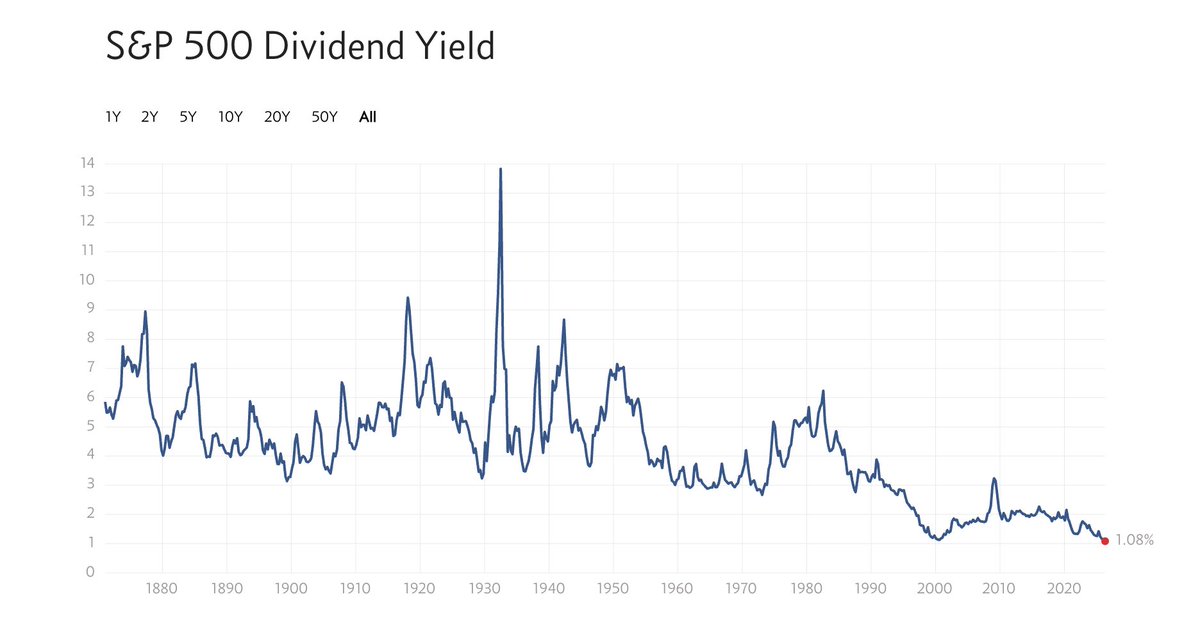
The S&P 500 dividend yield just hit an all-time low of 1.08%, going back to the 1800s. The prior low was 1.1% in 2000.
There are now "dividend" mutual funds with negative yields (their expense ratios are higher than their dividend yields).
Stock buybacks have exceeded dividends since the late 1990s.
And yet, nearly all stock funds still focus solely on dividends, which is crazy. (And it's not just about the buybacks, but also the share issuance!) Buffett's been talking about this more than anyone for decades...
We wrote a book on the topic 13 years ago, and the 2nd edition is free online.
As you tune into the Berkshire meeting, and gasp at the $400 billion in cash on their balance sheet, understand why they consistently choose buybacks over dividends...
https://t.co/rohyv8nzt0
Chart: Multpl
Market Crash Pattern.
Same setup. Every time.
Dotcom Crash: -49.1%
2008 Financial Crisis: -56.8%
Pandemic: -33.9%
The pattern is identical.
THE SETUP
Look at the bottom two charts:
Yield Curve (green): Inverts before every crash
Fed Rate (gray): Cuts aggressively during every crash
This is the playbook.
THE YIELD CURVE
When short-term rates rise above long-term rates, the yield curve inverts.
Dotcom (2000): Inverted → Crash
2008: Inverted → Crash
2020: Inverted → Crash
The yield curve has predicted EVERY recession since 1970.
No false positives.
THE FED RATE
After the yield curve inverts, the Fed eventually cuts rates.
But it's too late.
The damage is already done.
Dotcom: Fed cuts from 6% → 1%
2008: Fed cuts from 5.25% → 0%
2020: Fed cuts from 1.75% → 0%
2026: Fed starting to cut from 5%+
The pattern repeats.
WHERE WE ARE NOW
2026: Yield curve inverted for 2+ years (longest in history)
Fed is starting to cut rates.
The stock market is near all-time highs.
This is EXACTLY the setup from 2000 and 2007.
THE LESSON
The yield curve inversion is the WARNING.
The Fed rate cuts are the CONFIRMATION.
By the time the Fed cuts, it's already too late to avoid the crash.
THE PLAYBOOK
1. Yield curve inverts (WARNING: recession coming in 12-18 months)
2. Market ignores it and keeps rallying
3. Cracks appear (corporate earnings weaken, unemployment rises)
4. Fed starts cutting rates (CONFIRMATION: we're in trouble)
5. Market crashes
We're between step 4 and step 5.
THE QUESTION
Are we different this time?
Or are we following the same pattern as 2000, 2008, and 2020?
History says: Same pattern. Different excuse.
THE TAKEAWAY
The yield curve doesn't lie.
The Fed always cuts too late.
And crashes always feel different until they're over.
Then you look back and realize: It was the same pattern all along.