One of the easiest ways to accidentally end up in a stock with a huge catalyst?
Just buy leaders... like seriously.
Every time you buy relative strength, you're putting yourself in names institutions already care about. And if the environment is rewarding, those are usually the stocks getting upgrades, earnings beats, partnerships, AI announcements, government contracts, and all the other fun stuff that sends charts into orbit.
Keep it simple.
Leaders tend to keep finding reasons to lead.
$MRVL!
@ohiain After five years of learning and experience, I finally feel confident in my trading skills, but my capital is still very small (~$1k).
Do you think someone committed to the process can still make it long term starting that small? And is it truly worth pursuing?
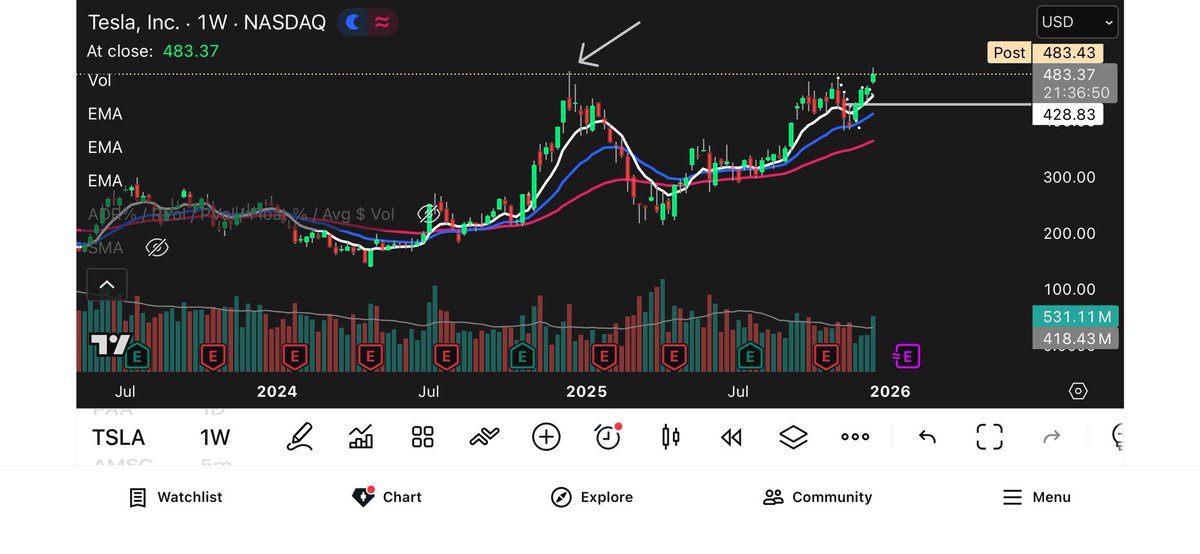
I’d say this level on the weekly is considered one of the strongest resistance peaks for price, which is why we’re seeing heavy selling pressure there. Price is still trying to absorb that supply.
The more likely scenario, in my view, is that price cools off a bit, digests the pressure, and then pushes higher with stronger momentum.
The alternative would be a clean close above the last bearish candle, but I lean toward the first scenario.
@jfsrev Hi Jeff, quick question: Does the 3-Stop Strategy fit a $10K account? Seems conservative, but does it slow growth for a smaller portfolio? What would you recommend to protect capital while still seeing meaningful growth?
Hi brother , I have a question that's confusing me a bit. I'm starting to understand this setup well, but I want to confirm: Why didn't we consider the wave marked in yellow as the First Leg?
My second question: Does a single daily close below the 20 EMA invalidate the setup, even if the price recovers above it the next day and all other strategy criteria are met?
Hi Jeff ..
Thanks for your reply ..
Unfortunately, I’m still a bit unclear. My problem is when I watch a stock from my watchlist and wait for it to break the previous day’s high. When the breakout happens at the market open within the first five minutes, I check that RVOL is high and LOD is below 60—but I don’t know exactly how to enter. Should I enter on the break of the high of the 5-minute opening candle, or the 30-minute candle?
At that time, the stock is already up more than 5%.
Could you please guide me on how to enter? What should I do when the breakout, RVOL, and LOD conditions are met? On which timeframe should I enter, and where should I place my stop loss split across three levels?
I was a losing trader for almost 2 years.
Then a few small pivots in my process led me to be consistently profitable for these past 4 years.
Here’s what I changed:
I’d like to share a super practical trading tool I built for placing orders via IB TWS.
The core feature? Place a market order with 3 staggered stop-losses.
This Python tool handles it automatically:
✅ Submits a market order
✅ Waits for fill
✅ Places 3 stop orders between your fill price and stop level
If you're curious about why this strategy is useful, go check out @jfsrevg detailed post. https://t.co/uFdIAg03io
Even if you don’t use this exact stop strategy, the panel itself is more modern, clean, and user-friendly compared to the native TWS interface.
I’ve uploaded the full code to GitHub. https://t.co/UrkDrUUHFA
No coding experience? No worries — I’ve also included a compiled .exe file so you can use it directly.
Want to see how it works? I just recorded and uploaded a demo on YouTube. https://t.co/UVyQw1Gqfs
Here’s what the GUI looks like.
You enter your ticker, quantity, and entry/exit prices.
Choose between different order types:
Market + 3 Stops, Limit, Market, Stop Order, and more.
With just one click, you send everything directly to TWS or IB Gateway.
I'm not a professional developer, so this project may not be perfect — but at the very least, it's functional and gets the job done. If you find it helpful, feel free to [buy me a coffee ☕].
Feel free to retweet and like!




![traderwillhu's tweet photo. I’d like to share a super practical trading tool I built for placing orders via IB TWS.
The core feature? Place a market order with 3 staggered stop-losses.
This Python tool handles it automatically:
✅ Submits a market order
✅ Waits for fill
✅ Places 3 stop orders between your fill price and stop level
If you're curious about why this strategy is useful, go check out @jfsrevg detailed post. https://t.co/uFdIAg03io
Even if you don’t use this exact stop strategy, the panel itself is more modern, clean, and user-friendly compared to the native TWS interface.
I’ve uploaded the full code to GitHub. https://t.co/UrkDrUUHFA
No coding experience? No worries — I’ve also included a compiled .exe file so you can use it directly.
Want to see how it works? I just recorded and uploaded a demo on YouTube. https://t.co/UVyQw1Gqfs
Here’s what the GUI looks like.
You enter your ticker, quantity, and entry/exit prices.
Choose between different order types:
Market + 3 Stops, Limit, Market, Stop Order, and more.
With just one click, you send everything directly to TWS or IB Gateway.
I'm not a professional developer, so this project may not be perfect — but at the very least, it's functional and gets the job done. If you find it helpful, feel free to [buy me a coffee ☕].
Feel free to retweet and like!](https://pbs.twimg.com/media/GuN1TcaXEAAn2KL.jpg)