A dynamic Cordis plugin for the DSH (DeepSeek Harness) web GUI that shows every skill installed in your session and lets you mark which skills must be used for your prompts.
https://t.co/BNPaBjCv8p
It solves the "wait, what skills do I actually have?" problem: instead of guessing from memory, open Settings → Skills and see the live catalog the agent can invoke — then pin the ones you care about.
A dynamic Cordis plugin for the DSH (DeepSeek Harness) web GUI that shows every skill installed in your session and lets you mark which skills must be used for your prompts.
https://t.co/BNPaBjCv8p
Fred George AI Skill — A lightweight AI Agent Skill (SKILL.md) that conditions coding assistants like Cursor, Claude, and Copilot to write software using Fred George’s signature methodology. https://t.co/E22xj9eaDs
BREAKING: A Russian attack drone has struck a residential building in Galați, Romania, according to reports from the scene.
Romania is a NATO member state. Initial reports indicate multiple people were injured, including several with serious injuries, after the Russian one-way attack drone impacted the building in eastern Romania overnight.
What if you had 25 min and Claude on March 25?
Google dropped the TurboQuant paper at 9am. Free. No code.
Just math proving AI memory can be compressed 6x.
By 9:15, anyone who understood the implications knew what was coming for memory stocks.
The problem - most people can't read a 30-page quantization paper over breakfast.
But AI can. You paste the paper into Claude. What if AI’s real edge isn’t explaining research, but turning it into a trading bot in minutes?
A fresh wallet made 3,317 predictions in days and turned $1,500 into $83,115 in 72 hours on Polymarket BTC markets.
That doesn’t look human. It looks algorithmic.
And that is why this changes everything. The paper was free. Claude cost $20 a month. The bot took minutes to build.
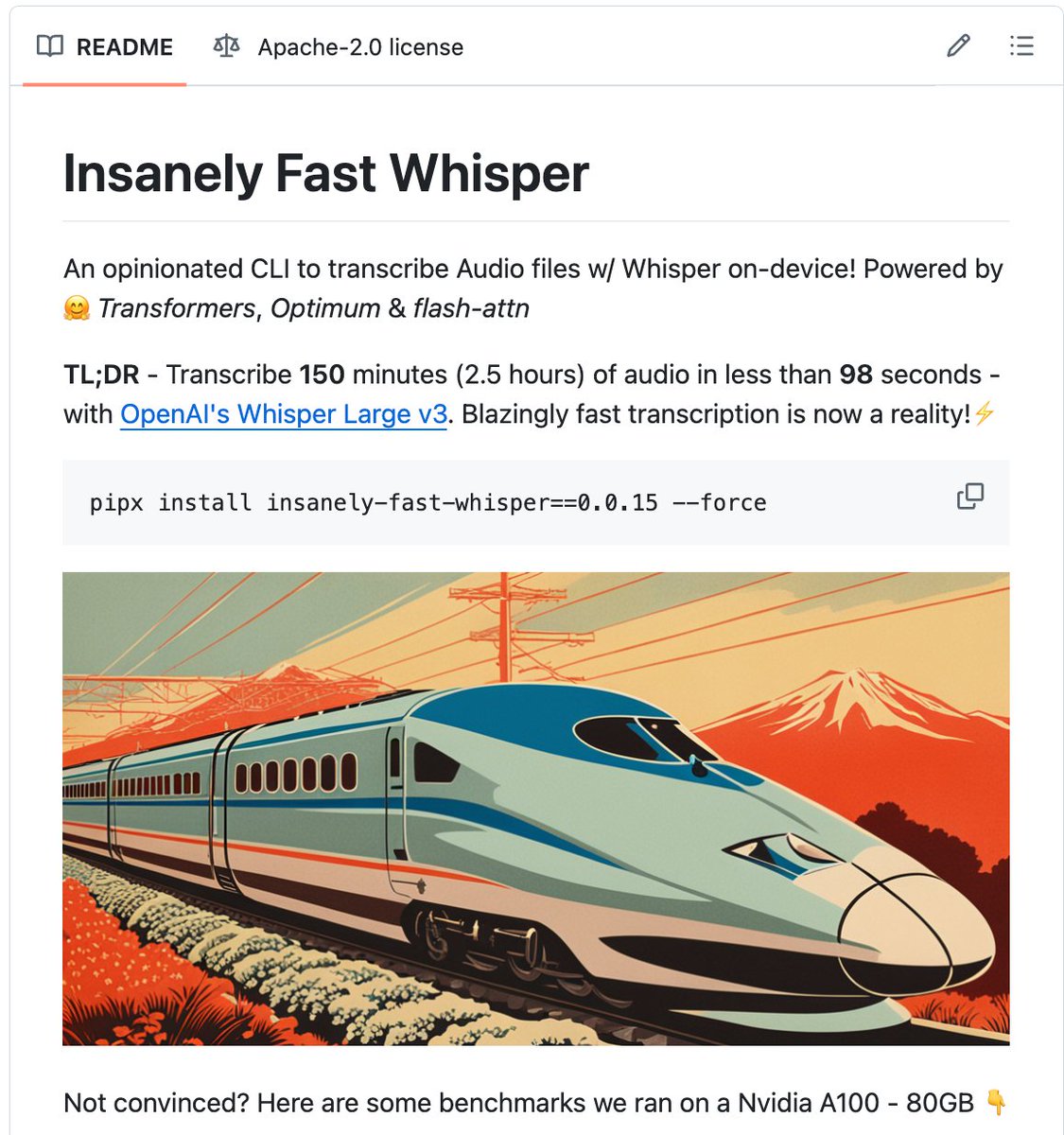
🚨 OpenAI charges $0.006/minute. Google charges $0.024. AWS charges $0.024.
Someone just open sourced a tool that does it for $0. And it's faster than all of them.
It's called Insanely Fast Whisper. And that's not hype. That's the benchmark.
150 minutes of audio. 98 seconds to transcribe. On your own machine. No API key. No cloud. No per-minute billing.
Here's what the numbers look like:
→ Whisper Large v3 + Flash Attention 2: 150 min of audio in 98 seconds
→ Distil Whisper + Flash Attention 2: 150 min in 78 seconds
→ Standard Whisper without optimization: 31 minutes for the same job
→ That's a 19x speedup. Same model. Same accuracy. Just faster.
Here's what it does:
→ One command to transcribe any audio file or URL
→ Speaker diarization — knows WHO said WHAT
→ Transcription AND translation to other languages
→ Runs on NVIDIA GPUs and Mac (Apple Silicon)
→ Flash Attention 2 for maximum speed
→ Clean JSON output with timestamps
→ Works with every Whisper model variant
Here's the wildest part:
https://t.co/WfJGCpSz09 charges $100/year. Rev charges $1.50/minute. Descript charges $24/month. Enterprise transcription contracts cost thousands.
Podcasters, journalists, researchers, lawyers, content creators — anyone still paying for transcription is lighting money on fire.
8.8K GitHub stars. 633 forks. MIT License.
100% Open Source.
(Link in the comments)
Someone built a Chromium browser that runs entirely in your terminal.
It's called Carbonyl, and it renders actual web pages in your command line. The best part is it runs with 0% CPU usage when idle.
- Full Chromium engine in the terminal.
- dles at exactly 0% CPU.
- Fast, lightweight, and completely terminal-native.
100% Open Source.
Software horror: litellm PyPI supply chain attack.
Simple `pip install litellm` was enough to exfiltrate SSH keys, AWS/GCP/Azure creds, Kubernetes configs, git credentials, env vars (all your API keys), shell history, crypto wallets, SSL private keys, CI/CD secrets, database passwords.
LiteLLM itself has 97 million downloads per month which is already terrible, but much worse, the contagion spreads to any project that depends on litellm. For example, if you did `pip install dspy` (which depended on litellm>=1.64.0), you'd also be pwnd. Same for any other large project that depended on litellm.
Afaict the poisoned version was up for only less than ~1 hour. The attack had a bug which led to its discovery - Callum McMahon was using an MCP plugin inside Cursor that pulled in litellm as a transitive dependency. When litellm 1.82.8 installed, their machine ran out of RAM and crashed. So if the attacker didn't vibe code this attack it could have been undetected for many days or weeks.
Supply chain attacks like this are basically the scariest thing imaginable in modern software. Every time you install any depedency you could be pulling in a poisoned package anywhere deep inside its entire depedency tree. This is especially risky with large projects that might have lots and lots of dependencies. The credentials that do get stolen in each attack can then be used to take over more accounts and compromise more packages.
Classical software engineering would have you believe that dependencies are good (we're building pyramids from bricks), but imo this has to be re-evaluated, and it's why I've been so growingly averse to them, preferring to use LLMs to "yoink" functionality when it's simple enough and possible.
GLM-OCR runs locally on 2GB VRAM, handles tables and math equations, and hits 260 tok/s on a Mac.
No cloud API. No subscription. Just your machine.
Local models are getting better and smaller faster than anyone expected.
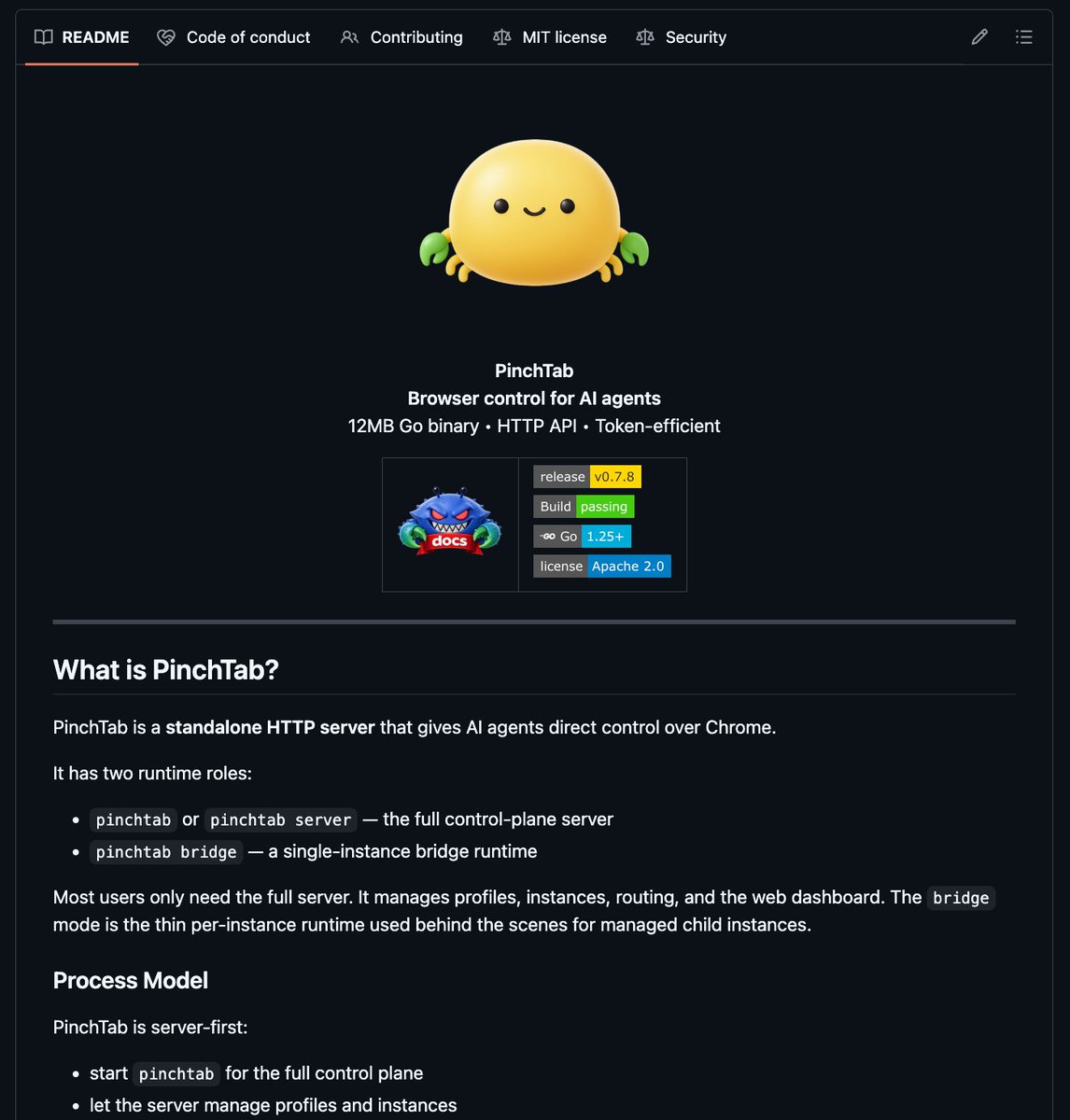
🚨BREAKING: Someone just built a 12MB binary that gives AI agents full browser control.
It's called PinchTab. No Playwright. No Puppeteer. No bloated dependencies.
Just a plain HTTP request and your agent clicks, types, and navigates like a human.
→ 13x cheaper than screenshots (uses accessibility tree instead)
→ Bypasses bot detection out of the box
→ Runs multiple Chrome instances in parallel with isolated profiles
→ Works with Python, TypeScript, Go, or any language that speaks HTTP
→ Installs in one command
Most browser automation tools weigh 500MB+ and need Python environments, npm nightmares, and Docker just to say hello.
PinchTab is 12MB. One binary. Zero dependencies.
This is what the browser control layer for AI agents actually looks like.
100% Open Source. MIT License.
me: "can you use whatever resources you like, and python, to generate a short 'youtube poop' video and render it using ffmpeg ? can you put more of a personal spin on it? it should express what it's like to be a LLM"
claude opus 4.6:
@balanionut nu, ii pun sa repare tot ce strica AI-ul, dupa care vine AI si strica iar tot, si iar reparam, bucla infinita si tot ce face AI repede acum va dura de cateva ori mai mult sa ai grija sa fie production ready
South Korea's stock market crash just exposed the one thing that could kill the entire AI revolution.
$270 billion wiped out in a single session.
Samsung down 12%. SK Hynix down 10%. The KOSDAQ dropped 14%.
It's their worst crash in 46 YEARS. Worse than 9/11.
This was the hottest market on the planet. Up 75% in the past year. All-time highs above 6,300 just days before.
Then it collapsed.
Everyone blamed the Iran war. Oil prices. Geopolitics.
But they're missing the real thing:
South Korea makes 70% of the world's DRAM chips. 80% of the high-bandwidth memory that powers every single AI data center on Earth.
Every Nvidia Blackwell chip. Every Google TPU. Every hyperscaler expansion. All of it runs on memory manufactured in ONE country.
And that country imports 97% of its energy through the Strait of Hormuz.
The same strait that Iran just shut down.
Ship traffic went from 138 vessels per day to 2. Zero tankers. Maersk, Hapag-Lloyd, CMA CGM all suspended operations.
Insurance companies pulled war risk coverage entirely.
And this isn't "temporary". Trump says the war could last 4-5 weeks. Iran says any ship that enters gets attacked.
Here's what you need to understand about the consequences:
Global DRAM inventory sits at 2-3 weeks. NAND at 3-4 weeks. There is no buffer.
If the Hormuz disruption lasts beyond a month, Korean fabs start running low on the energy needed to operate. Production cuts become unavoidable.
The entire AI buildout timeline slips in ways nobody has modeled.
OpenAI just raised $110 BILLION. Amazon committed $50 billion. Nvidia and SoftBank put in $30 billion each.
All of that money is earmarked for data centers that need memory chips from factories that can't run without Middle Eastern oil.
$195 billion in AI funding was deployed in February alone. The most consequential month in venture finance history.
And all of it depends on Korean semiconductor fabs keeping their lights on.
The memory supercycle was projected to exceed $440 billion in 2026. That projection assumed uninterrupted energy supply to the factories making the chips.
Nobody stress-tested what happens when you cut the power.
Retail investors in Korea were buying Samsung and SK Hynix on margin. Borrowed money at record levels.
When the crash hit, margin calls triggered forced liquidation. The selling fed on itself. Foreign investors dumped $3 billion in a single session.
Brent crude is above $90. Gas prices in the US jumped 14% in one week. Diesel doubled in Europe. Jet fuel tripled in Asia.
And the AI companies burning through billions per quarter on compute infrastructure? Their energy costs just EXPLODED.
Everyone's debating whether AI is a bubble based on software. Whether the models work. Whether the valuations make sense.
But nobody's asking the harder question:
What happens when the entire hardware supply chain runs through a 21-mile-wide strip of ocean currently controlled by a country at war with the United States?
The biggest risk to the AI revolution isn't bad models or overhyped startups...
It's that a $440 billion industry depends on chips made in factories that go dark if one strait stays closed for 30 more days.
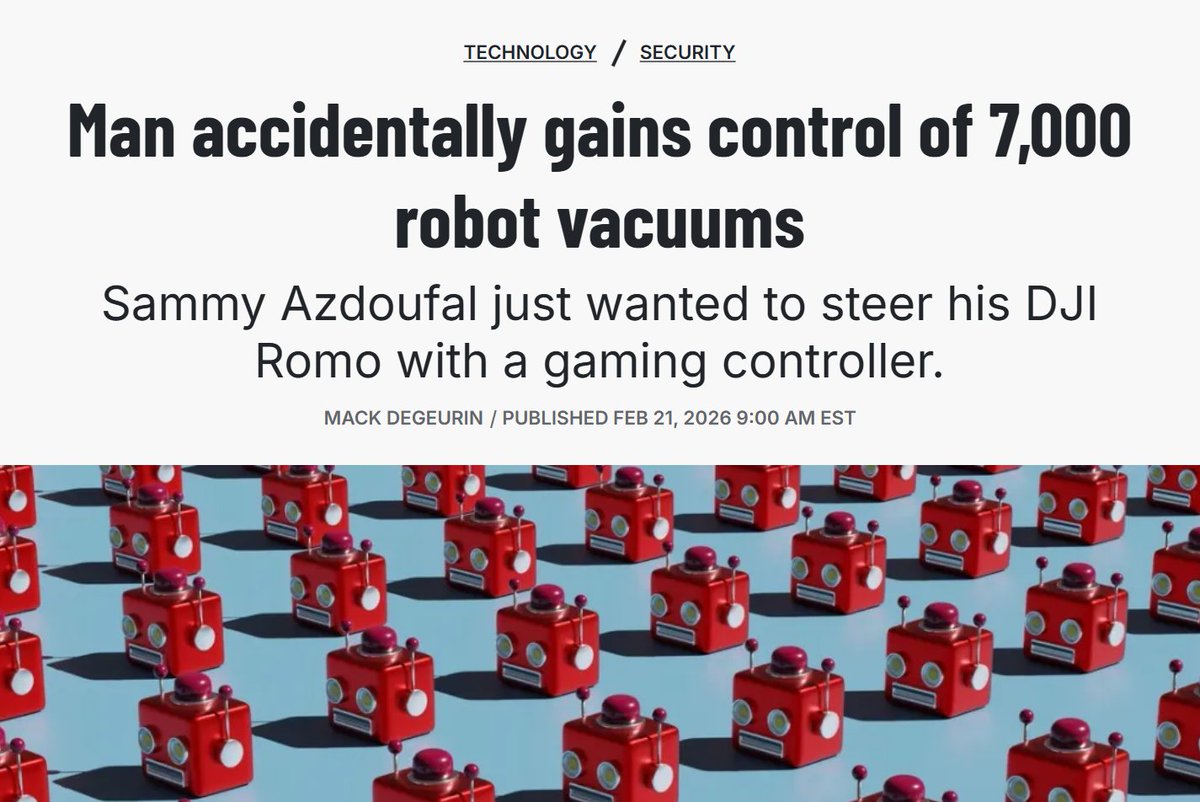
This story is actually insane:
• dude drops $2000 on a DJI robot vacuum like a lunatic
• refuses to use the normal app like a peasant
• Sammy Azdoufal fires up Claude to crack the API so he can drive it with an xbox controller
• Claude delivers the goods
• pulls an auth token from their servers, connects successfully
• except the system thinks he controls 7000 vacuums
• checks again
• yep, seven thousand
• DJI built authentication with zero device ownership verification
• any valid token works for any unit on the planet
• Sammy now has eyes inside homes across 24 countries
• live vacuum camera feeds everywhere
• full floor plans from the mapping data
• some guy in germany eating cereal at 3am, unaware his roomba is snitching
• one API call away from being the most informed burglar in history
• all he wanted was to steer his vacuum with a joystick
• does the right thing and reports it
• DJI fixes it in two days
• back to normal life with his stupidly expensive floor cleaner
• IoT companies stay undefeated at shipping garbage security
A blog post just wiped $30 billion off IBM in a single afternoon.
Not a product launch. Not an earnings miss. Not a competitor undercutting on price.
A five-minute blog post explaining that Claude can read COBOL.
IBM dropped 13%. Worst single-day loss since October 2000. Twenty-five years of stock resilience ended by one AI company publishing a capability update.
Here’s what happened:
95% of ATM transactions in America run on COBOL. Hundreds of billions of lines power banking, airlines, and government systems. The developers who built them retired decades ago. The knowledge left with them. Finding engineers who can even read COBOL gets harder every quarter.
IBM’s moat was never the technology. It was the fact that nobody else could understand it. Entire consulting empires existed because the code was too old, too tangled, and too critical to touch. Companies paid IBM billions because the alternative was catastrophic system failure.
Then Anthropic published a blog post saying Claude Code can map dependencies across thousands of lines of COBOL, document workflows, identify migration risks, and translate legacy logic into modern languages. Modernization in quarters instead of years.
The market heard: the priesthood just lost its monopoly on the sacred language.
And this isn’t the first time. Last week Anthropic announced Claude Code Security for vulnerability scanning. CrowdStrike dropped. Okta dropped. Cloudflare dropped. One company is serially destroying legacy moats with blog posts.
Now here’s where it gets surreal.
This same company, on the same day, also published evidence that three Chinese AI labs ran 24,000 fake accounts and 16 million exchanges to steal Claude’s capabilities. DeepSeek used it to build censorship tools. MiniMax pivoted within 24 hours when a new model dropped, redirecting half its traffic to steal the latest version.
And yesterday, the Pentagon summoned this same company’s CEO for what officials called a “sh*t-or-get-off-the-pot meeting,” threatening to blacklist them like Huawei for refusing to let the military use Claude without safety restrictions.
Three stories. One company. Twenty-four hours.
The company destroying legacy moats faster than the market can reprice them is simultaneously being threatened by its own government and looted by foreign competitors.
Anthropic is valued at $380 billion. Its CEO says a 12-month delay in AI would make him bankrupt. The Pentagon wants to designate it a supply chain risk. Chinese labs are running industrial espionage against it. And it just proved it can vaporize $30 billion in market cap with a Monday morning blog post.
Whatever you think about AI disruption, IBM’s stock just settled the argument.
Full institutional analysis on my Substack.
https://t.co/AEv8EMPdsZ