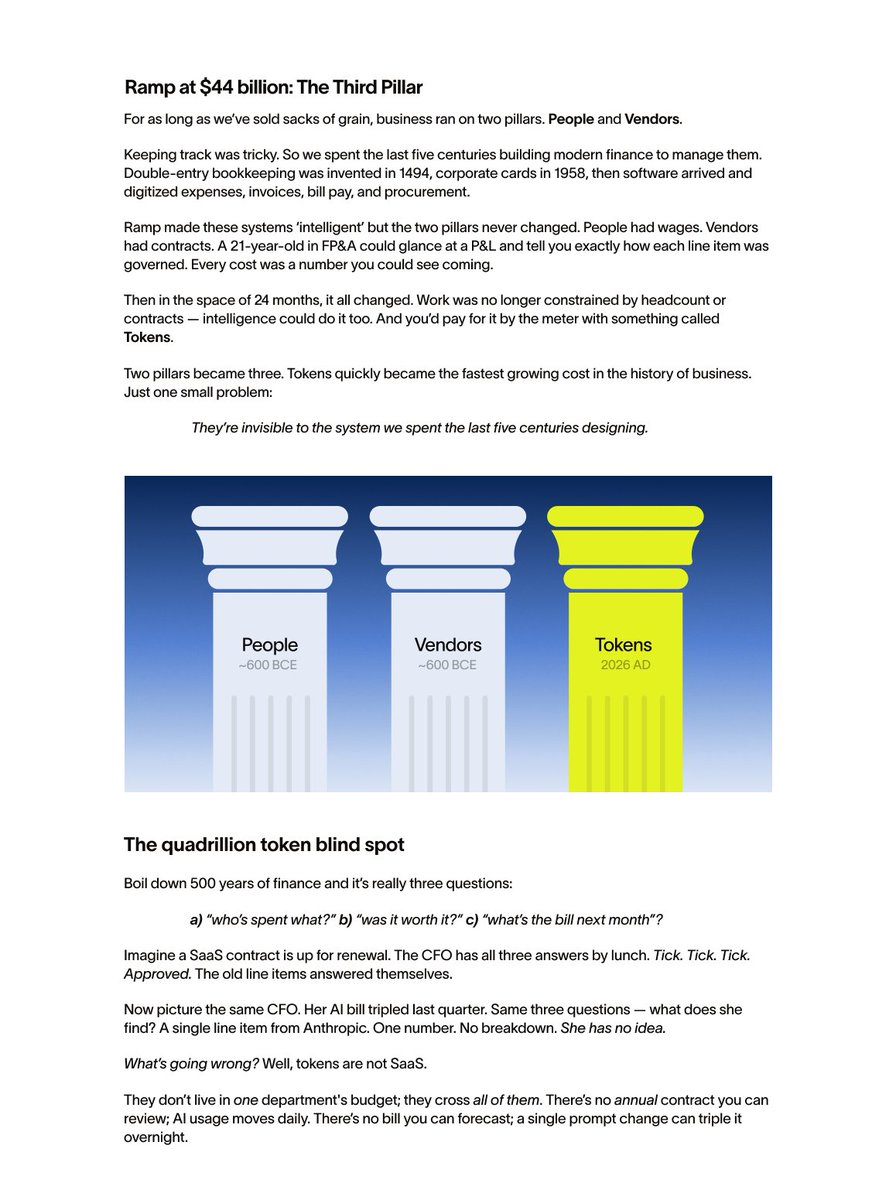
Today, Ramp raised $750M at a $44B valuation.
Last time we grew this fast, we were 1/20th the size.
For 2000 years, business was built on two pillars. Today, a third: intelligence.
It’s your least governed cost. It’s also your single greatest opportunity.
73' - The whole of Anfield stands to applaud as Salah comes off on his final appearance for the Reds - replaced by Frimpong.
Thank you for everything, Mo ❤️
[1-1] #LIVBRE
I have witnessed this club go from doubters to believers, and from believers to champions. It took hard work and I always did everything I could to help the club get there. Nothing makes me prouder than that.
Us crumbling to yet another defeat this season was very painful and not what our fans deserve. I want to see Liverpool go back to being the heavy metal attacking team that opponents fear and back to being a team that wins trophies. That is the football I know how to play and that is the identity that needs to be recovered and kept for good. It cannot be negotiable and everyone that joins this club should adapt to it.
Winning some games here and there is not what Liverpool should be about. All teams win games.
Liverpool will always be a club that means a great deal to me and to my family. I want to see it succeed for long after I have moved on.
As I’ve always said, qualifying to next season’s Champions League is the bare minimum and I will do everything I can to make that happen.
Krishna Rao is the CFO of Anthropic, and this is his first podcast appearance.
He joined the company two years ago when run-rate revenue was about $250M. Today it is $30B. He has helped raise ~$75B and is responsible for the procurement and allocation of compute.
I feel lucky we get to hear what it is like to sit inside a company this consequential at a moment this pivotal.
We discuss:
- The cone of uncertainty
- How he allocates compute across Trainium, TPUs, and GPUs
- What investors misunderstand about model companies
- Why the returns to frontier intelligence keep rising
- Platform vs application and where Anthropic builds its own products
- How Anthropic uses Claude internally
I have asked my closing question about the kindest thing more than 500 times. Krishna's answer is one I have never heard before.
Enjoy!
Timestamps:
0:00 Intro
2:38 The Compute Canvas
6:51 The "Cone of Uncertainty"
11:58 Why the Returns to Frontier Intelligence Are So High
16:45 Recursive Self-Improvement
20:20 Scaling Laws
23:30 Sourcing $100 Billion in Compute
28:05 Platform vs. Application Strategy
32:52 Pricing Dynamics
38:48 How Anthropic’s Finance Team Uses Claude
43:24 Raising Capital & Overcoming Investor Skepticism
52:32 Public Perception, Risks, and Government Regulation
57:25 Mythos Release
1:12:33 What Could Derail the AI Revolution?
1:13:47 Biotech and Healthcare
1:15:31 The Kindest Thing
One important lesson for all investors comes from Berkshire's Ajit Jain's exact mandate to his underwriting team: "Your job is to say no. Every now and then you will come across a deal that'll hit you with a 2x4 and it'll be screaming money." Abel and Jain are not budging. They are earning a risk-free yield and waiting for structural market dislocation. The capital discipline remains ruthless.
$BRK.A $BRK.B
Dylan Patel: “CPUs are sold out.”
$INTC earnings and conference call confirmed the looming CPU shortage.
There are three main drivers:
- Agentic systems, as CPUs do the planning and orchestration.
- Increasing complexity of and demand for reinforcement learning environments that run on CPUs.
- Increasing deployment of AI instilled apps. Models run on GPUs but apps themselves run on CPUs.
Demand for all these will grow secularly as AI systems will only get more agentic, RL environments will only get more complex, and deployment will only accelerate.
As a result, GPU-to-CPU ratio in AI workloads will move from 1:8 to 1:2 or maybe even 1:1 in the future.
CPU supercycle is about to start.
$AMD $INTC $ARM