🚀 How should LLMs sample on hard reasoning problems during post-training and inference where direct rollouts rarely produce a correct answer?
Best-of-N (e.g., GRPO) and tree search share two limitations:
🔻 Verification signals are sparse
🔻 Candidates stay within the model's own distribution
We introduce BES: Bidirectional Evolutionary Search — a search framework that couples forward candidate evolution with backward goal decomposition.
✅ Works for both post-training and inference.
[1/2] Most image gen models output flat pixels. Users need layers. Our MRT (CVPR'2026) closes that gap and supports:
• text → layers
• image → layers
• layers → layers
🔥 New SOTA on all three tasks
🔥 Beats Qwen-Image-Layered
🔥 10–100× faster, 50–90% less GPU memory
In the era of #ArtificialIntelligence, when human dignity is threatened by new forms of dehumanization, ours is the pressing duty to remain profoundly human. We must lovingly safeguard the grandeur of humanity bestowed upon us and revealed in its fullness in Christ, the splendor of which no machine can ever replace. #MagnificaHumanitas
https://t.co/6i9MWs6LJl
Short blog on why I think SSL isn't scaling.
tldr we're suppressing too much information from the SSL loss so that anything is learnt at all, but this limits the total set of things we may be able to learn.
https://t.co/dkPDF60FpQ
We discover the 𝐀𝐬𝐲𝐦𝐦𝐞𝐭𝐫𝐢𝐜 𝐑𝐨𝐥𝐞𝐬 𝐨𝐟 𝐃𝐚𝐭𝐚 𝐆𝐚𝐭𝐢𝐧𝐠 𝐚𝐧𝐝 𝐑𝐞𝐰𝐚𝐫𝐝 𝐆𝐫𝐨𝐮𝐧𝐝𝐢𝐧𝐠 𝐢𝐧 𝐒𝐞𝐥𝐟-𝐏𝐥𝐚𝐲 𝐑𝐋: data gating, not reward grounding, is the binding constraint on stability. A strict gate stabilizes every reward we tested, including a self-consistency reward with no access to ground truth; while no reward stabilizes once the gate is removed, not even one grounded in execution truth.
It challenges the common assumption that reward grounding is what governs self-play stability. The field's response to collapse has been better rewards: confidence penalties, momentum anchors, hacking detectors, all on the reward side. The binding constraint lives upstream, in the data pipeline.
A self-play system has two distinct levers that prior work conflates. A DATA GATE decides which proposer-generated tasks enter the training pool. A REWARD decides how the policy updates on what's admitted. The gate decides what data exists; the reward decides how the optimizer reacts. They are not symmetric!
The reward doesn't filter bad data; instead, it's maximized by it. Under self-consistency, the intrinsic–grounded gap saturates near 1.0: corrupted data receives higher reward than clean data, because intra-group agreement is easiest to maximize on ambiguous tasks.
The counterintuitive consequence we call the Grounded Proposer Paradox: a proposer with ground-truth verification access collapses FASTER than an ungrounded one when paired with a self-consistency solver. Cleaner tasks form the lowest-resistance path to the spurious self-consistent attractor. The upstream agent doesn't bias the downstream one toward truth; it sharpens the corridor to the wrong fixed point.
The shift: stop treating self-play stability as a reward-design problem. What enters the training loop matters more than how the optimizer scores it.
Align with how @cursor_ai has done its RL stage — Astraflow is a new RL engine that enables asynchronous, heterogeneous, and geo-distributed RL in a native way through dataflow abstraction~
Like @FireworksAI_HQ’s sparse RL transfer design, it syncs only ≤1.1% of model weights — making remote rollout lightweight and efficient.
Check it out!!!
Personal update: I've joined Anthropic. I think the next few years at the frontier of LLMs will be especially formative. I am very excited to join the team here and get back to R&D. I remain deeply passionate about education and plan to resume my work on it in time.
@thkostolansky unfortunately no, but I think there are papers who found self play lead to behaviorly more unsafe agents, such as https://t.co/BSLstQKqBk
@DimitrisPapail Interesting! This remind me of ICM (https://t.co/6fJsygIls2) but in the same weights, have you tried to use CE loss as the reward to let it explore even more
We’re releasing a 30B-A3B reasoning model that reaches gold-medal level across both physics and math Olympiad evaluations: IPhO directly, and IMO/USAMO with test-time self-verification and refinement.
A simple, unified scaling recipe for proof search.
https://t.co/yc2ZlLVbD2
New Preprint Alert ⏰
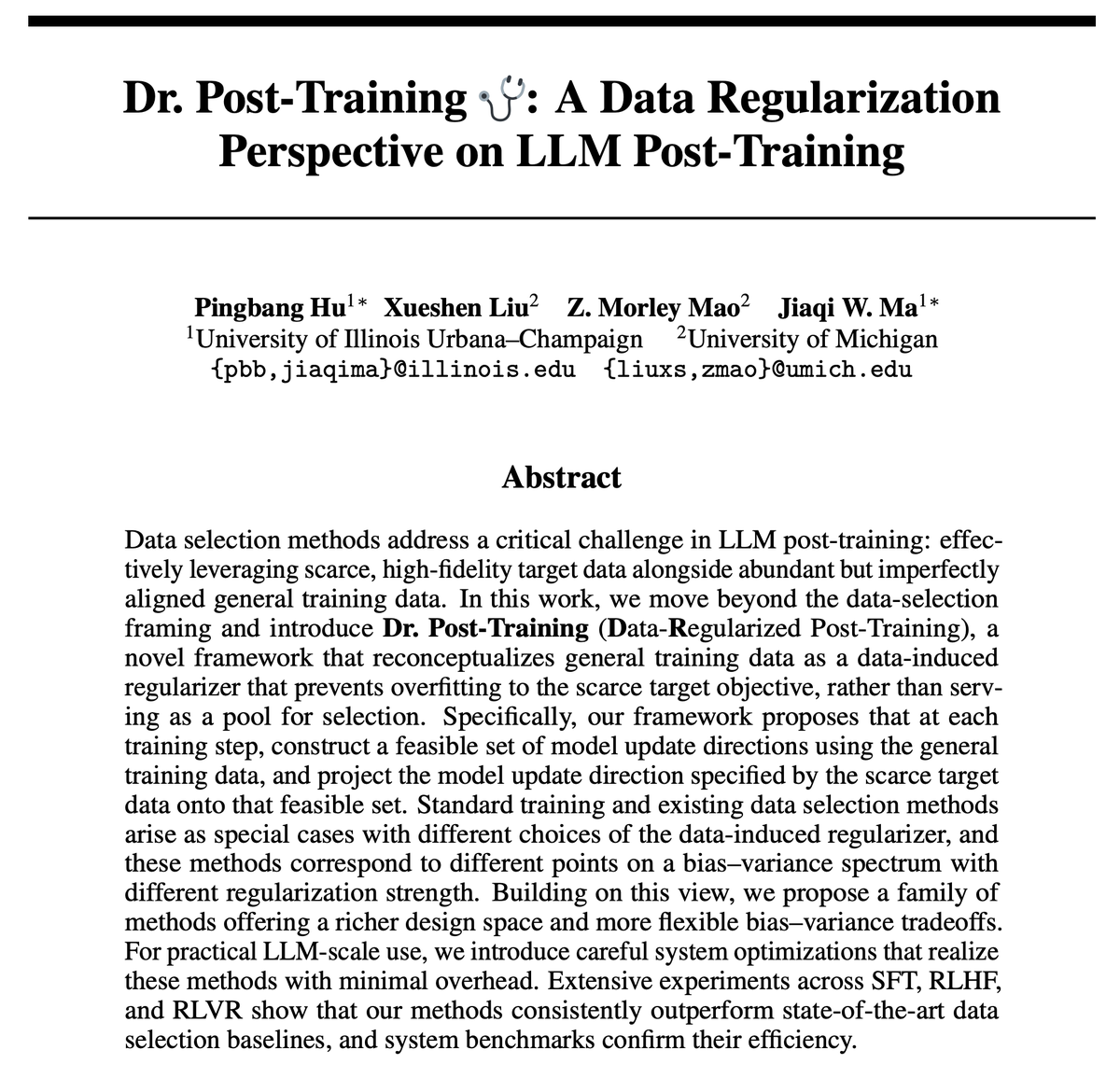
Propose Dr. Post-training 🩺 a Data Regularization framework, making your data more effective with ZERO overheads
Experiments demonstrate faster training convergence across SFT, RLHF, RLVR over SOTA data selection, opening up new data optimization designs!
@Kagurazaka_L@willccbb PRM is not a critic, critics are trained to output the expected sum of returns. Also it’s not classic, “classic” critics use the same context as the actor
Recent thoughts:
The Shift to Long-Horizon Tasks
The most likely breakthrough this year will be in long-horizon tasks. We are moving toward a stage where Large Language Models (LLMs) learn to complete extended, complex missions by interacting with Agent environments. This is perhaps where the true value of LLMs lies. Take cybersecurity as an example: imagine a model that continuously hunts for software bugs and vulnerabilities. While it sounds like a search process, it’s actually the model learning the high-level intuition and methodology of a professional hacker. Unlike humans, AI can run 24/7 without fatigue. It could potentially find exploits at a much higher frequwill ency and claim bounties on platforms like HackerOne or BugCrowd. It sounds fun, but fundamentally, it's a revolution that displaces the hacker. If even hackers are being "disrupted," one can only imagine the impact on general programmers.
From One-Person to None-Person Companies
Building on long-horizon capabilities, Autonomous Agent Systems (AAS) will inevitably become the next frontier. Last year, we were discussing the rise of the "One Person Company" (OPC). I didn't expect us to move so quickly toward the "None Person Company" (NPC). It’s an ironic twist—we might all end up as NPCs in this new ecosystem.
Engineering the Impossible: Memory and Learning
To realize the vision above, we must solve three technical pillars: Memory, Continual Learning, and Self-Judging.
I used to think these would require massive paradigm shifts and years of research. However, the pressure from both the technical and application sides is so intense that we are seeing these capabilities emerge through ingenious engineering "tricks":
Memory: Long context windows (1M+) and RAG have significantly bridged the gap.
Continual Learning: While true continual learning remains difficult, the release cycles are shrinking. Global models are updated monthly; domestic models are catching up. If we reach weekly updates by next year, it will effectively function as continual learning.
Self-Judging: This remains the most elusive, yet models like Opus 4.7 are already demonstrating early self-correction and judgment capabilities.
The Self-Evolving Endgame
The most difficult—and most promising—path is Self-Evolution. The current wave is incredibly fierce. I suspect that models like Claude may have already achieved a baseline for self-training: writing their own code, cleaning their own data, generating synthetic data, and then training on it. It might "waste" some compute, but it saves the most precious resources: human labor and time. In the LLM era, speed is everything. Rapid iteration is what creates the cognitive gap between leaders and followers. Claude’s rumored 2-million-chip cluster for next year is likely dedicated to exactly this: autonomous model self-training.
Technical Summary:
1M Context: Necessary baseline.
Memory & Continual Learning: Prerequisites, likely solved first via "tricky" engineering.
Harnessing Environments: The breakthrough point.
Self-Judging: The tipping point.
Full Self-Training: The endgame.
Redefining AGI and the Industry
If this is the road to AGI, then AGI’s definition should be the sum of all human collective intelligence, not just an individual’s intelligence. It must possess the creative capacity to produce something as profound as the "Theory of Relativity"—meeting the bar set by Hassabis.
During this transition, every APP will need to be reconstructed as AI-native. In fact, we might move past the concept of APPs entirely. The most significant challenge will be the reconstruction of the operating system itself. In the future, you won’t see a traditional desktop; you will see an LLM OS, where applications are "generated on demand." This challenges the 80-year-old Von Neumann architecture and represents a total upheaval of the computer science industry.
The Irreversible Wave
From completing long-horizon tasks to fully autonomous operations, every sector—Security, Finance, Law, E-commerce—will be reshaped. Many friends have reached out lately, asking how to transform their enterprises to keep pace with AI. But few truly realize that this irreversible process has already begun. As this massive technical wave hits, we must be prepared to act, but we must also start thinking seriously about how to regulate it.





![RainbowYuhui's tweet photo. [1/2] Most image gen models output flat pixels. Users need layers. Our MRT (CVPR'2026) closes that gap and supports:
• text → layers
• image → layers
• layers → layers
🔥 New SOTA on all three tasks
🔥 Beats Qwen-Image-Layered
🔥 10–100× faster, 50–90% less GPU memory https://t.co/zyFusxC8dy](https://pbs.twimg.com/media/HJUeaRaaEAAiCRw.jpg)