It's simply incredible how important the Lean 4 proof assistant has become to mathematics.
What would Levent have done without lean or something equivalent? He would be trapped in a gravitational black hole of slop and if he ever managed to put something out it would take the community a very long time to digest this proof.
With lean, verification is nearly instantaneous and digestion and simplification are going to happen incredibly fast
I hope finally that mathematicians will stop asking "but what is the point of Lean? Why do you want to formalize mathematics in Lean?"
I hope the answers to these questions are very obvious now, even if they weren't obvious in the spring/early summer (even to some mathlib maintainers!)
To the extent that some mathematicians are STILL questioning the validity of Levent's proof, or who still don't understand what formalization means, and so forth: come on, guys!
@jeffreycider@PrimaMente We generally saw much of the nice comparability drop without a few additional loss terms/strong lambdas but we didn't get a chance to sweep against reconstruction. Definitely a great experiment to run ty!
Introducing In-Context Module discovery (ICM): interpretable gene modules for comparing cell states across datasets. ICM is the latest advance for our virtual cell modelling framework: Parthenon.
ICM learns from primary human cells across 66 datasets and adapts its modules to new contexts without retraining.
In microglia, ICM recovers known state signatures, reveals unexpected cellular features in experimental models, and helps explain why a specific perturbation strongly shifts gene expression in one model and barely in another.
This gives biologists better tools choose perturbations and design better in vitro experiments.
We are excited to announce that @nvidia has committed to an investment in @PrimaMente.
Built upon years of close collaboration, this investment deepens our partnership and strengthens our ambition to tackle complex diseases.
Neurodegenerative diseases such as Alzheimer’s, Parkinson’s, and ALS remain among medicine’s greatest unmet needs. Making real progress requires global coordination around data, foundation models, and experimental and clinical validation.
We are grateful to @nvidia for their commitment and look forward to deepening our partnership as we pursue breakthrough discoveries for these diseases, and beyond.
Published biology can take weeks or months to turn into usable training data and new evals.
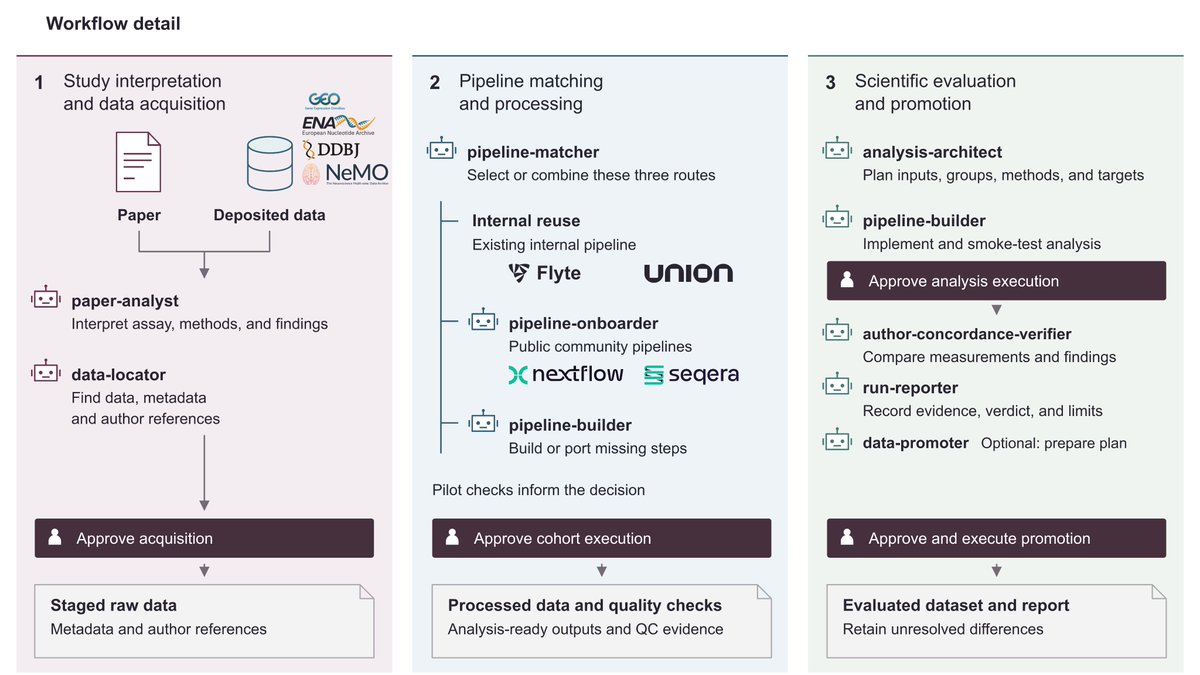
Our Prima Daedalus agents do it up to 10× faster, and 89% lower estimated cost. They reproduce papers, beat published results, and find previously overlooked biology.
cant wait until people realize you can install vimium or surfkeys into your browser containerized sessions. your agent swarms will significantly drop in cost and execution time for a complex web nav task :)
We introduce 𝘢𝘶𝘵𝘰𝘷𝘦𝘳𝘴𝘦 🌿🧫👽, a fast, evolvable description language for reinforcement learning environments, implemented in jax. First of many papers on this subject w/ @togelius.
Our goal is to provide a general framework for open-ended learning, in which we can implement canonical gridworld-type games, discover new (often alien) ones, and train robust player agents, that can observe a set of environment dynamics and adapt their behavior accordingly.
Notably, autoverse allows for the evolution of map layouts, rules and reward dynamics; other than the notion of an embodied "player" with the ability to edit tiles on the map, no semantics are hardcoded into the environment.
In sum, we set out to create a substrate for open-ended learning that is:
- capable of expressing a virtually limitless number of novel environments (via evolution of *all* aspects of the environment)
- fast, allowing for research at a small/academic scale (thanks to GPU implementation of environment dynamics)
- scalable, allowing for potentially unbounded environment complexity (by increasing the size of the map, number of rules, etc.)
Below is an example of an environment evolved via open-ended RL, in which environments are continually evolved to provide learnable challenges for player agents. Here, the agent is riding the waves generated by the environment, keeping them alive as long as it can to maximize reward. (The RL player is depicted in blue, game rules and their application across the board are depicted on the right.)
@mihirneal So sick! Would be cool to see an integrated gradients analysis on which parts of the fMRI are responsible for the different clusters of labels
It’s very fucking hard to build reliable virtualized web browsers at scale, handle the right traffic and not get banned from black listing too many of your VPNs IPs 🤔
Something that folks aren’t talking about much that I think is actually something the team did quite well is solving the problem of “Web Agents.” Specifically being able to reliably snd autonomously traverse the web. Not only is the search design hard but the engineering too
Today we're excited to introduce Devin, the first AI software engineer.
Devin is the new state-of-the-art on the SWE-Bench coding benchmark, has successfully passed practical engineering interviews from leading AI companies, and has even completed real jobs on Upwork.
Devin is an autonomous agent that solves engineering tasks through the use of its own shell, code editor, and web browser.
When evaluated on the SWE-Bench benchmark, which asks an AI to resolve GitHub issues found in real-world open-source projects, Devin correctly resolves 13.86% of the issues unassisted, far exceeding the previous state-of-the-art model performance of 1.96% unassisted and 4.80% assisted.
Check out what Devin can do in the thread below.