🚀 Hey there! Ready to embark on a journey of creating cutting-edge tech products? Whether you're a seasoned pro or eager to learn, I'm assembling a dynamic team.
As an AI Infrastructure Engineer, you must build these projects.
Systems that prove you can serve, scale & keep GPUs honest.
1.) Self-Hosted Inference Cluster
Build: Multi-node GPU cluster serving an open model with vLLM or SGLang, health checks, and a public latency report.
Why: Talk is cheap. A live cluster is the portfolio.
2.) Cost-Per-Token Dashboard
Build: TTFT, ITL, GPU util (DCGM) and $ per 1M tokens by model, tenant and route.
Why: Infra without FinOps is just expensive uptime.
3.) Queue-Based GPU Autoscaler
Build: KEDA (or equivalent) scaling on queue depth, with cold-start mitigation and spot fallback.
Why: Idle GPUs kill startups. Slow scale kills users.
4.) Continuous Batching Load Test
Build: Traffic generator that stresses continuous batching, KV cache limits and saturation points.
Why: You don’t know your serving stack until it breaks under load.
5.) Model Weight Delivery System
Build: Safetensors registry + sharded weights + CDN/lazy loading for fast node bring-up.
Why: Cold starts are often a storage problem pretending to be a compute problem.
6.) Multi-Model AI Gateway
Build: Routing, retries, fallbacks, rate limits and per-tenant token budgets across 2–3 serving backends.
Why: Production isn’t one endpoint. It’s a traffic policy.
7.) Quantized Serving Bakeoff
Build: Same model in FP16 vs AWQ/FP8; publish quality vs latency vs VRAM tradeoffs.
Why: Optimization without benchmarks is cosplay.
8.) Secure Multi-Tenant Inference Layer
Build: Tenant isolation, keyed access, sandboxed tool/exec paths, audit logs.
Why: One noisy neighbor (or leak) ends the B2B deal.
9.) Checkpointed Distributed Training Job
Build: Ray or Spój/Slurm job with FSDP/tensor parallel, fault injection, and resume-from-checkpoint.
Why: Training infra is judged on recovery not the happy path.
10.) Speculative Decoding Prototype
Build: Draft + target model path with prefix caching / chunked prefill; measure accepted-token rate.
Why: Speed wins are product features when you own the stack.
11.) GPU Partitioning Lab
Build: MIG (or equivalent) slices with fair scheduling, resource limits, and contention tests.
Why: Real clusters share silicon. You must prove fairness under pressure.
12.) Triton / Custom Kernel Path
Build: One hot path accelerated (attention, sampling or tokenizer-adjacent) with before/after metrics.
Why: Senior infra energy = knowing when frameworks aren’t enough.
13.) Observability Spine for Non-Determinism
Build: Traces for queue time, prefill, decode, cache hits, errors alerts on drift and cost spikes.
Why: You can’t page what you can’t see.
14.) Multi-Region Failover Drill
Build: Active-passive or active-active inference with DNS/failover and RTO/RPO notes.
Why: “We have GPUs” isn’t reliability. Failover is.
15.) Public Benchmark Teardown
Build: Publish an architecture + latency/cost report others can reproduce.
Why: Hiring managers trust public artifacts more than résumés.
Most people watch tutorials. Builders ship systems.
Bookmark & Repost.
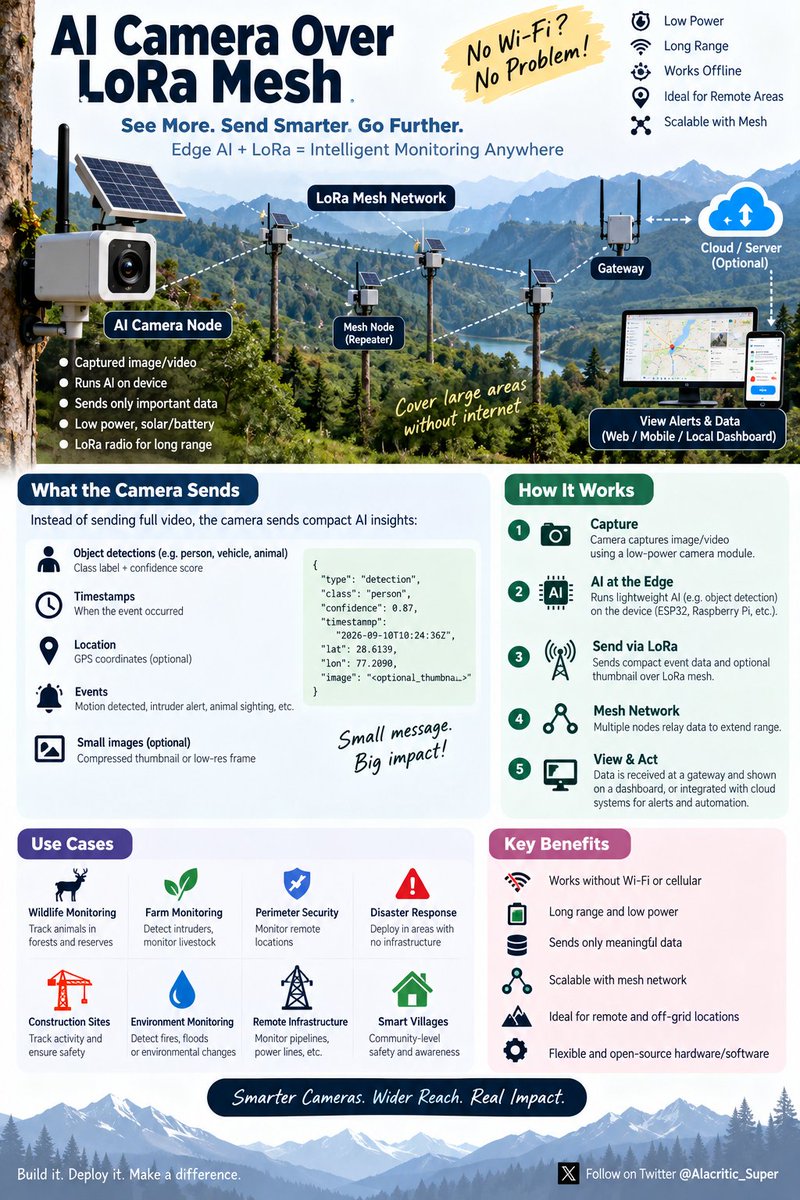
What if your AI camera didn't need Wi-Fi or cellular?
Imagine a camera running lightweight vision at the edge, detecting people, vehicles or objects locally, then sending the important results across a LoRa mesh.
Instead of pushing the entire video feed, the device could send AI-generated metadata, alerts, timestamps and selected low-resolution frames between nodes.
That means much lower bandwidth while keeping the system useful in remote areas, farms, disaster zones or large sensor networks.
The interesting engineering challenge is making the camera, edge AI, ESP32-class hardware and LoRa mesh work together within tight power and bandwidth limits.
Who wants to build a battery-powered AI camera that can communicate without Wi-Fi?
6 weeks ago, I posted about writing my first line of Python. Today, I completed a learning project on a bus booking system that runs on a MySQL database.
Find the details here: https://t.co/Bc8AxgHUMD
#Python#SQL#LearningToCode
X algorithm is so stupid, this guy has less than 1500 followers 🤦♀️.
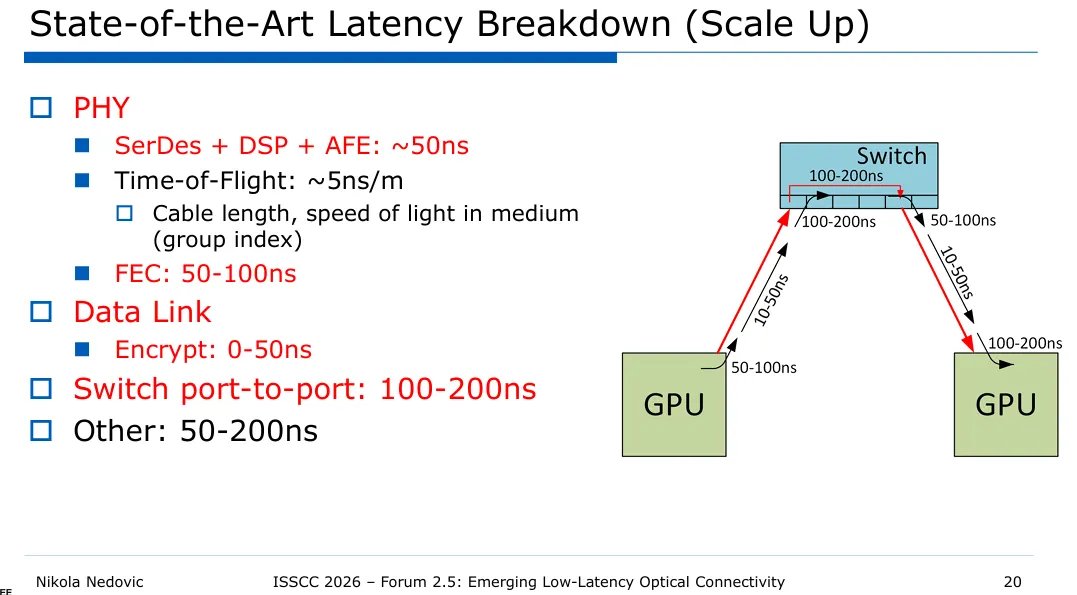
Every article you read from him adds 1 IQ point to your brain. The level of details so high, but what is most important is what details he chooses to highlight.
One of the most underrated account on AI and semiconductor TPOT of X.
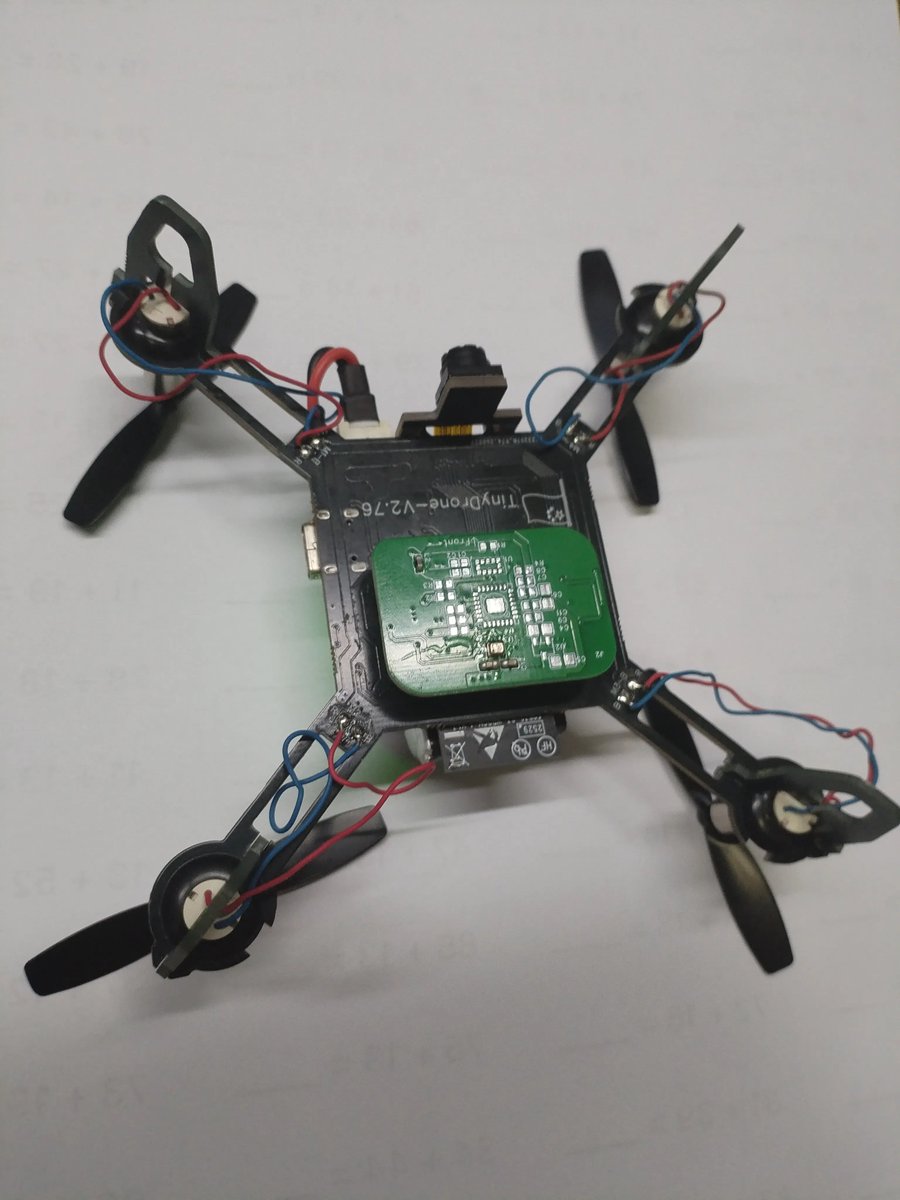
Someone built an open-source ESP32-S3 drone you can actually fly
Tiny-Drone packs an ESP32-S3, MPU6050 IMU and OV2640 camera into a small quadcopter.
You can control it from an Android app, phone browser or RC, with Wi-Fi video transmission built in.
The PCB and firmware are open source, and there are expansion options for a barometer, laser ranging and position hold.
It even supports RID broadcasting.
The firmware is based on Espressif's ESP-Drone project and uses ESP-IDF.
This is the kind of project that makes embedded development really fun. You get PCB design, sensors, motor control, Wi-Fi, camera streaming and flight control in one build.
Would you build your own ESP32 drone?
Introducing - Lapis One
We believe everyone should have a small Linux computer at home, and we’ve been thinking about what your first mini PC should look like in the age of AI agents. At Pamir, we want to bring a new wave of fun, hands-on tech to everyone.
For people who keep asking what to build in AI Engineering.
➣ Build your own Context Assembler
(token-budgeted memory + retrieval + tools)
➣ Build your own Retrieval Stack
(chunker + BM25 + dense search + reranker)
➣ Build your own Model Router
(cost/latency/quality routing + fallbacks)
➣ Build your own Semantic Cache
(embedding similarity + hit-rate tracking)
➣ Build your own Agent Orchestrator
(deterministic state machine, no LangChain)
➣ Build your own MCP Server and Client
(raw JSON-RPC, no SDK)
➣ Build your own Multi-Agent Consensus
(weighted voting + judge + escalation)
➣ Build your own Sandboxed Tool Executor
(isolated execution + resource limits)
➣ Build your own Guardrails Middleware
(injection detection + PII redaction)
➣ Build your own Durable Workflow Engine
(checkpoint/resume, mini-Temporal)
➣ Build your own Streaming Proxy
(SSE + TTFT and ITL metrics)
➣ Build your own LLM Tracer
(OpenTelemetry-style spans for every hop)
➣ Build your own Eval Harness
(trajectory grading + CI regression gates)
➣ Build your own Prompt Registry
(versioning + A/B routing + rollback)
➣ Build your own Data Flywheel
(feedback → synthetic data → LoRA loop)
Pick 3. Build them from scratch. Document every decision.
Most people import libraries.
Builders understand what happens underneath.
Bookmark this. You'll need it.
Researchers from Zhejiang University developed a unique ring-shaped drone that can shrink itself to fly through narrow gaps.
A servo motor can contract the drone by about 31.4%, while its open center can also be used to grab and carry objects.
This design allows the drone to squeeze through tight spaces and pick up objects without needing separate robotic arms or claws.
First we had OpenCat bringing DIY bionic pets to desktops. Then Hugging Face dropped Microduck, breaking barriers for affordable reinforcement learning.
Now we have AI robot dogs like Sirius targeting full pet companionship.
We are actively witnessing the birth of modular, permanent pets. Hardware wear and tear gets replaced but the digital bond stays.
This was my final Ph.D. work co-led by Rosy Chen and I.
Prior work fixates on zero-shot sim-to-real resulting in compromises such as the choice of simple sensors like proprioception.
With PTLD we show that if you're allowed to collect a little real data, you can actually deploy rich sensorimotor policies with significantly stronger performance.
Paper: PTLD: Sim-to-Real Privileged Tactile Latent Distillation for Dexterous Manipulation.
@rosychen0501, @mukadammh, @michaelkaess, Tingfan Wu, Francois Hogan,@JitendraMalikCV, @akashshrm02
CMU · UW · UC Berkeley · FAIR at Meta.
📄 https://t.co/vtADBDR404
🌐 https://t.co/0MA3cBBd4R
🎥 https://t.co/f6focGWleH
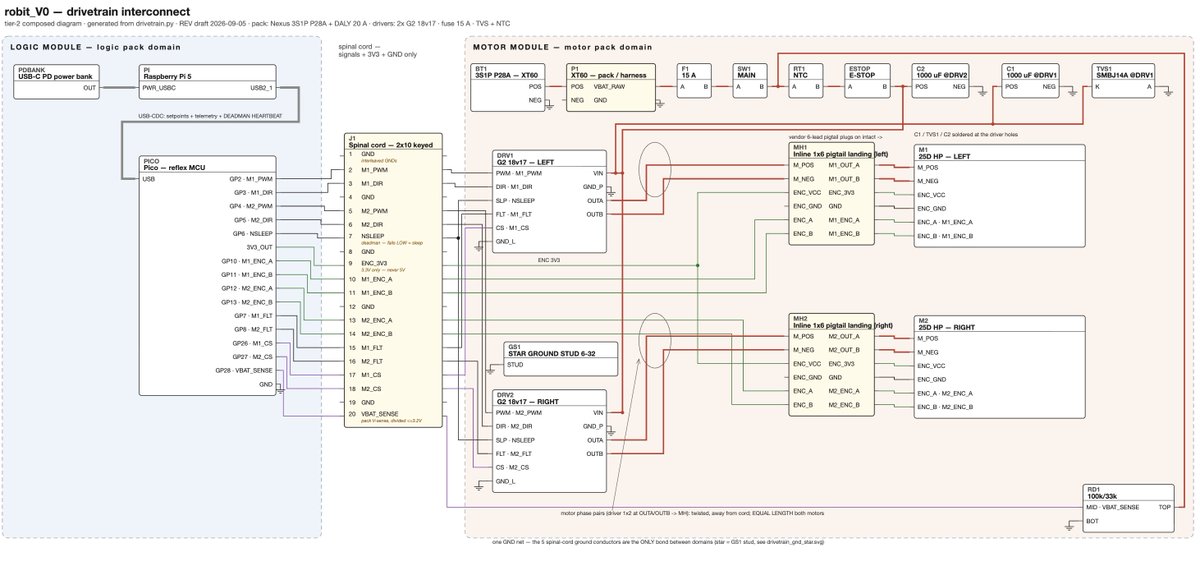
Claude CAD Fable designing Robit V0. Full interconnect is routed and packaged in CAD.
From schematic, to bench layout, to packaged layout. All from one netlist source of truth. All checked for interference and minimum bend radii. All executed in build123d code-CAD.
I'm gonna keep posting about this until it sinks in. This is a whole new world. Agentic mechanical design engineering is here!