Neither do I agree, or disagree, with all that is there in this thread. But I feel this have gems of points on #Religion, #Culture, #Belief, #Society - something which I possibly used to think in parts at best.
Atheists who are born as Hindus but don't actively practice the religion are no different from millions of Christians who don't participate in any religious activity. They also celebrate their festivals in the same way as you do. Such an approach is vacuous for many reasons.
@rachchde@kothariabhishek I think he is referring to videos of Raghav Chadha. Believe he had gone to court to get the content removed, but court didn't agree. But govt subsequently blocked content under IT Act.
@whoisthismommy +..would be forced to rectify issues here if enough people complaints reach the regulator. Make sure to highlight that airport made no arrangements for passengers standing in the heat, and the extra delay associated with the separate manual verification mechanism you highlighted.
@whoisthismommy The airport is required to provide these free transfers at a frequency of 20mins by regulation. This is deficiency of service otherwise. If possible, would suggest you raise a complaint with the operator on this citing your case. You may not directly benefit, but the airport..+
You can read your entire evolutionary history in what your body does to food. Every gene you carry is a note your ancestors left about what they ate. And what we eat today has left no note yet, because we haven't had time to adapt to it
An enumerator from Rajasthan told The Hindu on condition of anonymity, “In the mobile app, if we enter that a household has a tin roof, we are asked by our superiors to change it to concrete. Are we supposed to lie? Similarly, if the house does not have a toilet and occupants are defecating in the open, we are told to check if there is a toilet nearby, even that of a neighbour or a relative, which they may be using occasionally or even a public urinal. Then the entry can be changed from ‘open defecation’ to having access to a toilet.”
Clicked these thermal images during an auto ride today in Delhi. The ambient temperature today was 43 degrees celsius today but thermal images of different surfaces both within and outside the auto was reached upto 60 degrees celsius.
We seriously underestimate what extreme heat does to the human body. We should start asking who is responsible for this rising heat and are those more vulnerable and exposed to extreme heat responsible for rising heat.
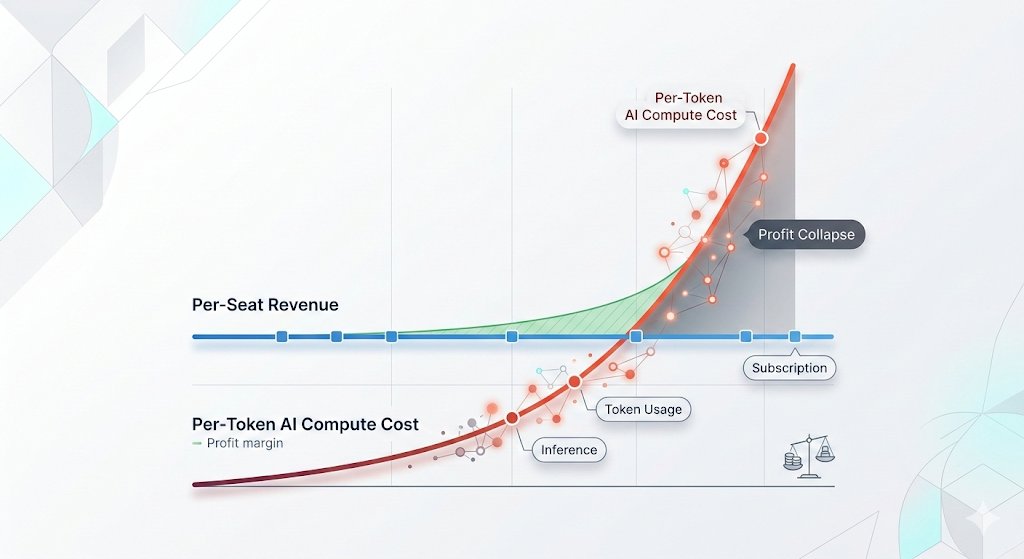
🦔Microsoft canceled its internal Claude Code licenses this week after token-based billing made the cost untenable, even for a company with effectively infinite cloud resources. Uber's CTO sent an internal memo warning the company burned through its entire 2026 AI budget in just four months. American AI software prices have jumped 20% to 37%, and GitHub (owned by Microsoft) is dropping flat-rate plans for usage-based billing across its products.
My Take
The AI subsidy era is ending in real time. The same company that put $13 billion into OpenAI and built the Azure infrastructure powering most of Anthropic's compute just looked at the bill from a competitor's coding tool and decided it was not worth paying. That is not a productivity failure on Anthropic's end. Token-based pricing is forcing every enterprise customer to confront the actual cost of running these models at scale, and the number turns out to be far higher than the flat-rate experiments suggested.
This ties directly to my Gemini Flash post yesterday. Anthropic, OpenAI, and Google all raised effective prices in the last six months. Enterprises that built workflows assuming AI costs would keep falling are now watching annual budgets evaporate in months. Two outcomes look likely from here. Either enterprises scale back AI usage to fit budgets, which slows the revenue ramp the labs need to justify their valuations ahead of IPOs, or the labs cut prices and absorb the losses, which makes the unit economics worse at exactly the wrong moment. Both paths land in the same place, the numbers stop working, and somebody has to take the writedown.
Hedgie🤗
Devesh Kapur & I in @IndianExpress
Wedges in political representation & rising fiscal transfers reflect deeper federalism challenges:
-divergence in performance, economic & fertility across states &
-eroding democratic sensibility
Arun Jaitley anecdote highlights this loss
1/
1/ Owing to high barriers to entry, India’s lodging and hotels industry has become a cartel that raises prices at will and fleeces customers.
India’s luxury hotel average daily rate (ADR) in Mumbai and Delhi now rival those of New York and London. Absurdly enough, the financial press sometimes celebrates this as some triumph of Indian hospitality. It is nothing of the sort. High prices are the unmistakable stamp of a supply-constrained market in a low income country, which should actually have a very competitively priced and deep pool of lodging options. The hotel industry is a structural failure being hyped as a success.
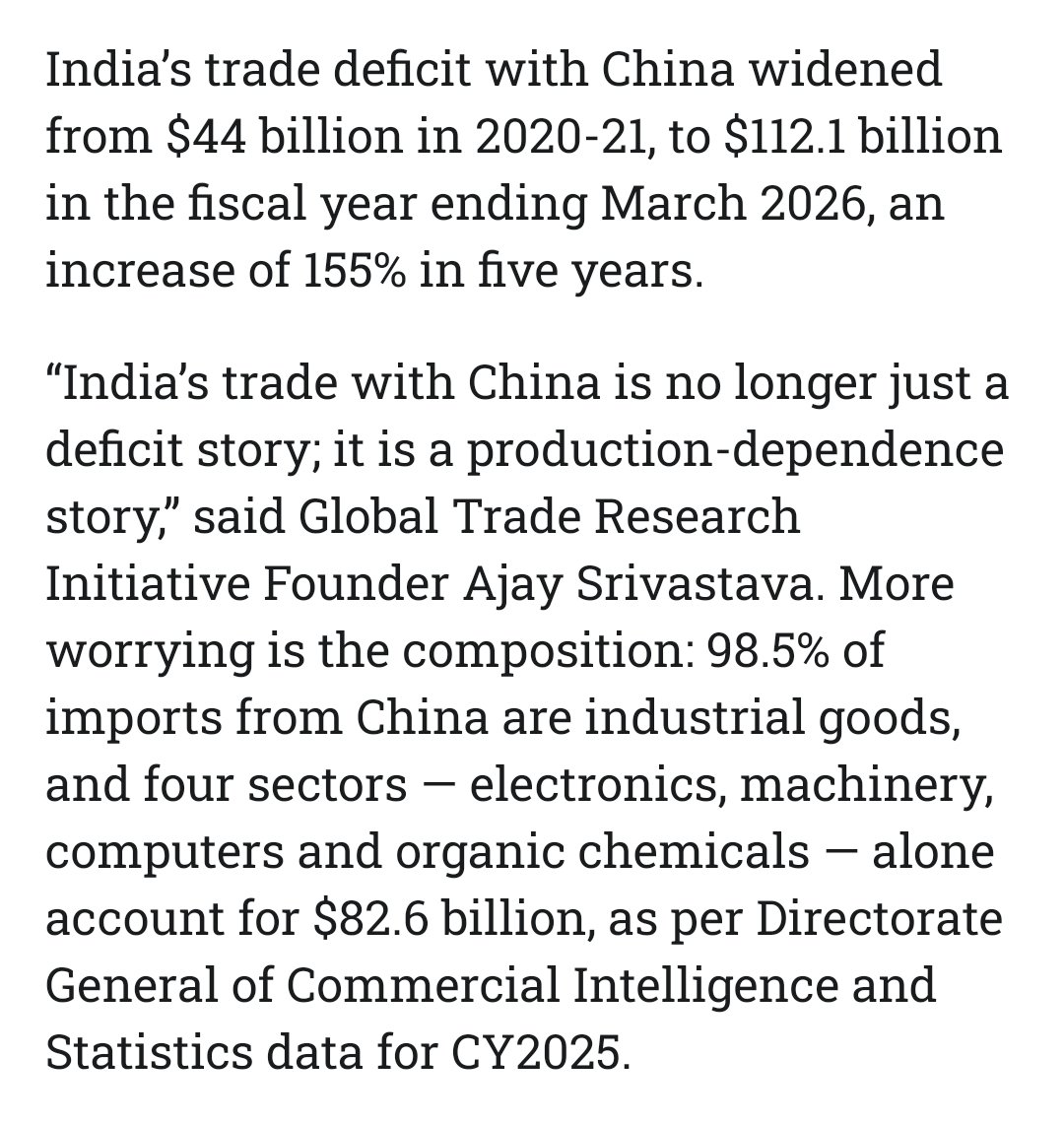
Indian oligarchs, as Raghuram Rajan said back in 2010, make their wealth via state discretion from real estate, natural resources & exclusive licenses. Real 'strategic threat' is this oligarch class which refuses to invest in industrial tech, which is imported wholesale frm China
@nongratadesi@shyampsunder I think many of the international funds are shut for fresh investments as RBI has not yet increased the limit on what funds in India can invest abroad for multiple years now.
China has maintained massive crude inventories despite Middle East supply disruptions:
Chinese crude inventories have fallen by less than 1 million barrels since the Iran War began on February 28th.
As a result, total Chinese crude oil inventories still stand at ~1.8 billion barrels, including strategic reserves.
Since March 2025, inventories have risen +400 million barrels, or +29%.
This comes as cheap Iranian and Russian crude continues to flow into China, while the country also introduced measures to suspend fuel exports to keep domestic supplies stable.
Chinese purchases of Iranian crude are set to rise to a record ~1.9 million barrels per day this month.
China has the world’s largest oil buffer and is using it carefully.
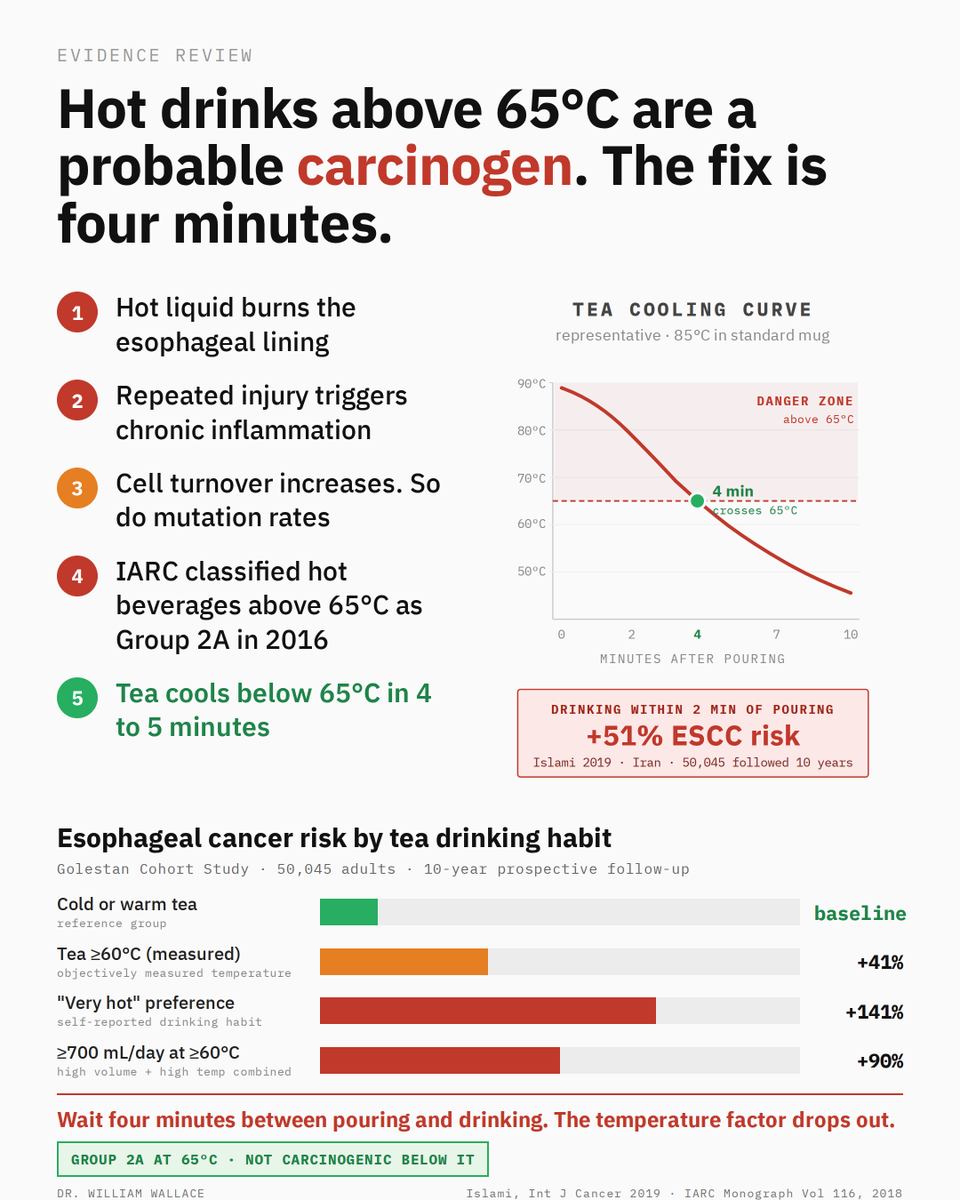
Drinking beverages above 65°C is a Group 2A carcinogen. The mechanism is thermal injury to the esophageal lining, repeated over years, driving chronic inflammation and cell turnover.
Islami 2019 prospectively followed 50,045 adults in Iran for 10 years and measured tea drinking temperature objectively. People who drank tea at 60°C or higher had 41% higher risk of esophageal squamous cell carcinoma. People who preferred "very hot" tea had 141% higher risk. People who drank within 2 minutes of pouring had 51% higher risk than people who waited 6+ minutes.
A separate cohort in Kenya (Middleton 2019) found 3.7 times the risk for "very hot" drinkers vs warm.
Tea cools below 65°C in roughly 4 to 5 minutes in a standard mug. The threshold is the temperature, not the drink.
Islami, Int J Cancer 2019: https://t.co/EATANIFVdl
Middleton, Int J Cancer 2019: https://t.co/zqCaq0nQOf
For the average conflict-site economy, the IMF estimates output falls around 3% immediately at the start of conflict, reaching cumulative losses of around 7% over five years. These losses are larger and more persistent than those from banking crises, currency crises, sovereign debt defaults, or major natural disasters.